




KW Exec: Natural Gas Gaining Popularity but Diesel Will Still Dominate
CORRECTED -- Kenworth Truck Co. sees a lot of promise in natural gas-powered vehicles, so it featured them last week at gatherings for dealers, customers and trade press writers at its plant in Chillicothe, Ohio. But diesel-powered trucks form a huge majority of those on the road and will continue to dominate the Class 8 business, one of the company’s executives commented to reporters.

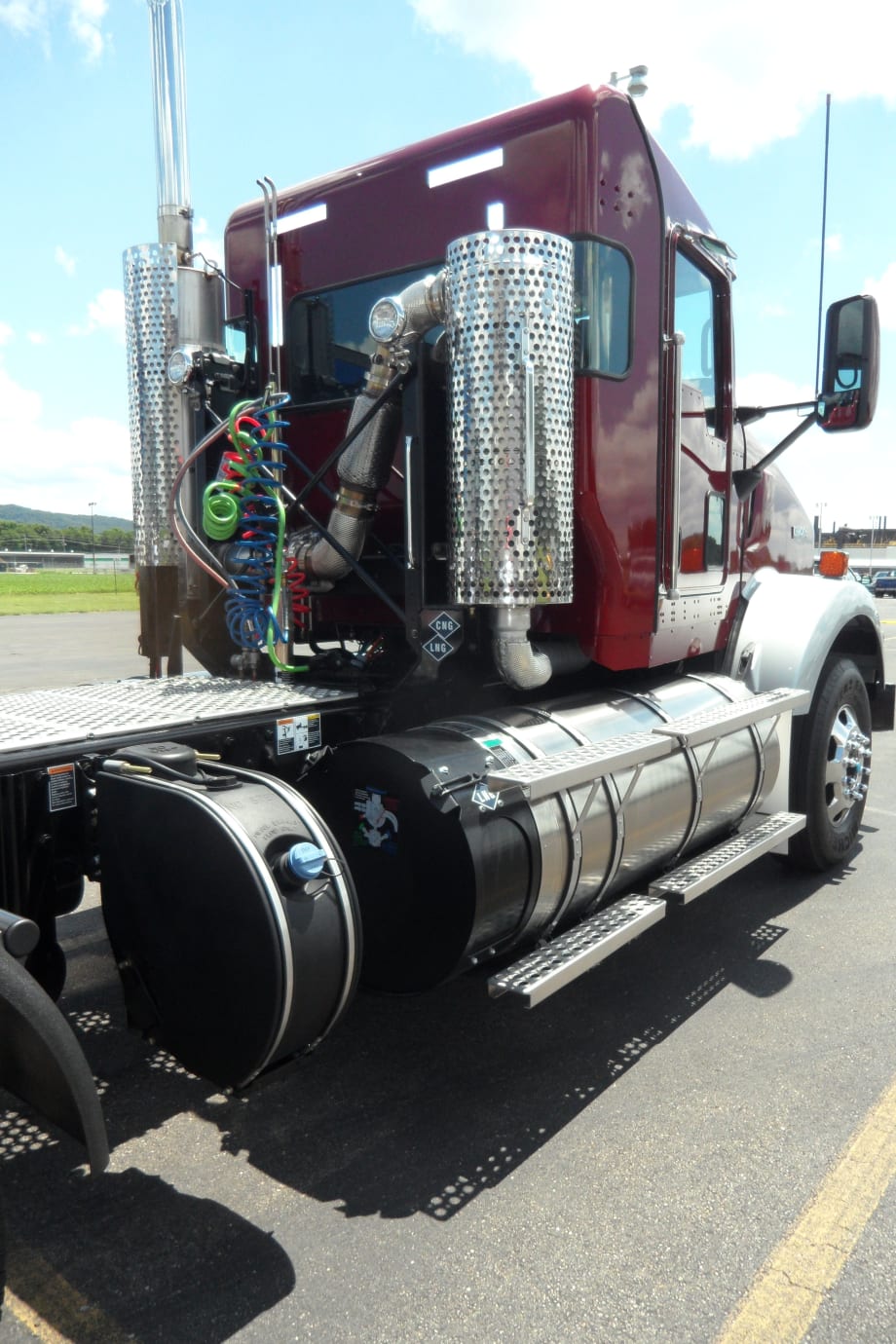
“Fair amount of complexity” comes with dual-fuel Westport GX/HD, as on this T800. It has a tank for diesel exhaust fluid (with blue cap) and a diesel particulate filter (the shorter stack behind the cab), as well as large cryogenic saddle tanks (one on each side) to store liquefied natural gas.

CORRECTED -- Kenworth Truck Co. sees a lot of promise in natural gas-powered vehicles, so it featured them last week at gatherings for dealers, customers and trade press writers at its plant in Chillicothe, Ohio. But diesel-powered trucks form a huge majority of those on the road and will continue to dominate the Class 8 business, one of the company’s executives commented to reporters.
“As an industry, we’ve been evangelizing about gas and its benefits, and that’s fine,” said Andy Douglas, KW’s national sales manager for specialty vehicles. “But what are the total costs of gas? What are the running costs,” including erecting or getting access to fueling stations, and maintaining the trucks?
Kenworth reps talk about the costs with customers interested in compressed or liquefied natural gas because of its very clean-burning characteristics and its low and stable cost as a fuel, Douglas said. Some fleets buy gas for as low as $1.50 per diesel-equivalent gallon, which is most attractive.

But the premium for a gas-powered heavy truck is $30,000 or more, and fueling stations are very expensive, so government support has been needed to make it financially feasible for fleets, he noted.
Leasing is one tool to ease customers into the trucks, with finance companies like PacLease and Ryder absorbing upfront costs and customers paying those off through leasing charges. More fueling stations are appearing around the country, and they will make operations possible for more fleets.
Major shippers are becoming “green”-minded and encouraging trucking companies to convert to gas, Douglas said. One is Proctor & Gamble, which has directed that 20% of its outbound shipments are pulled by gas-powered tractors. A few fleets that can’t comply have lost some of their P&G business, while others that do have gained some loads.
Most operators of gas-powered trucks that Douglas sees are private fleets that run locally, returning home nightly so they can refuel; one is Monarch Beverage in Indianapolis, which is converting its fleet to CNG. Or the trucks run in interstate corridors where LNG fueling stations have been set up, like United Parcel Service in the San Bernardino-to-Las Vegas corridor.
UPS announced several weeks ago that all its Class 8 truck acquisitions in 2014 will be natural-gas-powered. UPS currently operates 103 Kenworth T800s with the Westport 15L dual-fuel diesel LNG engines and is currently in build on additional units. (Mack announced that 122 of UPS’s truck order will be Vision tractors with the ISX12-G.)

“I haven’t seen anything like it in the gas world,” Douglas said of the spark-ignited ISX12-G, because of the interest fleet managers have shown in it. Cummins first released it with a 350-horsepower rating, and in August will offer a 400-horsepower version that will be more effective in high gross-weight tractor-trailers. It will have no trouble propelling heavy rigs, at least in flat and moderate terrain.
And the larger engine can be ordered with a manual transmission rather than a more expensive Allison automatic transmission that’s mandatory with the 8.9-liter ISL-G. Until March, when the ISX12-G was released, the ISL-G, also a spark-ignition engine, was the only Class 8 gas powerplant available.
Cummins’ ISL-G is widely used in trash collection trucks and now in some concrete mixer chassis. Some delivery fleets are using it in container drayage in the Los Angeles Basin and to pull vans and reefers in flat places like Florida. Its modest power and torque are adequate for such uses, but marginal when gross combination weights exceed 65,000 pounds, which was the original limit that Kenworth set, Douglas said.
In the mountain West, fleets prefer the 15-liter Westport GX/HD to pull long upgrades at high weights, he said. The 15-G is a compression-ignition engine that uses small amounts of diesel fuel to combust natural gas in its cylinders. The engine brings with it “a fair amount of complexity” to a truck chassis.
Use of diesel fuel requires that the truck be equipped with a diesel particulate filter and urea injection, which the gas-only ISX12-G and ISL-G don’t need. However, all gas engines are premium-priced and all require expensive storage tanks and fuel-handling systems aboard their trucks.

Kenworth offers natural gas engines in five of its T-series Class 8 models, and another will be available late this year. Most KWs with gas engines are assembled in the Chillicothe plant, Douglas said. Some using the GX/HD and destined for western service are made in Renton, Wash., only a couple of hours south of Vancouver, B.C., where Westport assembles the engine.
Building gas-powered KWs poses no particular problem except for the fitting of temporary “pony” tanks to the chassis, said Scott Blue, plant manager in Chillicothe. Permanent CNG or LNG tanks are installed by specialty companies like Triligy and Agility.
Gas as a motor fuel is becoming more available as government-sponsored and privately financed fueling stations are built, Douglas said.
“The map is greening,” he said as he showed slides displaying areas with natural gas stations expanding around the United States. “It’s no longer a science project. It’s entering a mature state. This year, 3% to 4% of the (truck) build will be natural gas.”
However, 99% of the trucks on the road now are diesel, Douglas noted. “Engines have gotten many improvements over the years, and you can’t beat it for energy density,” he said of diesel fuel. These factors will continue to make diesel practical and popular.
Six gas-powered Kenworths were part of a ride-and-drive demonstration staged outside the plant for the special visitors. Three others were diesel-powered, to underscore the present and future relevance of modern diesel engines and clean-burning diesel fuel.
Corrected 2 p.m. EDT 7/16/2013. We previously reported that Kenworth is getting the majority of the UPS order, but in fact Kenworth does not yet know how much of that order it will receive, according to a Kenworth spokesperson. We apologize for the error.
More Fuel Smarts

Jennie Abarca Is Proving Electric Trucks Can Do the Job
HDT Truck Fleet Innovator Jennie Abarca is building confidence in fleet electrification one load at a time while openly sharing the challenges she encounters along the way as a small-fleet owner.
Read More →
Cummins Adjusts 2027 Engine Rollout After EPA Proposal
The engine maker will gradually introduce its new Model Year 2027 diesel engines while continuing to offer current models during the transition, citing the EPA's proposed emissions rule changes.
Read More →
EPA Proposal Could Ease 2027 Truck Costs and Buying Uncertainty
The proposal doesn't change the tougher NOx standard, but it would revise key implementation requirements that manufacturers say have driven up costs and complicated fleet purchasing decisions.
Read More →
Cummins, Paccar Ease DEF Derates After EPA Guidance
Updated diesel engine software gives truck operators more time to address emissions-system issues while staying compliant with EPA emissions standards.
Read More →
Maintenance in the Messy Middle Part 3: Biodiesel
Biodiesel can reduce emissions, improve fuel-system lubricity and use existing diesel infrastructure. But NACFE’s Messy Middle maintenance report says fleets must actively manage storage, cold-weather operation, filters and oil drain intervals to avoid problems.
Read More →
Enhance Fleet Performance with High-Efficiency Auxiliary Power Units
Drive sustainable cost savings while increasing driver comfort during short- and long-haul logistics operations.
Read More →
Maintenance in the ‘Messy Middle’ Part 2: Renewable Diesel Fuel
NACFE's latest Messy Middle Powertrain Service & Maintenance report says renewable diesel gives fleets an opportunity to reduce carbon emissions without changing trucks, fueling infrastructure or maintenance practices. But technicians still need to understand several important operational differences.
Read More →
The Diesel Engine Enters NACFE’s ‘Messy Middle’
NACFE’s new Messy Middle Powertrain Service & Maintenance report says keeping modern diesel engines running now depends as much on software, diagnostics and data as traditional mechanical service.
Read More →
DTNA Software Update Gives Truckers More Time Before DEF Derates Take Effect
The changes reflect EPA guidance aimed at reducing downtime caused by emissions-system faults while maintaining compliance requirements.
Read More →
New Agentic Predictive Maintenance Report Demonstrates How Degraded Aftertreatment Systems Waste Fuel
Questar analyzed a large mixed-class fleet and discovered it was wasting as much as $30 in fuel per vehicle, per day, because of mechanically degraded aftertreatment systems.
Read More →