




CARB Extends Clean Truck Check Reporting Deadline
As the Dec. 31 deadline looms for owners of trucks operating in California to get them registered in the Clean Truck Check database, the California Air Resources Board announced it is extending the reporting deadline to Jan. 31, 2024.

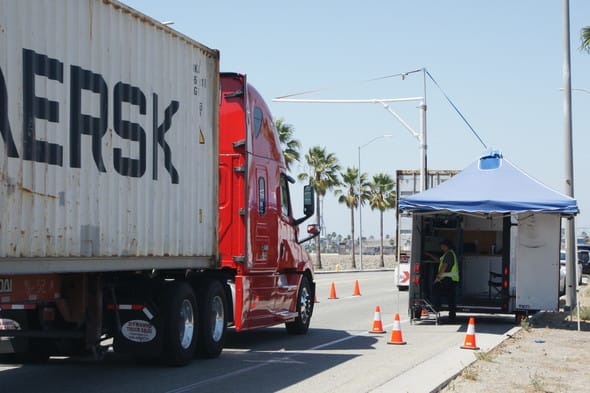
A demonstration of the California heavy-duty truck smog-check apparatus at the Port of Los Angeles.
Photo: CARB
As the Dec. 31 deadline looms for owners of trucks operating in California to get them registered in the Clean Truck Check database, the California Air Resources Board announced it is extending the reporting deadline to Jan. 31, 2024.
Clean Truck Check, previously called the Heavy-Duty Inspection and Maintenance Program, is supposed to ensure that heavy-duty vehicles operating in California are well-maintained and repaired quickly when needed to reduce emissions. It covers nearly all non-gasoline vehicles with a gross vehicle weight rating over 14,000 pounds operating in the state.
As HDT reported previously, the program is being implemented in three phases. The first phase started Jan. 1, 2023, with the deployment of Remote Emissions Monitoring Devices. These monitor the exhaust emissions of passing heavy-duty vehicles and flag potential high emitters.
Phase 2 of Clean Truck Check
The phase for which the deadline is being extended is Phase 2, which started Oct. 1. It requires vehicle owners who are subject to the program to enter their vehicles in CARB’s Clean Truck Check database and pay an initial annual compliance fee of $30 per vehicle by Dec. 31 (now Jan. 31).
After that deadline, all trucks driving in California will need proof of compliance to continue operating in the state.
Phase 3 of Clean Truck Check will require heavy-duty vehicle owners to conduct periodic emissions testing. This is similar to California’s Smog Check program for cars. Periodic testing begins in 2024 and applies to all compliance deadlines after July 1, 2024.
Information on How to Comply with Clean Truck Check
To access the reporting database to complete reporting requirements, visit the California Clean Truck Check, Vehicle Inspection System (CTC-VIS) Portal.
For additional information and guidance regarding the Clean Truck Check reporting requirements, training, fact sheets, and other helpful information are available on the Clean Truck Check Program Page.
You can also find training videos on the reporting page posted in English, Spanish, and Punjabi. There are seven short training module videos for specific reporting topics, as well as the "Question and Answer” forum from a previously held reporting training webinar on Nov. 3, 2023.
CARB staff recommend watching a recording of the training prior to logging into the database and completing fleet reporting requirements.
In addition, CARB has scheduled an online training webinar on the CTC-VIS reporting database for Jan. 9, 1:30 p.m. – 5:00 p.m. (Pacific Time)
More Fuel Smarts

How Volvo Updated Its D13 for EPA 2027 [Watch]
Volvo’s updated D13 promises lower emissions without sacrificing performance or fuel economy. Take a closer look at what changed inside the engine in this HDT Spotlight video.
Read More →
Diesel Price Spike Shortens Payback for Natural Gas Trucks, Report Says
Energy Vision estimates fleets could recover the higher purchase price of an RNG-fueled Class 8 tractor in 1.3 to 2.8 years under current fuel-price scenarios.
Read More →
Calstart Becomes Catalyst Mobility, Reflecting Broader Focus
Calstart is now Catalyst Mobility, reflecting the nonprofit’s growing national role in clean transportation, including zero-emission trucks, infrastructure and incentive programs.
Read More →

Record Diesel Prices Squeeze Trucking Fleets
Average U.S. diesel prices have climbed to nearly $6 a gallon, surpassing the 2022 record as tight refinery capacity and Middle East disruptions keep fuel costs elevated.
Read More →
How Fuel Delivery Shapes Engine Performance
Fuel delivery depends on more than what happens at the injector. For fleet, maintenance and technical professionals, looking at the full path from pump to injector can provide useful context for understanding engine performance.
Read More →
East Coast Port Launches $45M Electric Truck Push
The Port Authority of New York and New Jersey announced millions in incentives for zero-emission drayage trucks, yard tractors, and new charging hubs near the port.
Read More →
California Bill Could Shed Light on Electric Truck Prices
Why do battery-electric Class 8 trucks remain so expensive? A California bill headed to Gov. Gavin Newsom would give fleets and state agencies more visibility into what manufacturers charge.
Read More →
Detroit Opens Orders for EPA 2027 Engines
Detroit isn’t starting from scratch to meet EPA 2027 diesel emissions standards. Its Gen 6 DD13 and DD15 engines keep much of today’s platform while updating the fuel and aftertreatment systems.
Read More →
Zero-Emission Truck Corridor Planned for West Coast
California, Oregon, Washington, British Columbia and Baja California are coordinating plans for truck charging and hydrogen fueling from Canada to Mexico.
Read More →
A Closer Look at Kenworth’s Electric T880E Vocational Truck [Video]
Learn more about Kenworth's T880E battery-electric vocational truck at the Paccar Technical Center, including its range, applications, upfitting considerations, and PTO options, in this HDT Spotlight video.
Read More →