




Behind the Scenes at a Weigh Station
In Georgia, weigh stations serve as a base of operation not just for truck weight inspectors but also for patrol officers who conduct roadside safety inspections. HDT spent a day on the scene during Roadcheck.
June 19, 2023

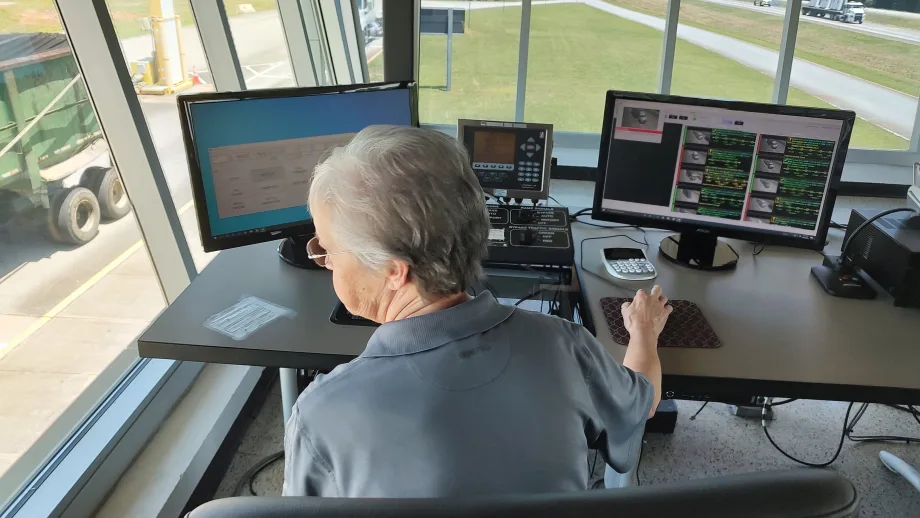
Ellen Thomas, a senior weight inspector, directs a driver to move forward as she weighs each axle in a Georgia weigh station.
Photo: Wayne Parham
8 min to read
In a small way, Ellen Thomas’ daily view is a little like that of a commercial truck driver. She stares out at the interstate through a piece of glass, taps into technology, and must stay focused. Plus, like a driver, she must understand weights and the related federal requirements.
But while a driver views the world while on the go, Thomas is stationary — glued to the monitors in the scale house at one of Georgia’s weigh stations.
That has been her daily home for 10 years. The former airline employee is now a senior weight inspector for the Georgia Department of Public Safety at an Interstate 20 weigh station in Columbia County, just outside Augusta.
In Georgia, weigh stations serve as a base of operation not just for truck weight inspectors, but also for patrol officers who conduct roadside safety inspections. HDT visited a Georgia weigh station to get a glimpse into commercial vehicle safety from the viewpoint of state enforcement officials.
The Scene Inside the Weigh Station
Thomas watches her monitor, keeping an eye out for anything flagged by the system once a truck passes two sets of weigh-in-motion scales, one on the interstate and the other on the ramp leading into the weigh station, and a collection of automated cameras. Even tire problems will be flagged by the system as trucks approach.
Georgia uses International Road Dynamics for the system that tracks the inbound or passing trucks and is one of only three states that do not allow third-party bypass.
A weight inspector views a screen full of images, one of each truck, that are accompanied by data points such as weight by axle, tractor, or trailer, and total. Plus, cameras capture both the DOT numbers and the license plates, feeding even more information into the system. Thomas, and her fellow weight inspectors around the state, also see information such as if a driver has a bad safety score or repeated violations.
To prevent backups, the system detects if too many trucks are on the ramp and automatically tells others to bypass. However, all oversized and hazmat loads are required to pull in.
“Then once we actually weigh it out with the scales behind the station, we determine if what we're seeing here is correct," Thomas said. "They could weigh more, or it could be less, than what we actually see [on the weigh-in-motion scales]."
Monitoring Truck Weights
Once a driver is directed to the scales adjacent to the weigh station, each axle is weighed independently. The driver is given directions to pull forward each time by a curbside sign activated by the weight inspector monitoring the scales. Then, the weight inspector heads outside to measure the truck and trailer and talk to the driver.
“We measure from the tailgate to the first hub and then center hub center, hub center, all the way down to we get to the front bumper and check the tag on front, check the make of the truck, and explain to the driver what it is that's causing problems,” explained Thomas. “And then we ask for driver's license, cab card, and bill of lading,”
The weight inspector usually takes the cab card and any notes back into the scale house and enters the information into the system.
During a visit by HDT, Thomas encountered a truck and trailer that was 2,200 pounds overweight. The driver claimed it was a temporary issue because he had just fueled.
“I’ll burn that out in the next two miles; she’s fuel-happy,” he told Thomas.
The excuse didn't wash, and the driver was issued a $111 citation for violation of interstate load limitations.
Some drivers push back, make excuses, or may get upset. But for Thomas and the other weight inspectors, regardless of the attitude of drivers, must stick to applying the regulations equally.
“We do have some that get agitated, and we have some that are just as pleasant," she said. “With the latter, you walk up to the door and tell them what it is, and they already have their cab card, bill of lading, and driver's license in hand. It saves them time. And it saves me time if we are on a friendly basis to begin with.”
Safety-Related Enforcement
In Georgia, the weigh/inspection stations fall under the Department of Public Safety, and each is home to both weight inspectors and sworn law enforcement officers operating as part of the Motor Carrier Compliance Division. In 2002, the agency averaged 237 sworn law enforcement officers that conducted size and weight enforcement, made commercial vehicle safety inspections, and enforced criminal and traffic laws. There were 30 weight inspectors enforcing weight rules and laws in the same time frame.
Commercial vehicle inspection and enforcement is a two-pronged effort, with more inspections performed by officers on the side of the road than at weigh stations. According to the Motor Carrier Compliance Division, in 2022:
Officers and weight inspectors issued 22,114 overweight assessments.
20,694 assessments were issued for interstate violations.
1,076 assessments were issued for state route violations.
340 assessments were issued for county road violations.
MCCD conducted 75,056 commercial vehicle safety inspections.
Of the 75,056 commercial vehicle safety inspections, 52,264 were conducted roadside, while 22,792 inspections were conducted at weigh stations.
“A lot of drivers do not even know what inspections we actually do. And that's not just Georgia, it’s anywhere in the U.S.,” said Sgt. Tommy Kelly.
Commercial motor vehicle inspections are the same, regardless of the state where they occur, he pointed out. All CMV inspectors follow Commercial Motor Vehicle Safety Alliance inspection procedures. CVSA's out-of-service criteria are sent out with any revisions every April 1. However, he said there could be additional state-specific laws regulating trucking in addition to federal standards.
Types of Truck Inspections
Sgt. Chasen Woodie said MCCD officers perform three types of truck inspections:
Level I
Level II
Level III
“Level I is a full inspection where we go underneath the truck and measure the brakes," he says. "A Level II is basically a full inspection, but you're not measuring the brakes.
"Level III is just obviously checking your license and your logbook. Level III is used more if [a driver is] speeding; we'll do a quick Level III inspection, unless during the inspection we see a tire or mechanical violation and we can bump it up to a Level II or Level I inspection,” explained Woodie.
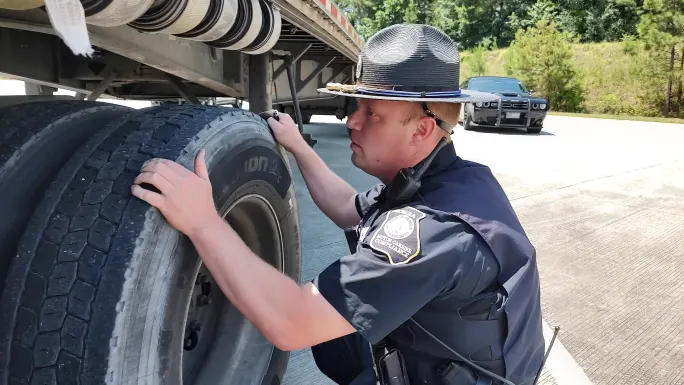
Motor Carrier Compliance Officer 3 Michael Coke checks tires as he performs a Level II inspection on a truck at a weigh station in Columbia County, Georgia.
Photo: Wayne Parham
Woodie also pointed out that records of CMV violations found during inspections are networked together across state lines. A weight inspector or officer in Georgia can easily see if a truck had violations a day or two earlier in Florida or other states.
In some states, such as Texas, local law enforcement agencies can inspect commercial vehicles. In Georgia, that is not the case and only MCCD handles inspections.
During the recent CVSA International Roadcheck, the focus areas were anti-lock braking systems (ABS) and cargo securement. However, Woodie said that day was no different than any other day for MCCD.
“It was business as usual for us. We do commercial enforcement nonstop,” he said.
Truck Brake Testing
Trucks are usually brought into the shed for Level I inspections. Inside the structure officers are shielded from the elements, but more importantly they can enter the pit for a walk-under inspection to check for things like frame cracks, loose-U-bolts, and more. At one end of the shed is a performance-based brake tester, which can test the brakes on each axle independently.
Level II and Level III inspections can be performed in a parking lot behind the weigh station, or roadside when an officer stops a vehicle.
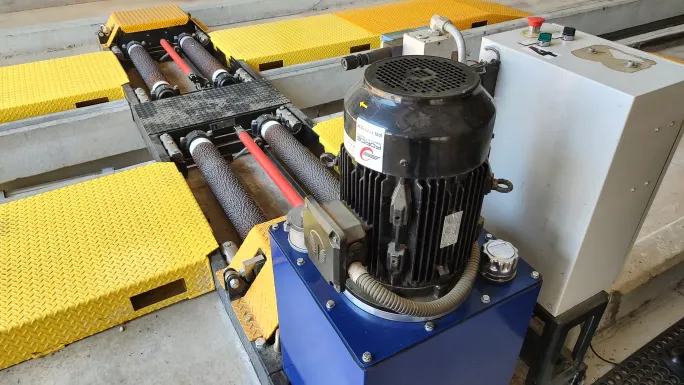
Many of the weigh stations in Georgia have an inspection shed with a walkable pit and a performance-based brake tester.
Photo: Wayne Parham
Targeting Truck Driver Behavior
In fiscal year 2022, Georgia led the nation in drug and alcohol violations, 769 total, among commercial drivers. In crash causative factors violations, Georgia ranked number one in drivers using handheld devices, following too closely, and lane restrictions.
So, while out patrolling, the MCCD officers focus heavily on commercial drivers’ actions.
“Some of the major targets that we're looking for are speeding, following too close, using a handheld mobile telephone, failure to obey a traffic control device, fatigued driving, hours of service violations, lane violations, failing to use seatbelts, and drug and alcohol use,” said Kelly.
But a commercial motor vehicle can simply be pulled over by an officer for a safety inspection at any point. While out on the road, the officers also watch for key issues with trucks — tire problems, load securement issues, and possible overweight issues.
“Over the years, after you do this for a while, you can look at a tire and kind of tell if it's a bad tire when they run down the road and you can look and see if it's overweight by how much the tires are squatting, that’s another thing,” said Kelly.
Truck Driver Safety Education
Kelly pointed out that he and others in his role are not just about enforcement, they also provide driver and carrier education as an effort to make the roads safer. Officers will visit companies and educate drivers on what they should be doing and what officers watch for out on the road.
“We go all the time to safety meetings. We’ll come in, we’ll speak to drivers, and show a presentation on what we look for. We’re giving you the answers to the test, we are coming in to tell you this is what we're looking for, this is what we're trying to find. We will do an inspection outside, we will walk all the drivers around and show them exactly what we do,” Woodie explained.
“We would much rather come to your business and handle that on the education side to try to help you and your company get the drivers where they need to be than have to handle business on the side of the road,” Kelly said. “But if we have to handle business on the side of the road, we will.”
Subscribe to Our Newsletter
More Safety & Compliance

Kodiak Lines Up Fleets for Driverless Trucking
An agreement for 75 trucks, a new Texas freight lane, and progress on safety validation move Kodiak closer to its planned driverless highway launch.
Read More →
More Trailer Data Through the Same Seven-Way [Video]
Can trucking’s standard seven-way connector handle more cameras and trailer data? Grote’s Adam Slade shows HDT how the company is using new technology with its 4See trailer system, not only to add a new backup camera but also to expand other capabilities — without adding another connection.
Read More →
PrePass Intelligence Mines Fleet Bypass, Toll and Safety Data
PrePass Intelligence helps fleets measure bypass savings, flag potential toll overcharges, and spot suspicious transactions by combining data from separate systems.
Read More →
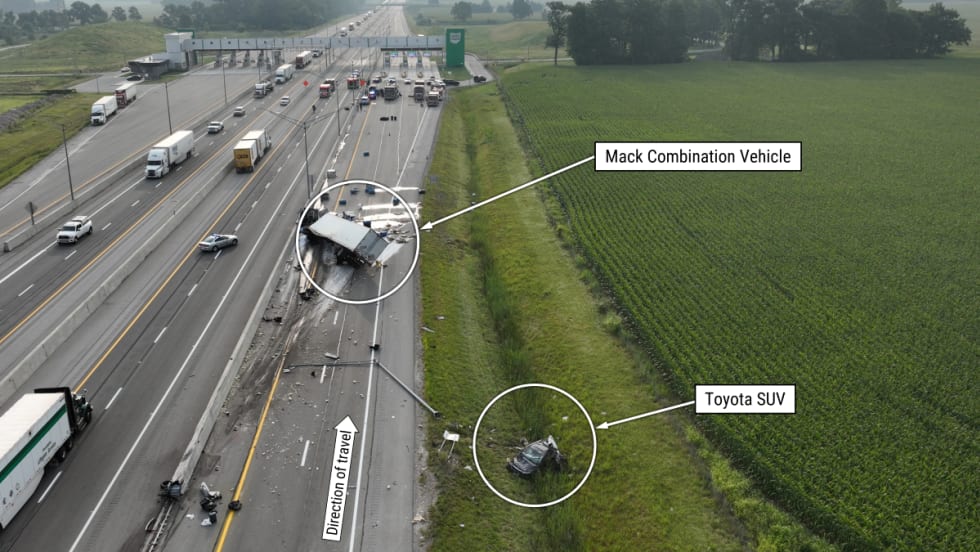
Fatal Crash Exposes Toll Plaza Risks
An NTSB investigation found that last-minute lane changes and large speed differences at an Ohio toll plaza created a hazard the truck driver couldn't avoid in time.
Read More →
When Language Stops the Truck: The Return of ELP Out-of-Service Orders
English language proficiency rules for commercial drivers aren’t new, but renewed out-of-service enforcement has raised the stakes. Here’s what carriers need to know before a driver reaches a roadside inspection.
Read More →
Sponsored•October 6, 2026
A Camera Isn't a Safety Program. Here's What Brokers Are Screening for Now
Footage alone may not be enough to pass broker vetting processes. Here's what counts as a defensible safety program now.
Read More →
Marijuana and Trucking’s Drug-Testing Dilemma
Marijuana is getting stronger, laws are changing, and drug tests still can’t reliably establish impairment. What does that mean for truck drivers and the fleets that employ them?
Read More →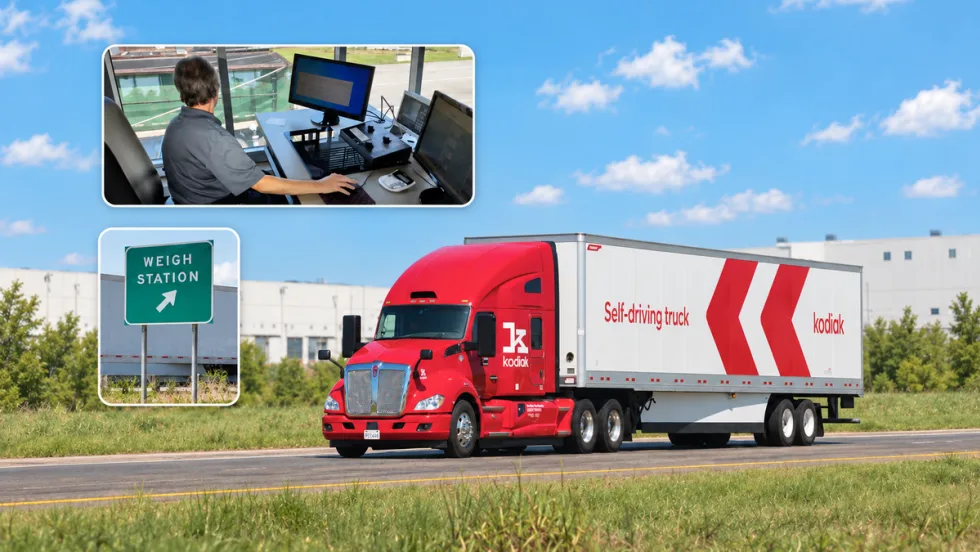
PrePass, Kodiak Connect Driverless Trucks to Roadside Enforcement
The system will allow enforcement agencies to verify Enhanced Inspection information and decide whether Kodiak’s autonomous trucks can bypass roadside screening sites.
Read More →
From One Generation to the Next: How Mentorship Builds Safer Truck Drivers
After three decades in trucking, Harold Perry shares what he's learned about driver safety, mentorship, and helping the next generation build confidence behind the wheel.
Read More →
FMCSA Pauses Biennial-Update Enforcement Amid Motus Transition
Carriers whose updates were due on or after June 1 have more time, while FMCSA works to stabilize its new registration system and warns of phishing sites impersonating its new carrier registration system, Motus.
Read More →