




Volvo: Take the Leap in Electrification
Why Volvo Trucks believes it's not only imperative, but also very possible, for more trucking fleets to get started with electrification efforts.

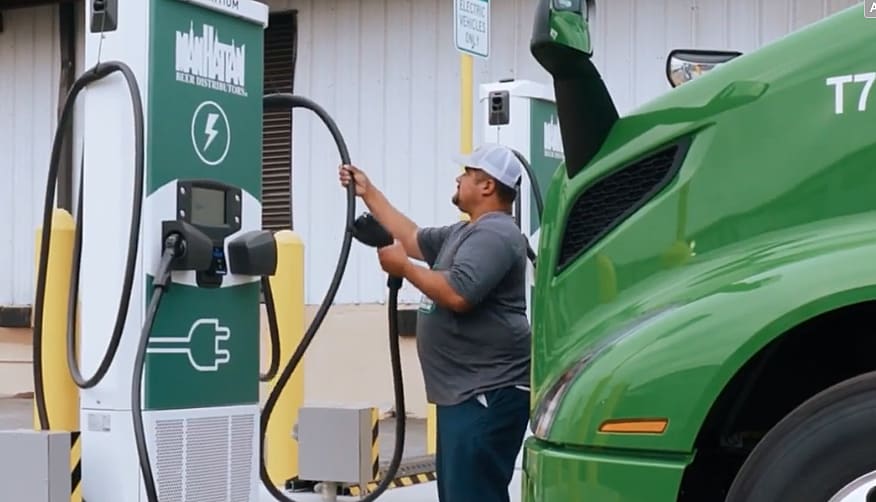
Range and charging infrastructure, while a key concern, can be addressed by carefully choosing the right applications for truck electrification.
Photo: Screen capture, Volvo Leap webcast

Manhattan Beer Distributors recently took delivery of the first of five Volvo VNR Electric trucks.
Photo: Screen capture, Volvo Leap webcast
Volvo Trucks said it’s time to “Take the Leap” and invest in zero-emissions transport. A special live webcast Oct. 12 highlighted not only Volvo's efforts, but also shippers and trucking operations that are taking the lead in Europe and the U.S.
“We are approaching a historical shift not seen since we shifted from carriages to trucks,” said Jessica Sandström, senior vice president of product management and sustainability for Volvo Trucks.
Volvo has set targets for 50% of its global sales to be electric by 2030, and to be selling only fossil-free trucks by 2040.
“It’s simply the right thing to do,” Sandström said. “On top of this, we are completely convinced this is good for our business,” as well as a win for Volvo employees.
A recent study indicated that half of the goods that travel in Europe today travel 300 kilometers or less, meaning those could be electrified right now, Volvo said. But truck buyers are held back by concerns such as range, charging, and cost.
“But there is really a value in being the early out,” Sandström said. “if you start early, build the competencies around how to utilize this new technology, you will have business advantages and be able to capture early new possibilities.”
The webcast emphasized that in order to accelerate this shift, it will take transport companies, shippers (transport buyers), governments, and others working together.

“We are approaching a historical shift not seen since we shifted from carriages to trucks."
Photo: Screen capture, Volvo Leap webcast
Ikea: How the Shipper's Role is Changing
“There is simply no way we can reach our targets without collaboration,” said Angela Hultberg, head of sustainable mobility for Ikea, which has an ambitious goal of making 100% of its home deliveries electric by 2025.
“I think the role of transport buyers in the industry is changing. If we want to meet our targets… we have got to be part of making that happen. It’s not enough to just say, ‘I want to buy sustainable transport services.’ But we also have to send a signal to policy makers to say, ‘this is what we want as an industry… we will do our part but we need the policy support as well.’”
Urban delivery applications such as Ikea’s are a prime target for early adoption of electric vehicles, as municipal governments enact regulations targeting pollution. “If we cannot reach our customers’ front doors, we don’t have deliveries… and then we go out of business,” Hultberg said. “We also see that our customers are becoming more and more aware and they will expect it from us…. They want to know we’re a responsible company if they’re going to spend their money here.”
As a front-runner, Hultberg said, Ikea has also been the first to run into the obstacles. The company has had to invest in charging infrastructure and help secure vehicles for its transportation suppliers.
“I don’t think we can do things the same way we’ve been doing,” she said. “Our role as a transportation purchase is definitely changing. We are now much deeper into supply chain than we’ve ever been,” whether that’s working with OEMs to develop vehicles, buying leasing platforms so it can buy the vehicles and then lease them to its service providers, digital EV sharing platforms, or charging infrastructure platforms. All of which, she said, require collaborating with partners outside Ikea. “I think it’s about finding the partners who want to go on this journey with you.”
Hultberg advised the industry to not wait around for perfect solutions, but to invest in the best available options on the market today and deploy them. “It’s about getting this up to scale.”
And scaling Ikea is, with 90% of its deliveries in China already electric, 100% electric in Amsterdam and Paris, and with some level of electric vehicles in 20 countries, including the U.S. “We are trying new and different solutions, as well, to make it happen as quickly as we possibly can.”
Volvo also brought on Amazon as another example of a large purchaser of transport with ambitious sustainability goals. Amazon is a co-founder of the climate pledge, targeting net-zero carbon transport by 2040, a decade ahead of the goals set by the Paris Climate Agreement.
Amazon noted that it has ordered 100,000 electric delivery vehicles to be deployed in its fleet between now and 2030. In Europe, there already are thousands of low- or zero-emissions delivery vans, and electric cargo bikes in some cities.
And it’s not just last-mile delivery, explained Helder Velho, Amazon’s linehaul director for Europe. Long-haul transport has not had as many low-carbon options available as last-mile, he said, and they also require more infrastructure investments. It has been testing electric and hydrogen fuel cell trucks, as well as using trucks running on renewable natural gas.
“It’s not going to be easy, and we can’t do it alone,” he said. “We want other companies to join us on this journey to accelerate the pace and make this change happen.”
Early Fleet Adopters
In the U.S., Volvo highlighted Manhattan Beer Distributors in New York City, which recently took delivery of the first of five Volvo VNR Electric trucks.
The fourth largest beer distributor in the country, it has 400 trucks. More than 150 of those already operate on compressed natural gas, with 50 more on the way, but the company is taking the next step in its sustainability efforts with electric trucks.
Mitchel Bergson, chief transformation officer, said it’s “really an extension of what we’ve done over the last two decades.” There are benefits of being an early adopter, he said. “We get to get ahead of the game. The sooner we start, the faster we can train our people, and the faster we can create positive change… we can’t afford to wait to have system solutions to address climate change.”
One of the keys to adoption, Bergson said, is to pick the right spots for deployment. “For us, that means starting in New York City,” where urban routes are a good fit. For trucks in the suburbs that cover a lot more ground, “we’re not there yet,” he said. “We’re starting in the city, where we have shorter routes, the power service we need, where we can allocate the space for charging stations. There are many ways to dissect your business and find the right place for the right technology.”
For other transport companies thinking about going electric, he said, “Get started now. There’s no time to wait. You can test, you can pilot, but get some electric trucks in your fleet. I think electrification is coming… get on board with the change.”
In Europe, Volvo highlighted DFDS, which recently ordered 100 electric trucks. Volvo Trucks President Roger Alm personally delivered the first Volvo FM electric to the company at the Port of Gothenburg in Sweden.
Niklas Andersson, executive VP of DFDS’ Logistics Division, explained that it is analyzing the “flows” for specific routes and trucks. For this first truck, which will run approximately 120 kilometers per shift, it will be able to do overnight slow-charging. This also will save some time for drivers who won’t be spending time filling up with diesel.
For other routes, charging solutions might involve top-up charging, such as when the truck is loading and unloading.
“What we will do is analyze the different flows we have,” Andersson explained. “How long can we drive? What is the battery capacity, the ideal distance for every truck? We will look at where we need charging stations throughout the geographies we are acting in today.”
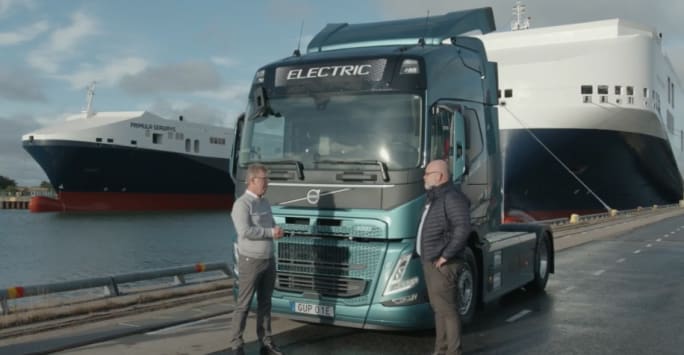
Volvo Trucks President Roger Alm delivered the first of a 100-truck order for electric trucks to DFDS.
Photo: Screen capture, Volvo Leap webcast
Volvo explained that it is working with another customer, DHL Freight, on predictable linehaul operations appropriate for electric trucks. Running between two logistics centers in Sweden, the truck leaves Jonkoping at 3:30 a.m. and travels to Gothenburg, where it is unloaded. After unloading, it charges for 90 minutes to two hours. Then it’s ready to take off and do a distribution round within the region of Gothenburg. It returns to the logistics center, loads up, goes to the charging station, then returns to Jonkoping. With this setup, the truck operates 450-500 kilometers a day.
Beyond Making Trucks
Accelerating electric-truck adoption also means that truck makers are becoming much more than truck makers.
Because batteries and charging infrastructure are important pieces of the puzzle, Volvo set up a separate business unit to focus on them called Volvo Energy. For instance, it will address the entire life cycle of batteries, from a first life in a truck, to a second life outside the trucks, such as in energy storage, and finally recycling.
For instance, Volvo said, it supports its customers with the most suitable charging hardware for their operations. European customers get a charger as part of the purchase, while in the U.S., the charger and installation are part of the overall financial solution.
Volvo is also part of a collaborative project to build at least 1,700 high-performing, green-energy charging points across Europe. It will have charging available in its own distribution network and at all its dealers.
ACEA, the European association of motor vehicle makers, predicts that by 2025 there will be approximately 40,000 battery-electric medium- and heavy-duty trucks in Europe, and 270,000 by 2030.
While Volvo pointed out its own investments in charging infrastructure, Volvo also stressed that “investments have to be made by politicians in various countries around the world to make this happen,” Alm said.
“Things are moving, but of course they don’t move fast enough,” he said. In both Europe and the U.S., he said, “we need to scale up the volume a lot faster and drive electrification faster than we are today.”
What is required to make the transformation, he said, is “a big sense of urgency.”
“The technology is there. The transformation is happening. The charging infrastructure is being built out. We have the knowledge, we have the trucks, we have the information. We can make it happen.”
More Fuel Smarts

How Volvo Updated Its D13 for EPA 2027 [Watch]
Volvo’s updated D13 promises lower emissions without sacrificing performance or fuel economy. Take a closer look at what changed inside the engine in this HDT Spotlight video.
Read More →
Diesel Price Spike Shortens Payback for Natural Gas Trucks, Report Says
Energy Vision estimates fleets could recover the higher purchase price of an RNG-fueled Class 8 tractor in 1.3 to 2.8 years under current fuel-price scenarios.
Read More →
Calstart Becomes Catalyst Mobility, Reflecting Broader Focus
Calstart is now Catalyst Mobility, reflecting the nonprofit’s growing national role in clean transportation, including zero-emission trucks, infrastructure and incentive programs.
Read More →

Record Diesel Prices Squeeze Trucking Fleets
Average U.S. diesel prices have climbed to nearly $6 a gallon, surpassing the 2022 record as tight refinery capacity and Middle East disruptions keep fuel costs elevated.
Read More →
How Fuel Delivery Shapes Engine Performance
Fuel delivery depends on more than what happens at the injector. For fleet, maintenance and technical professionals, looking at the full path from pump to injector can provide useful context for understanding engine performance.
Read More →
East Coast Port Launches $45M Electric Truck Push
The Port Authority of New York and New Jersey announced millions in incentives for zero-emission drayage trucks, yard tractors, and new charging hubs near the port.
Read More →
California Bill Could Shed Light on Electric Truck Prices
Why do battery-electric Class 8 trucks remain so expensive? A California bill headed to Gov. Gavin Newsom would give fleets and state agencies more visibility into what manufacturers charge.
Read More →
Detroit Opens Orders for EPA 2027 Engines
Detroit isn’t starting from scratch to meet EPA 2027 diesel emissions standards. Its Gen 6 DD13 and DD15 engines keep much of today’s platform while updating the fuel and aftertreatment systems.
Read More →
Zero-Emission Truck Corridor Planned for West Coast
California, Oregon, Washington, British Columbia and Baja California are coordinating plans for truck charging and hydrogen fueling from Canada to Mexico.
Read More →
A Closer Look at Kenworth’s Electric T880E Vocational Truck [Video]
Learn more about Kenworth's T880E battery-electric vocational truck at the Paccar Technical Center, including its range, applications, upfitting considerations, and PTO options, in this HDT Spotlight video.
Read More →