





California Fleet Turns to Volvo Lights for Truck Electrification Expertise
Volvo Group Creates Electrification Business Unit
A new business unit within the Volvo Group will take a life-cycle approach to batteries, electric vehicles, and other aspects of transportation electrification.
January 28, 2021
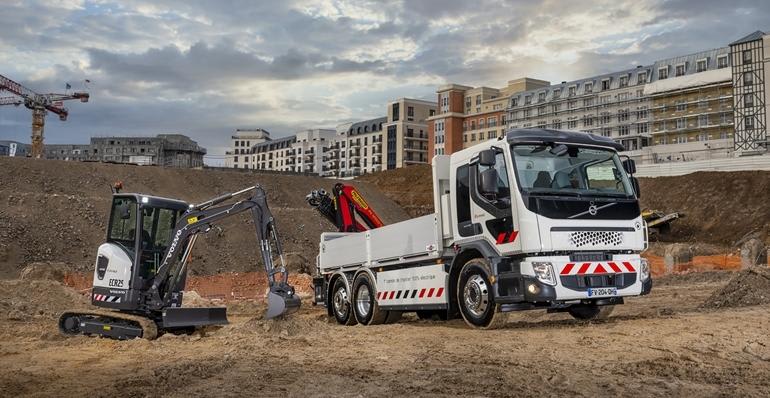
Volvo believes taking a life-cycle approach to batteries will help accelerate the adoption of zero-emissions vehicles, like this electric compact excavator and Volvo FE Electric truck.
Photo: Volvo Group
2 min to read
A new business unit called Volvo Energy will strengthen the Volvo Group’s business flow of batteries for electric vehicles over their life cycle, as well as working on charging infrastructure for battery-electric and fuel-cell electric vehicles, the Swedish commercial vehicle maker has announced.
Giving used batteries a second life in different applications will reduce the environmental impact from electric and hybrid electric commercial vehicles and machines, the company said.
“There is a great and growing interest for electric vehicles and machines among our customers,” said Martin Lundstedt, president and CEO of the Volvo Group. “This is of course very positive as it accelerates the transition towards more sustainable transport solutions. Our ambition is to offer our customers the most competitive solutions when it comes to electrification, including batteries and charging infrastructure. With Volvo Energy, we are taking a holistic view of the entire life cycle, which benefits both our customers’ business and society as a whole.”
The Volvo Group already offers electrified equipment ranging from city buses, to trucks for waste management, construction and urban distribution, to compact excavators and loaders. The roll-out of additional, electric vehicles and related services will continue at a high pace, it said, and later this year, it will also include heavy-duty trucks for regional transport or construction.
Volvo Energy will be a business area with full profit and loss responsibility. It will have both an internal role (providing batteries and charging solutions to the Volvo Group’s other business areas), and an external role: offering used, remanufactured, and refurbished batteries to customers for use across different applications.
Volvo Energy will also carry the Group’s responsibility for hydrogen infrastructure solutions for fuel cell electric vehicles. Collaborations with various business partners and actors across the ecosystem will be key to its success, Volvo said.
Commercial vehicle batteries will be used for many years in the vehicle before they need to be replaced or remanufactured/refurbished. However, if completely new batteries are fitted to the vehicle, the used ones will generally still have considerable life left to offer, which makes them ideal for energy storage purposes, Volvo said, for example in buildings or in green energy production. Repurposing these batteries means natural resources are conserved.
Joachim Rosenberg, member of the Volvo Group Executive Board and Chairman of UD Trucks, will head the new business area. Starting in February, he will lead the effort to create Volvo Energy while also continuing to run UD Trucks and preparing the transfer of UD Trucks ownership to Isuzu Motors as part of the previously communicated strategic alliance between the Volvo Group and Isuzu Motors.
The financial results for Volvo Energy will be reported as part of the Volvo Truck Group.
More Fuel Smarts

How Volvo Updated Its D13 for EPA 2027 [Watch]
Volvo’s updated D13 promises lower emissions without sacrificing performance or fuel economy. Take a closer look at what changed inside the engine in this HDT Spotlight video.
Read More →
Diesel Price Spike Shortens Payback for Natural Gas Trucks, Report Says
Energy Vision estimates fleets could recover the higher purchase price of an RNG-fueled Class 8 tractor in 1.3 to 2.8 years under current fuel-price scenarios.
Read More →
Calstart Becomes Catalyst Mobility, Reflecting Broader Focus
Calstart is now Catalyst Mobility, reflecting the nonprofit’s growing national role in clean transportation, including zero-emission trucks, infrastructure and incentive programs.
Read More →

Record Diesel Prices Squeeze Trucking Fleets
Average U.S. diesel prices have climbed to nearly $6 a gallon, surpassing the 2022 record as tight refinery capacity and Middle East disruptions keep fuel costs elevated.
Read More →
Sponsored•September 9, 2026
How Fuel Delivery Shapes Engine Performance
Fuel delivery depends on more than what happens at the injector. For fleet, maintenance and technical professionals, looking at the full path from pump to injector can provide useful context for understanding engine performance.
Read More →
East Coast Port Launches $45M Electric Truck Push
The Port Authority of New York and New Jersey announced millions in incentives for zero-emission drayage trucks, yard tractors, and new charging hubs near the port.
Read More →
California Bill Could Shed Light on Electric Truck Prices
Why do battery-electric Class 8 trucks remain so expensive? A California bill headed to Gov. Gavin Newsom would give fleets and state agencies more visibility into what manufacturers charge.
Read More →
Detroit Opens Orders for EPA 2027 Engines
Detroit isn’t starting from scratch to meet EPA 2027 diesel emissions standards. Its Gen 6 DD13 and DD15 engines keep much of today’s platform while updating the fuel and aftertreatment systems.
Read More →
Zero-Emission Truck Corridor Planned for West Coast
California, Oregon, Washington, British Columbia and Baja California are coordinating plans for truck charging and hydrogen fueling from Canada to Mexico.
Read More →
A Closer Look at Kenworth’s Electric T880E Vocational Truck [Video]
Learn more about Kenworth's T880E battery-electric vocational truck at the Paccar Technical Center, including its range, applications, upfitting considerations, and PTO options, in this HDT Spotlight video.
Read More →