




European Fleet Orders 100 Electric Volvo Trucks
With a record order in Europe and several recent orders in the U.S., Volvo says electric-truck adoption is gaining momentum.

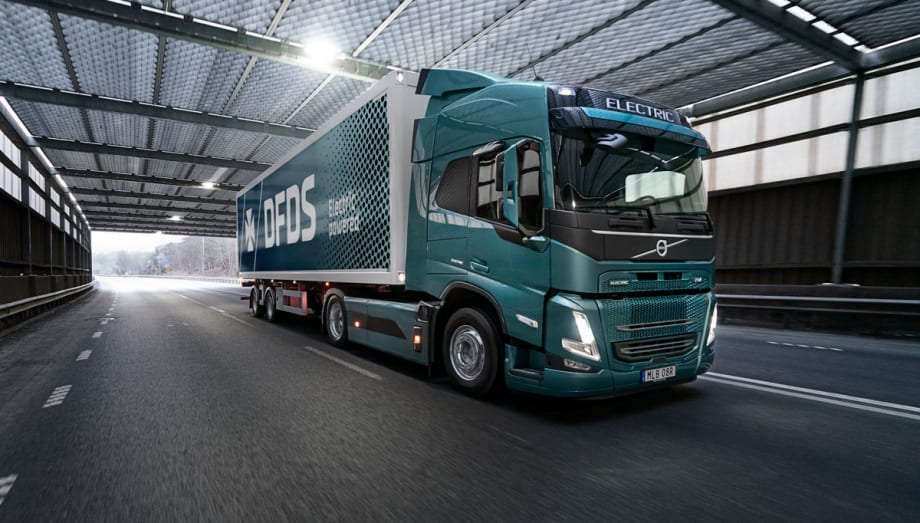
With a single fleet order for 100 FM Electric trucks in Europe and several recent orders in the U.S. for the VNR Electric, Volvo says electric-truck adoption is increasing.
Photo: Volvo
Volvo Trucks reports progress in electric-truck adoption in both Europe and North America, including a record order in Europe and the opening of a new electromobility showcase in America.
The order for 100 FM Electric trucks is the largest commercial order to date for Volvo electric trucks and one of the largest ever for heavy electric trucks worldwide. The order came from DFDS, Northern Europe's largest shipping and logistics company.
First deliveries of the Volvo FM Electric to DFDS will start in the fourth quarter of 2022 and continue throughout 2023. The trucks will be used for both short- and long-haul transport in the DFDS logistics system in Europe.
"At DFDS, we're determined to play our part in reducing CO2 emissions and creating a sustainable supply chain,” said Niklas Andersson, head of the logistics division at DFDS. “We know how important electrification is in the journey to reach our CO2 targets, and I hope we can inspire others as we move forward in this vital transition.”
The FM Electric can carry a weight of 44 tons (gross combination weight) and has a range of up to 300 km. The vehicles can be charged both via overnight depot charging (each truck comes with an AC charger) and via high-power charging on route (DC charging). DFDS has chosen a financing solution provided by Volvo Financial Services.
“This is a major milestone in our commitment to fossil-free transportation, and I am very proud of the partnership we have with DFDS,” said Roger Alm, president of Volvo Trucks, in a news release. “Together we are showing the world that electrified heavy truck transport is a viable solution already today. I believe this will encourage many more customers to confidently take the first step in their own electrification journey.”
Increasing Electric-Truck Adoption
Volvo noted that the electrification trend in the heavy truck market is accelerating.
In Europe, a few hundred trucks above 16 tons have been registered so far this year. Of these, approximately 40% are Volvo electric trucks.
Volvo’s target for 2030 is that half of its global truck deliveries will be electric. “We are pleased to see that growing interest among our customers is starting to be reflected in firm orders, not least by this impressive order from DFDS,” Alm said.
Volvo Trucks started serial production of electric trucks in 2019, one of the first truck brands to do so. The product range now includes six electric truck models – the Volvo FH, Volvo FM, Volvo FMX, Volvo FE, Volvo FL — and in North America, the Volvo VNR Electric.
VNR Electric
Volvo Trucks North America made several announcements of U.S. fleet adoptions during the recent Alternative Clean Transportation Expo, although perhaps none quite as impressive as DFDS' 100 trucks.
NFI, as part of a project to deploy 100 electric trucks in California, will be taking delivery of 30 Volvo VNR Electrics
Performance Team, A Maersk Company, a warehousing and distribution company, placed an order for 16 Volvo VNR Electric trucks. The acquisition is part of Maersk’s Environment Social Governance (ESG) strategy to decarbonize logistics. The El Segundo, California-based company operates a North America warehousing and distribution network of 45 locations and a fleet of 215 trucks.
Dependable Highway Express (DHE), SunPower Corp. and Kuehne+Nagel announced a sustainable freight initiative to transport solar photovoltaics products using solar-powered Volvo VNR Electric trucks. The trucks will run warehouse distribution routes for SunPower from its facility in Ontario, California, where they are recharged daily by 100% renewable electricity generated by on-site solar panels.
And, VTNA announced that by the end of the year, it use the Volvo VNR Electric on local logistics routes servicing the company’s New River Valley truck assembly operations in Dublin, Virginia. Working with local suppliers and carriers, Volvo Trucks will deploy three VNR Electric trucks to transport inbound parts and components daily to the plant.
Electromobility Showcase
Volvo Trucks North America recently celebrated the opening of its new electromobility showcase at its Customer Experience Center in Dublin, Virginia. The facility offers customers the opportunity to test drive the Volvo VNR Electric model around a 1.1-mile closed track. The 36,000 square-foot facility features new Volvo VNR Electric component displays, training, and fully operational charging infrastructure.
Volvo Trucks’ team of onsite specialists will be able to answer questions related to:
Volvo VNR Electric vehicle specifications, including range
Special financing and insurance solutions
The Volvo Gold Contract service and support offering with the Volvo VNR Electric
Infrastructure best practices, including installation partners, hardware and software options, and anticipated project timelines.
The Volvo Trucks Customer Experience Center is located next to Volvo Trucks’ New River Valley manufacturing plant where the Volvo VNR Electric is assembled.
More Fuel Smarts

How Volvo Updated Its D13 for EPA 2027 [Watch]
Volvo’s updated D13 promises lower emissions without sacrificing performance or fuel economy. Take a closer look at what changed inside the engine in this HDT Spotlight video.
Read More →
Diesel Price Spike Shortens Payback for Natural Gas Trucks, Report Says
Energy Vision estimates fleets could recover the higher purchase price of an RNG-fueled Class 8 tractor in 1.3 to 2.8 years under current fuel-price scenarios.
Read More →
Calstart Becomes Catalyst Mobility, Reflecting Broader Focus
Calstart is now Catalyst Mobility, reflecting the nonprofit’s growing national role in clean transportation, including zero-emission trucks, infrastructure and incentive programs.
Read More →

Record Diesel Prices Squeeze Trucking Fleets
Average U.S. diesel prices have climbed to nearly $6 a gallon, surpassing the 2022 record as tight refinery capacity and Middle East disruptions keep fuel costs elevated.
Read More →
How Fuel Delivery Shapes Engine Performance
Fuel delivery depends on more than what happens at the injector. For fleet, maintenance and technical professionals, looking at the full path from pump to injector can provide useful context for understanding engine performance.
Read More →
East Coast Port Launches $45M Electric Truck Push
The Port Authority of New York and New Jersey announced millions in incentives for zero-emission drayage trucks, yard tractors, and new charging hubs near the port.
Read More →
California Bill Could Shed Light on Electric Truck Prices
Why do battery-electric Class 8 trucks remain so expensive? A California bill headed to Gov. Gavin Newsom would give fleets and state agencies more visibility into what manufacturers charge.
Read More →
Detroit Opens Orders for EPA 2027 Engines
Detroit isn’t starting from scratch to meet EPA 2027 diesel emissions standards. Its Gen 6 DD13 and DD15 engines keep much of today’s platform while updating the fuel and aftertreatment systems.
Read More →
Zero-Emission Truck Corridor Planned for West Coast
California, Oregon, Washington, British Columbia and Baja California are coordinating plans for truck charging and hydrogen fueling from Canada to Mexico.
Read More →
A Closer Look at Kenworth’s Electric T880E Vocational Truck [Video]
Learn more about Kenworth's T880E battery-electric vocational truck at the Paccar Technical Center, including its range, applications, upfitting considerations, and PTO options, in this HDT Spotlight video.
Read More →