




The Foundational Future of Heavy-Duty Truck Air Brakes
The future of trucking is increasingly relying on brakes as the foundational technology that will enable fully integrated safety and autonomous vehicle systems.

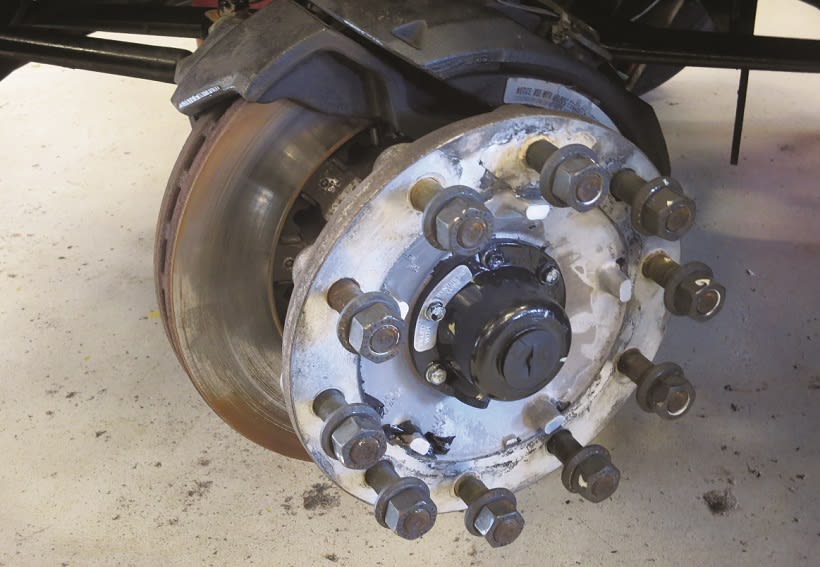
One advantage fleets enjoy with air disc brakes is decreased inspection intervals and reduced maintenance costs, with a shorter time required to change out pads compared to drum brake installation and adjustment.
Photo: Deborah Lockridge
In 1992, commercial vehicle air brake systems took a tentative step into the future when antilock braking systems were mandated by the federal government.
Some truckers had a hard time trusting the technology, after an earlier attempt at mandatory ABS failed spectacularly. But this time was different, thanks to the advent of electronic, computer-controlled “brains” for the systems. Electronic sensors could react to a panic stop and alternately apply and disengage a truck’s foundation brakes far faster than any human ever could, to mitigate skids and help the driver maintain control until the vehicle was safety stopped.
It was a major advancement in commercial vehicle safety, and this version of ABS, building on what had been proven in the passenger-car market, proved to be a robust, reliable system that gave fleet maintenance managers few headaches.
Electronic Control Systems Come of Age
But the ABS mandate was the harbinger of something much larger.
“That’s because for the first time in history, commercial vehicle brakes gained both ‘eyes’ and a ‘brain,’” says Fred Andersky, director of customer solutions for Bendix.
“Those sensors acted as electronic eyes to let the unit’s brain – the ECM – know the brakes were locked up and to start sending signals to avoid initiating a skid.”
That was only the beginning. In 2004, Andersky says, this brake evolution continued, with steer sensors showing up on ABS.
“This was our first taste of sensors working together with stability control systems and steering and braking systems to give integrated control of a vehicle,” he explains.
“And just a few years ago, additional sensors enabled active cruise control systems with braking – systems that can determine if a collision is imminent and alert drivers and apply brakes autonomously if there is no timely human response.”
Autonomous Trucks and Smart Brakes
The common denominator in this 30-year evolution of vehicle technology is the brake system, which has emerged as the foundational vehicle system that will enable stepping-stone solutions that will gradually add various automated and autonomous vehicle technologies to trucks.
While we may eventually get to point where driverless trucks are commonplace, Andersky is firm in his belief that for the foreseeable future, the focus will be on developing Level 3 and 4 autonomous systems designed to make trucks safer, and drivers more productive and comfortable.
“We’ve already disclosed a great deal of the roadmap as to where we see commercial vehicle braking going in general,” says Jon Morrison, president of Wabco’s Americas business division, which is now owned by ZF.
“I think we’re going to see the single-piston air disc brake eventually emerge as a critical part of future braking systems. When you look at electronic brake control systems today, as well as the work we’re doing with electric truck builders like Nikola, as well as work for autonomous vehicles and platooning – which in our world is simply close following distances – all of those things require a robust foundational brake system with improved sensor technologies. And we are headed in that direction today.
"But – again – we will still see drivers behind the wheel for a long period of time to come. And our first job as we develop these brake systems will be to help and assist the driver.”
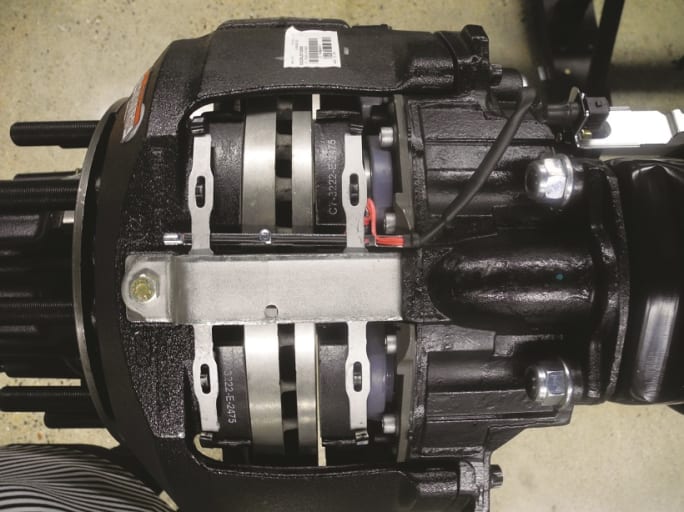
Air disc brakes currently account for only around 25% of the Class 8 truck market today. But experts predict market penetration of around 50% in as little as three years.
Will Drum Brakes Fade Away?
In short, commercial vehicle braking systems – like so many other systems on trucks – are in the midst of an evolution away from long-accepted, rarely questioned specifications, toward more modern technologies.
According to Bryan Williams, vice president of metals engineering for ConMet, drum brakes still comprise 70% to 75% of the brake specs in the Class 8 truck market. But that’s changing.
“Air disc brakes are becoming increasingly popular and will likely become the most popular brake option within the next three to five years,” Williams says. “Certain applications are more suited to disc brakes than drum brakes and vice versa, so application does play a role to a certain extent.
"However, most fleets will find over time that disc brakes are a better option than drum brakes due to their performance and maintenance advantages.”
Compared to the drum brake, the air disc brake has multiple advantages, explains Walt Frankiewicz, president of Haldex North America and senior vice president for Haldex North America Sales, including close to cost parity once the full cost of the drum brake is considered.
Additionally, he notes, air disc brake performance in terms of brake torque output is significantly higher than on drum brakes. This means more stopping power available to the vehicle.
Most importantly, Frankiewicz notes, “the cost related to ease of service of the air disc brakes is in the range of only 20% of the cost for service of a drum brake for lining wear issues. Even better, some fleets today are experiencing an increased service interval with air disc brakes.
"However, this depends on the application, and as of today, claims of increased pad life are unsupported by and large.”
What About Trailer Brakes?
To date, most of the cutting-edge work on next-generation brake technology is focused on the tractor side of the tractor-trailer equation – a situation that Roger Jansen, OEM Account Manager, SAF-Holland, doesn’t find surprising.
“As general rule, trailer adoption of air disc brakes has trailed behind tractor adoption rates in North America for a variety of reasons,” he explains.
“First off,” Jansen says, “most fleets put a lot more miles on their tractors than on trailers and usually replace tractors a lot more often than trailers, which can remain in fleets for long periods of time. “Given all that, most fleets are less inclined to spec more new technology on trailers.”
“Still,” Jansen says, “trailer air disc specs are certainly following the lead set by tractors, with around 20% of trailers fitted with those braking systems today. And those numbers seem to be growing by around 2% to 5% per year,” he notes.
“And while there will always be a few applications that drum brakes will always be preferred – vocational and construction hauling, for example – I think the evolution on the on-highway side will follow the same model that Europe did and migrate steadily toward air disc brakes.”
The main reason this push will occur, Jansen thinks, is because of the performance consistency air disc brakes offer.
“That’s the biggest advantage air discs have over drum brakes,” he says. “The onboard computing systems that are critical for integrating braking and safety systems on trucks work on precise mathematical models and calculations that demand very consistent and repeatable braking performance in additional to temperature and friction wear stability.
"Air disc brakes, without question, have a clear advantage in these areas. They simply work better with ECUs and autonomous vehicle control systems.”
Air Disc Brakes Make Their Case
Keith McComsey, director of marketing and customer solutions for Bendix Spicer Foundation Brake, says his company is getting a lot more questions about air disc brakes than it was two or three years ago – a trend which he largely attributes to a growing emphasis on safety in the industry.
“Air disc brakes don’t fade out the way hot drum brakes do,” McComsey explains. “They are always consistent, whereas hot drum brakes can require as much as an additional 70 feet of stopping distance compared to their capability when cold. This has obvious safety implications and gives the driver another operational inconsistency to deal with during the course of their day.”
Williams also emphasizes that air disc brakes don’t fade.
“They also provide more consistent torque output than drum brakes, feel more car-like, have better stopping power, and pads are easy to replace. Disc brake disadvantages are higher [initial] cost, and the wheel ends run at higher temperatures than drum brakes. Drum brakes are still lower cost initially, meet the federal stopping distance requirements, are familiar to technicians, and run at lower temperatures overall.”
Adoption of air disc brakes in trailers lags behind tractors by a significant degree, however.
“What I tell fleet managers is that whenever you add air disc brakes to another axle, they just get more effective in stopping the vehicle efficiently,” McComsey says. “But, if you have air discs on the tractor, and the drums on the trailer fade out, the front brakes then have to work that much harder to stop the truck, and their friction material wears out that much faster.
"So we believe there are a strong safety, maintenance and cost cases for spec’ing air disc brakes on the trailer as well.”
Cost has been the main barrier to increased air disc penetration in the North American Class 8 market, but Frankiewicz says that barrier is crumbling. In Europe, he says, the cost hurdle for air discs versus drum brakes was less significant because European drum brakes tended to be fairly expensive in their own right due to so many OEM alternatives.
“In North America, the cost of a drum brake has been far below the European cost level, which explains why the transition has not fully been accelerated in North America. However, as the cost curve continues downward on air disc brakes, and innovations from companies like Haldex drive the weight and ultimate cost of the air disc brake to parity with drum brake, the advantages of the air disc brake will be readily apparent in the bottom line of the fleets.”
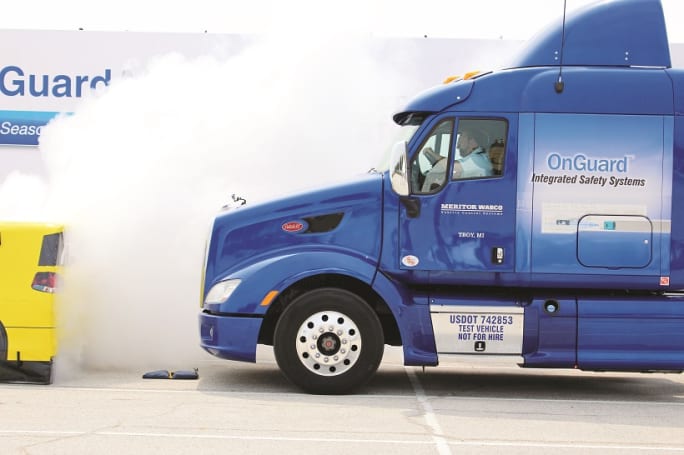
Companies in the U.S. and abroad build on the truck’s braking system to develop automatic emergency braking and other high-tech safety systems for today and the future.
Photo: Wabco
Greater Control, More Information
Also helping air disc adaption along is the fact that the system has become the default brake for most or all of the bus and coach manufacturers in the North American market, Frankiewicz says. Due to their severe duty cycles, many buses are taken out of service for inspection every 1,500 miles, in addition to a required wheel-off inspection (and lining change) every 6,000 miles.
“So the financial savings air discs offer for the transit authorities is very evident,” he says.
And it’s not just buses. Air discs are now the standard front axle specification on many truck OEM vehicle platforms, he adds, although there has been a tendency to permit fleets to delete this standard option to save cost.
“We see ADB volume increasing steadily on the trailer units as well, with Haldex volume in particular growing an order of magnitude in the past year. In general, across the market, air disc brake is about 25% of all installs today and will be at the 50% point in the 2021 timeframe by our analysis.”
Given those projections, along with the unceasing work going on to develop autonomous vehicle systems and electric trucks, it’s not surprising that new, enhanced, electronically enabled braking systems are already beginning to appear on the market.
Early in September, for example, Bendix announced its new Intellipark electronic parking brake system, which brings the familiar red-and-yellow air brake control valve buttons into the modern age.
According to Andersky, the Intellipark system provides a host of safety functions, including preventing rollaway and runaway crashes by automatically setting the brakes if the driver exits the vehicle while it is not parked.
Beyond rollaway mitigation, the system uses information available on the vehicle network to allow the parking brake to be released only when an authorized driver is in full control of the vehicle. Intellipark also delivers features such as Trailer Auto-Park Release, which can automatically release trailer brakes when the vehicle is moving.
Other systems are under active development as well.
Regenerative braking systems aren’t new, but Frankiewicz says that given the influx of electric trucks into the market in the near future, their development is continuing to grow, primarily vehicles for urban areas, as a means of reducing the frequency of drum brake service and reducing brake dust emissions. He predicts this trend will continue as various electrical mobility devices at the wheel end become more prevalent.
Eventually, he predicts, “The form of the regeneration of energy will change from a retarder/braking function to a wheel-end motor/generator package that will more readily accommodate both mobility and stopping in one package. China is already moving out on these type of systems on its transit vehicles.”
Technology Trends Accelerate
Greg Cooper, product manager, brake products for Stemco (since acquired by Hendrickson), notes that transit buses and refuse trucks are increasingly switching to hybrid drive powertrains.
“Out west in the U.S., most transit buses use fully electric and some hybrid buses,” he says. “These systems use an electric motor mated to a regenerative energy collection system that also acts as a brake does most of the deceleration of the bus or refuse truck. This means that up to 80% of the stopping is done with the motor or regenerating system.
"Brakes on vehicles like these typically are not seeing much over 250 degrees in temperature and not using the brakes as much. All indications are this trend will continue and grow in the next several years.”
Wabco’s Morrison believes fleets will likely see more advanced braking systems in the near future.
“I think a near-term advance is going to be more diagnostic and telematics capability at the wheel end itself,” he says. “This is going to include features such as friction-wear sensing capabilities that will help fleets determine how much pad life they have at each wheel position.”
This feature, he says, will allow fleet managers to schedule trucks for brake maintenance on their own timetables, instead of the emergency, need-it-yesterday scenario that is typical today.
“Additionally,” he says, “We’re going to see increased temperature-monitoring diagnostic capability from brake systems, including technology that will provide information on wheel end health and additional protection for rotors and bearings.”
More than anything else, commercial vehicle brake experts all agree that as more sensors and telematics capabilities find their way onto Class 8 brake systems, it will empower greater integration throughout the vehicle for a whole host of advanced safety systems, driver coaching, and the capture of kinetic energy.
More than the foundation for stopping a Class 8 truck, braking systems are evolving into the foundational platform that will enable a new generation of vehicles with capabilities unimagined just a few years ago.
More Equipment

How GP Transco Cuts Trucking Fuel Costs, a Tenth of a Gallon at a Time
What’s another tenth of a mile per gallon worth? GP Transco shares how equipment upgrades and driver coaching turn small gains into meaningful fuel savings.
Read More →
Electric Yard Tractors Move Beyond Pilots
Operating-cost savings have overtaken sustainability goals as the leading reason surveyed fleets are adopting battery-electric terminal tractors, according to new NACFE research.
Read More →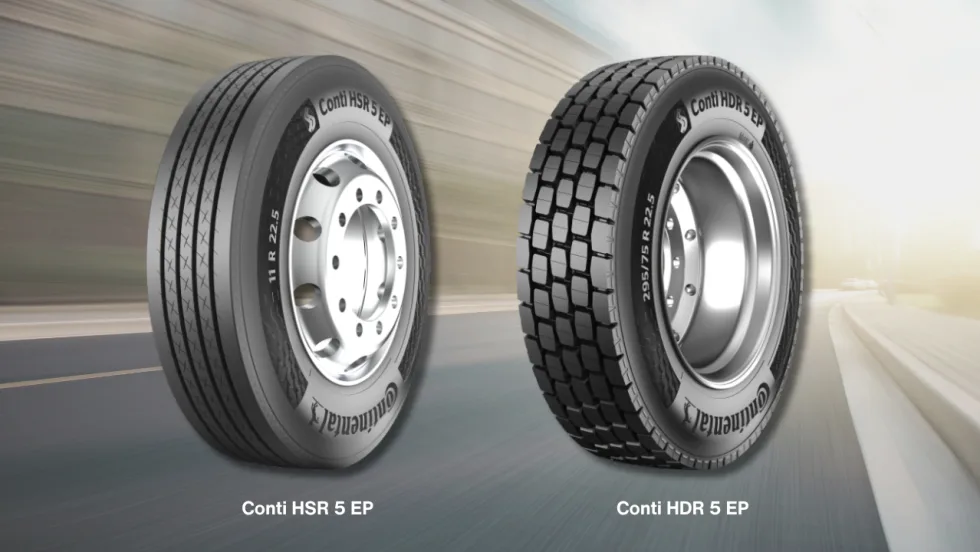
Continental Introduces New Regional Truck Tires
Continental says its new Generation 5 steer and drive tires for regional operations offer longer tread life, with estimated mileage gains of 22% and 19%, respectively.
Read More →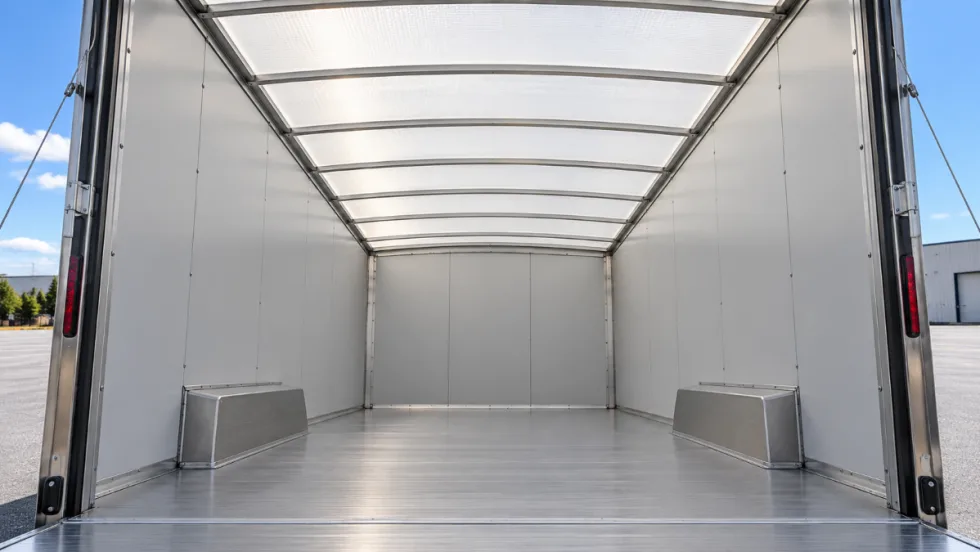
Tekmodo Introduces CargoBright Brand for Translucent Trailer Roofs
CargoBright is designed to diffuse daylight across the cargo area while performing as a working vehicle roof.
Read More →
Fleet Economics Shape Electric Truck Outlook
ACT Research expects costs, charging infrastructure, and technology improvements to drive zero-emission commercial vehicle adoption as federal regulations and incentives retreat.
Read More →
Kodiak Targets Dallas–Houston for Driverless Trucks
The company says its autonomous trucks are completing the I-45 run without a safety observer taking control. It plans to remove the observer by the end of 2026.
Read More →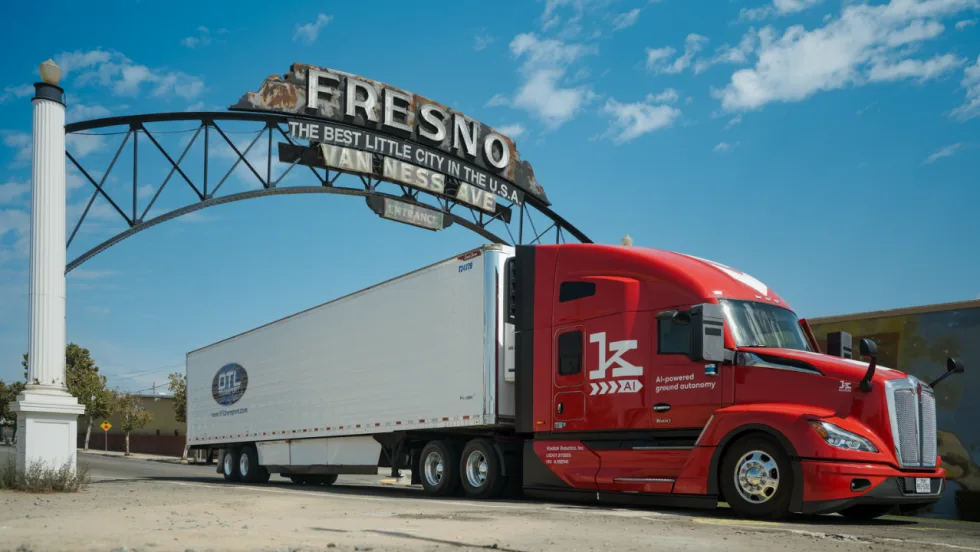
Kodiak Hauls Produce in California Autonomous Truck Pilot
Kodiak AI and DTL Transport have begun hauling produce between Fresno and Los Angeles under California’s new rules for testing heavy-duty autonomous trucks. A safety driver remains behind the wheel.
Read More →
Used-Truck Remarketing Math Is Changing
Used-truck value is no longer just a concern at trade-in. Decisions made throughout a truck’s first life can influence what it’s worth years later.
Read More →
How Volvo Updated Its D13 for EPA 2027 [Watch]
Volvo’s updated D13 promises lower emissions without sacrificing performance or fuel economy. Take a closer look at what changed inside the engine in this HDT Spotlight video.
Read More →
Michelin Tire Improves Efficiency and Durability for Regional Fleets
The Michelin X Multi Energy D2 is a regional haul drive tire engineered to help fleets improve fuel efficiency, durability and traction in demanding stop-and-go operations.
Read More →