




Kodiak Hauls Produce in California Autonomous Truck Pilot
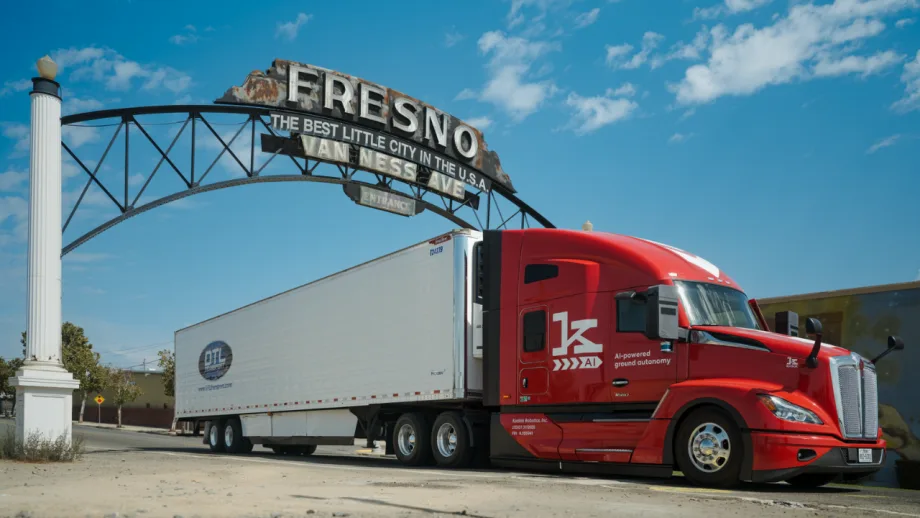
Kodiak AI and DTL Transport have begun hauling produce between Fresno and Los Angeles under California’s new rules for testing heavy-duty autonomous trucks. A safety driver remains behind the wheel.

Kodiak
Kodiak AI and Fresno, California-based DTL Transport have completed their first produce deliveries using an autonomous truck in California, with a human safety driver behind the wheel.
The pilot began September 22. The trucks are hauling perishable freight about 225 miles from Fresno to a Los Angeles distribution center, primarily on State Route 99 and Interstate 5, according to Kodiak.
DTL specializes in cross-country team runs and hauls produce for major grocers.
The runs follow a change in California regulations that opened public roads to testing of heavy-duty autonomous trucks. Kodiak received a state permit August 13 to test with a safety driver.
The permit does not authorize fully driverless testing or deployment. Those require separate permits under the California DMV’s system.
What DTL and Kodiak Are Studying in the California Pilot Program
For DTL, the pilot is a chance to see whether autonomous trucks could help it handle growing freight volumes when demand exceeds its available fleet capacity.
The companies also plan to assess what the technology might mean for transit times, shipping costs, and the shelf life of the produce they haul. They have not yet reported results from those measures.
“Our work with Kodiak helps us understand how embracing this cutting-edge technology improves safety, increases margins, and affirms our leadership position in the industry,” said DTL President and CEO Lucky Dosanjh.
Kodiak said the companies may consider additional routes after the pilot.
Separately, Kodiak says it plans to launch driverless operations on public highways in Texas by the end of 2026.
More Equipment
Used-Truck Remarketing Math Is Changing
Used-truck value is no longer just a concern at trade-in. Decisions made throughout a truck’s first life can influence what it’s worth years later.
Read More →
How Volvo Updated Its D13 for EPA 2027 [Watch]
Volvo’s updated D13 promises lower emissions without sacrificing performance or fuel economy. Take a closer look at what changed inside the engine in this HDT Spotlight video.
Read More →
Michelin Tire Improves Efficiency and Durability for Regional Fleets
The Michelin X Multi Energy D2 is a regional haul drive tire engineered to help fleets improve fuel efficiency, durability and traction in demanding stop-and-go operations.
Read More →
ZF Expands Commercial Vehicle Push in North America
ZF is expanding its North American commercial-vehicle presence with new transmission applications, electrification, trailer technology and autonomous-driving systems.
Read More →
Tesla Wants a Self-Driving Semi. Are Cameras Enough?
Could Tesla’s camera-only autonomous driving technology work on an 80,000-pound Semi? In this commentary, HDT's Deborah Lockridge takes a look at Tesla, Cybercab, and how autonomous trucks see the road.
Read More →
Kodiak: Driverless Long-Haul Truck Launch on Track for 2026
Kodiak AI says its driverless long-haul safety case is 93% complete and it remains on track to begin commercial operations by year-end 2026.
Read More →
What DOT’s Automated Vehicle Strategy Means for Trucking
The U.S. Department of Transportation issued a new automated-vehicle strategy that outlines plans for driverless-truck regulations, cross-state freight corridors, and federal safety standards.
Read More →
East Coast Port Launches $45M Electric Truck Push
The Port Authority of New York and New Jersey announced millions in incentives for zero-emission drayage trucks, yard tractors, and new charging hubs near the port.
Read More →
PlusAI Going Public to Fund Autonomous Truck Launch
A SPAC deal could provide PlusAI with up to $300 million as it works toward a 2027 commercial launch of factory-built autonomous trucks.
Read More →
NHTSA Moves to Rewrite Truck Fuel-Economy Rules
The National Highway Traffic Safety Administration says it lacks authority to regulate medium- and heavy-duty truck engines separately from complete vehicles, but the existing standards have not yet been eliminated.
Read More →