




Bendix to Double Air Disc Brake Production
In response to soaring adoption rates on Class 6-8 vehicles, Bendix has announced plans to double its production of air disc brake products.

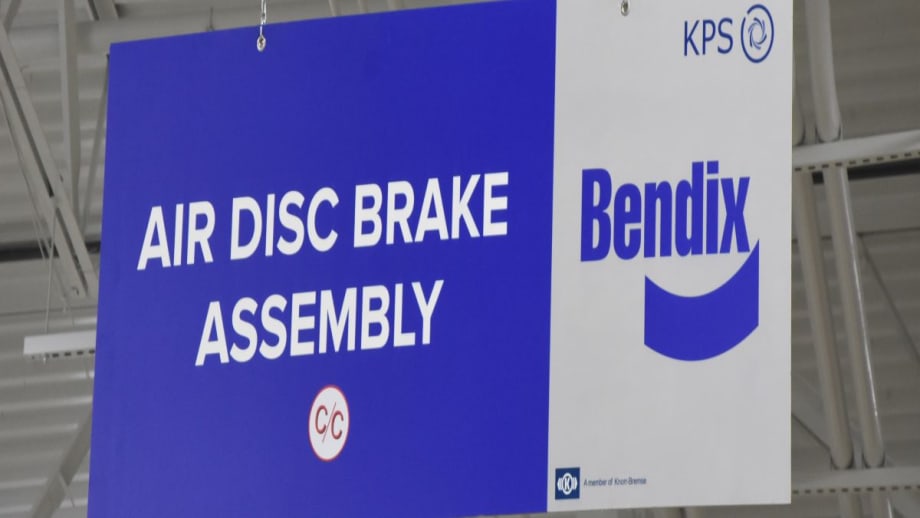
Citing soaring adoption rates, Bendix has announced that it will double its production of air disc brakes for commercial vehicles.
Photo: Bendix
Bendix Commercial Vehicle Systems said that the air disc brake (ADB) market for commercial vehicles in North America continues to expand. According to the OE supplier, adoption rates of air disc brakes on Class 6-8 vehicles now top 50% – up from approximately 25% in 2018.
Bendix introduced its ADB22X air disc brake in 2005. Now, the company said it is positioned to meet the accelerating customer demand through strategic production investments designed to support ADB growth.
100% Growth in Air Disc Brake Production
Those investments have prepared Bendix to accommodate 100% growth in ADB production dating back to 2018, with a more than 30% increase in volume realized to date, the company said.
“Adoption rates for air disc brakes have grown sharply in the last few years,” noted Nicole Oreskovic, vice president of sales and marketing for Bendix. “Anticipating that growth has been the foundation of the investments we’ve made – all with the commitment to support what this market needs in ADB volumes for tractors and trailers.”
Oreskovic said Bendix has been a leader in the development and advocacy of air disc brakes since 2005. “We continue to adapt our design and manufacturing processes for increased capacity,” she added. “That uniquely positions us to enable and help drive the market conversion to ADBs, as we have for the last 20 years.”
Bendix is a part of Munich, Germany-based Knorr-Bremse, a global leader in air disc brake production. The company has produced more than 50 million air disc brakes to date.
The company’s ADB production numbers reflect the market growth since the Bendix ADB22X air disc brake launched in 2005, the company said. It took eight years to reach the 400,000-unit production mark in 2013, but just five more to hit the 2 million mark and three more to double that milestone.
Largest Installed ADB Capacity in North America
According to Aaron Schwass, vice president, wheel-end, North America, for Bendix, the company has focused on three primary aspects at its Bowling Green facility, helping drive the goal of doubling the operation’s production capacity and addressing customer need. Some of the investments were part of a 130,000-square-foot expansion completed at the plant in 2020.
“Bendix has the largest installed air disc brake assembly capacity in North America for the commercial vehicle market thanks to our sustained investment focus over the years,” Schwass said. “That position is further bolstered with strategic levers that have put us in position to meet current and future ADB demand.”
Specifically, Schwass cited a new high-volume assembly line. He said it has increased ADB assembly capacity by more than 40%. The company also expanded its resources with additional machining capacity to support the increased volumes.
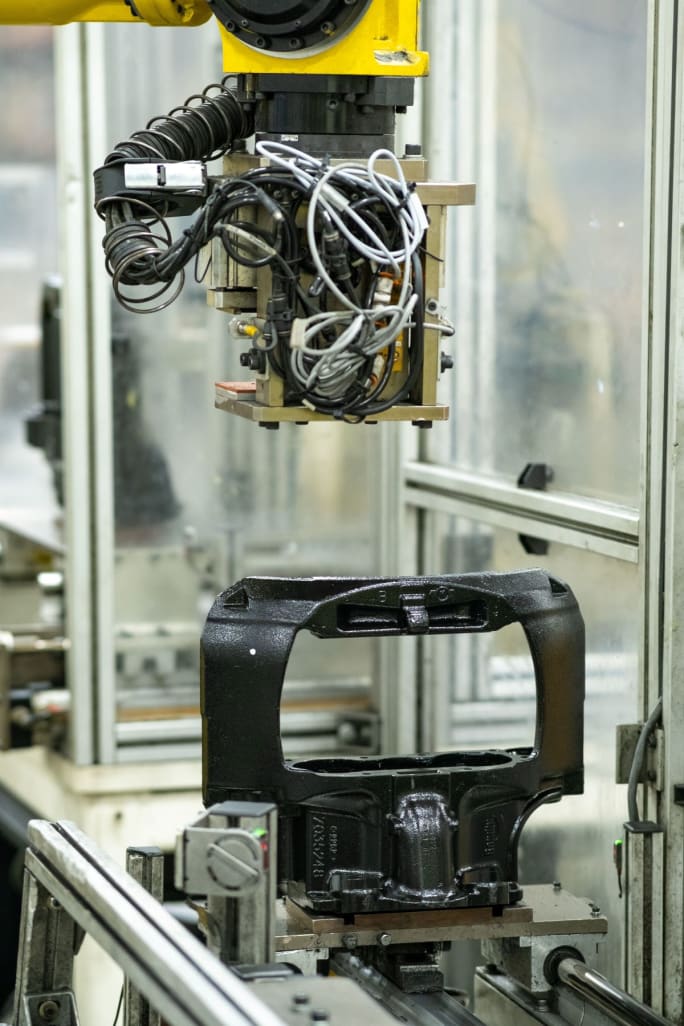
A new, high-volume assembly line at the Bendix manufacturing plant in Bowling Green, Kentucky, has boosted air disc brake assembly capacity by 40%.
Photo: Bendix
The third key focus area was an increase in supplier capacity, both in product-specific tooling and supplier development, to enable the supply base to sustain the level needed to support Bendix’s internal capacity.
In addition, Schwass cited the co-locating of some R&D personnel and test equipment in the Bowling Green facility to help expand the capability and efficiency of the plant. Beyond Bowling Green, Bendix invested in the capability of air disc brake aftermarket operations at its Huntington, Indiana, facility.
Shorter, Safer and Smoother Stopping Power
According to Bendix, drivers appreciate shorter stopping distances with air disc brakes on trucks. This goes along with smoother, straighter, and more stable stops, for a car-like feel and virtually no brake fade.
Combination vehicles with ADBs on all tractor and trailer wheel-ends boast a 50-foot shorter stopping distance compared to drum brakes. As a result, fleets that equip ADBs report increases in driver satisfaction and retention, the company said.
A fleet’s decision to spec air disc brakes depends on its application and business needs, Bendix noted.
Return on investment (ROI) in ADBs usually depends on a combination of factors, including lightweight design, extended brake system life, quicker pad changes – roughly one-quarter the time of drum brakes once the wheel is off – and a longer friction duty cycle.
However, Bendix said that across a wide range of applications – line haul, refuse, and school bus, for instance – fleets are seeing lower total cost of ownership through the adoption of ADBs.
In addition, the company said, fleets are benefiting from ADBs because of their positive impact on CSA (Compliance, Safety, Accountability) scores and brake inspections – for example, Bendix ADBs have an internal adjustment mechanism, which decreases the possibility of brakes being found out-of-adjustment during inspections.
“Safety plays an important part in ROI as well, and when we look at braking technology through the lens of making vehicles safer for drivers and others sharing the road, air disc brakes contribute to that,” Oreskovic said. “Fundamentally, they help make roads safer.”
A critical way ADBs may improve safety is by further enhancing the capability of collision mitigation systems, which depend on stopping power at the wheel-ends to work at their best.
“Commercial vehicle safety technologies are becoming more integrated and complex,” Oreskovic said. “As we talk about autonomy and electrification, from a foundation brake perspective, ADB is a key contributing technology to support and enable where the industry is going.”
In that way, Bendix’s role as a complete safety system provider is key, she added.
“As a safety system provider, we look at the whole safety system, air disc brakes included,” Oreskovic said. “We’re examining the tractor and trailer and constantly working to refine, evolve, and enhance the system so that all parts are working optimally both individually and together. That comprehensive approach is at the core of who Knorr-Bremse and Bendix are as companies.”
More Safety & Compliance
A Camera Isn't a Safety Program. Here's What Brokers Are Screening for Now
Footage alone may not be enough to pass broker vetting processes. Here's what counts as a defensible safety program now.
Read More →
Marijuana and Trucking’s Drug-Testing Dilemma
Marijuana is getting stronger, laws are changing, and drug tests still can’t reliably establish impairment. What does that mean for truck drivers and the fleets that employ them?
Read More →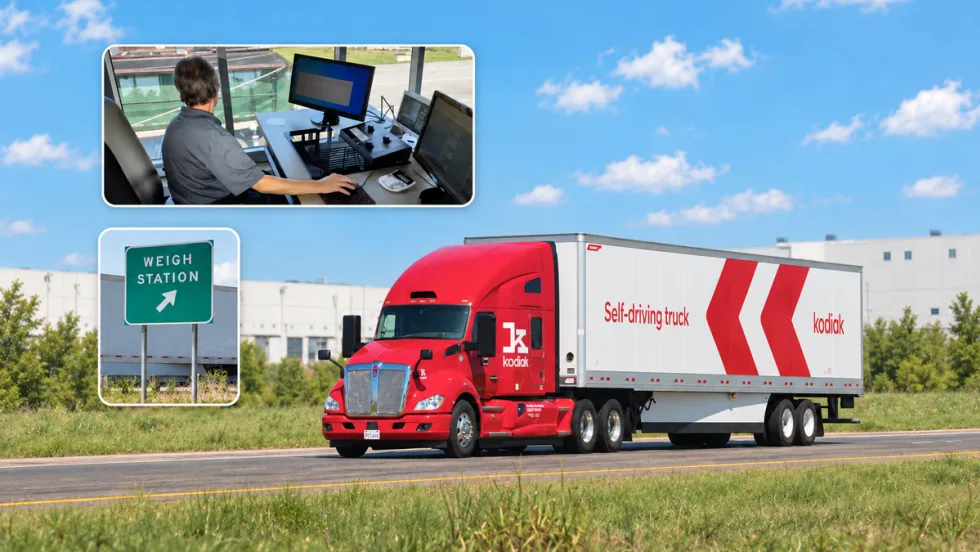
PrePass, Kodiak Connect Driverless Trucks to Roadside Enforcement
The system will allow enforcement agencies to verify Enhanced Inspection information and decide whether Kodiak’s autonomous trucks can bypass roadside screening sites.
Read More →

From One Generation to the Next: How Mentorship Builds Safer Truck Drivers
After three decades in trucking, Harold Perry shares what he's learned about driver safety, mentorship, and helping the next generation build confidence behind the wheel.
Read More →
FMCSA Pauses Biennial-Update Enforcement Amid Motus Transition
Carriers whose updates were due on or after June 1 have more time, while FMCSA works to stabilize its new registration system and warns of phishing sites impersonating its new carrier registration system, Motus.
Read More →
ZF Expands Commercial Vehicle Push in North America
ZF is expanding its North American commercial-vehicle presence with new transmission applications, electrification, trailer technology and autonomous-driving systems.
Read More →
Truck Drivers Need More Than Another Alert
Fleets have more visibility into truck health, safety events, and driver activity than ever. The next challenge is turning all that information into useful guidance for the person who has to decide what to do next.
Read More →
Tesla Wants a Self-Driving Semi. Are Cameras Enough?
Could Tesla’s camera-only autonomous driving technology work on an 80,000-pound Semi? In this commentary, HDT's Deborah Lockridge takes a look at Tesla, Cybercab, and how autonomous trucks see the road.
Read More →
What DOT’s Automated Vehicle Strategy Means for Trucking
The U.S. Department of Transportation issued a new automated-vehicle strategy that outlines plans for driverless-truck regulations, cross-state freight corridors, and federal safety standards.
Read More →
NYC Expands Speed, Pedestrian Safety Tech Across Fleet
New York City is expanding intelligent speed assistance and pedestrian-alert systems across its municipal fleet, moving the technologies from pilot programs into vehicle procurement and retrofit requirements.
Read More →