



Are Wide-Base Tires Still Worth the Effort?
After two decades, most fleets have made up their minds on wide-base single tires. They either love them – or they can’t be bothered.
 MENU
MENU SEARCH
For maximum fuel efficiency from tires, go beyond passive tire pressure monitoring and look to telematics data.
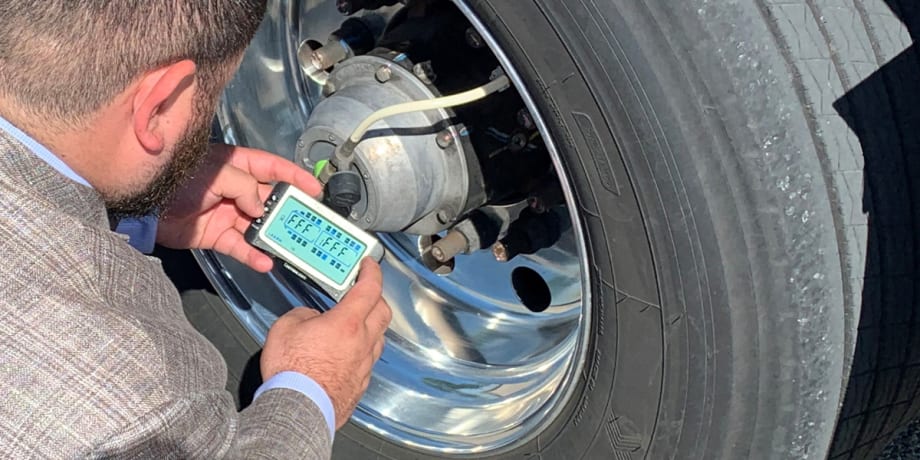
Using telematics to get tire pressure data back to the fleet manager allows fleets to make decisions as to whether the alerts require immediate action or scheduling a work order when the driver reaches the destination terminal.
Photo: PSI
Only driver wages beat out fuel as the largest expense for fleets. With even the slightest underinflation of tires on tractors and trailers causing degradation in fuel economy (not to mention tire wear), effective pressure monitoring should be at the top of a fleet’s list to save on fuel.
Developments in not only tire pressure monitoring, but also in automatic tire inflation, in the past seven years have made technologies more available — and now there’s data to back up claims of fuel savings.
The North American Council for Freight Efficiency last year updated its 2013 Confidence Report on the benefits tractor and trailer tire pressure systems. The report is part of NACFE’s effort to provide data and insight on technologies that can help improve freight efficiency and to increase fleets’ confidence in adopting such technologies.
Despite the proven benefits of proper tire inflation’s positive effect on fuel economy, NACFE found that 3% of trailers and nearly 3.5% of trucks operate with four or more tires underinflated by at least 20 psi. A truck running with all tires underinflated by just 10 psi means a 0.5% to 1% increase in fuel consumption, according to NACFE.
Approximately 25% to 30% of tractors are equipped with tire pressure monitoring systems, NACFE found. Just 15% of trailers are. Yet one in five trucks are operating with one or more tires underinflated by at least 20 psi. Perhaps effective tire pressure management goes deeper than monitoring.
While most fleets do a great job of setting up systems to monitor tire pressure in their fleets, says Collin Shaw, ZF marketing and business development leader, the missing link is that many systems stop at alerting the driver. That’s a fine solution if the tire pressure is fluctuating due to altitude, temperature or weight of the haul, but not if a larger failure is brewing, he explains.
The solution? Telematics that can alert fleet managers of happenings on the road and give them a new kind of visibility.
Shaw, whose product expertise is in trailer tire pressure management and monitoring, says it’s great to have a TPMS to monitor pressure and temperature for each individual tire based on pre-set targets. Even better is an automatic tire inflation system, which will reinflate the tire as pressure falls below those targets. But what if a trailer has a constant leak that could point to an upcoming critical event where a tire blows?
“Unless you’re creating actionable information, and you’re giving that information back to the driver, it doesn’t do any good,” Shaw explains.
That’s why the company last year launched its trailer braking system (iABS), which has the ability to take on sensors from other parts of the trailer, including tire pressure information from the company’s OptiTire TPMS.
Craig Smith, marketing manager at Pressure Systems International, agrees that getting data back to the fleet manager is an important part of having an effective tire pressure management program that saves fuel and tires.
“TPMS requires someone to react to alerts in order to be effective,” Smith explains. “The first question when considering TPMS is, “Can I count on my driver to report and/or respond to low pressure alerts?” If the answer is ‘no’, then investing in a vehicle-based TPMS is going to have diminished results and very unlikely to deliver on the ROI.”
This shouldn’t be surprising, since most drivers are compensated based on miles they drive, not their tire pressure, Smith says. That’s where telematics swoops in and becomes the hero of the story.
“Decisions can then be made as to whether the alerts require immediate action or scheduling a work order when the driver reaches the destination terminal,” he says. “Many fleets are already using some type of telematics today, so usually the most cost-effective way is to integrate the TPMS data into their existing system.”
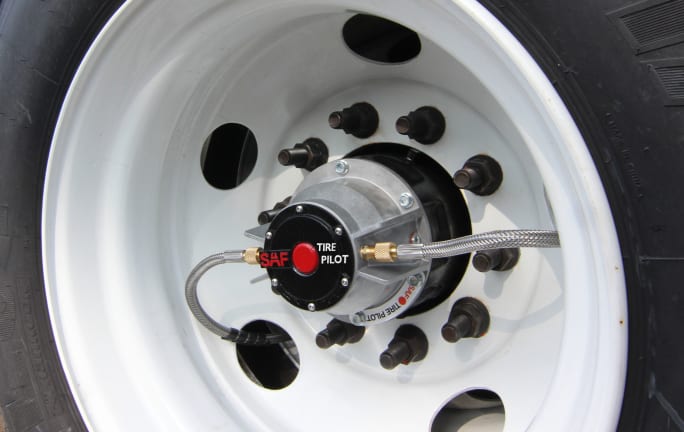
Developments in not only tire pressure monitoring, but also in automatic tire inflation, in the past seven years have made technologies more available – and now there’s data to back up claims of fuel savings.
Photo: SAF-Holland
Some telematics systems can help establish more than tire temperature and pressure, such as how long that tire ran under- or over-inflated. That type of data helps fleets determine whether a tire must be replaced.
“At the fleet level, TPMS system data can be used to more effectively address issues like frequent tire replacements and tire failures on the road, helping shape better tire strategy and maintenance plans,” says Guangning Zhao, who oversees TPMS at Bendix.
Using location through telematics’ GPS data can also help determine “hot spots” for punctures, such as shippers’ yards or truck parking areas that are not clean. Some fleets have also been able to use temperature data to flag brake problems such as a dragging brake or a malfunctioning brake valve.
Telematics can allow fleet managers to track historical information that measures performance of individual tire locations for each trailer in the fleet in order to identify a problem tire that exhibits a continued or repeated need for service, says SAF-Holland Product Manager Bill Hicks. Repeated service could be a key indicator of another wheel-end issue that needs to be addressed.
Aperia’s Halo Connect, a “smart” version of its standard Halo TPMS for trucks, is another product that offers fleets an in-depth look at tire pressure data.
Halo Connect expands on the typical threshold-based monitoring (the more passive system) and begins tracking the severity of the alert, the reason for the alert (temperature fluctuation, for example) and how quickly the fleet needs to address the issue.
Because the alerts in the platform are more specific and pinpointed, the system alerts driver of issues 75% less.
“You get alerts early, not often, so you can really trust the platform,” says Aperia’s Judith Monte, vice president of marketing and customer experience.
Processing more data for fleets that will help them make the most cost-saving decisions and ultimately improve fuel economy seems to be the path forward.
Hendrickson, for example, is working on a wheel-end sensor product called the Watchman, according to Hendrickson’s Matt Wilson, general manager of the controls business unit of trailer commercial vehicle systems.
Entering production in the fourth quarter of the year, the sensor will transmit additional data, including current tire pressures, through a telematics system back to the cloud. From there, the fleet’s home office can monitor the pressure in real time. The data-rich sensor can be paired with Hendrickson’s TireMaax tire inflation system.
An automatic tire inflation system can also address a low tire situation when the vehicle is on the road, with no intrusion for the driver.
“This quick response maximizes tire life and fuel economy as well as increases fleet uptime,” SAF-Holland’s Hicks says.
ATIS uses either a compressed air system on the truck or pulls in atmospheric air to reinflate tractor or trailer tires whenever the system detects pressure is below a target level.
Some systems also offer the ability to let air out if tires are over-inflated, such as when outside temperature rises during operation.
One of the latest capabilities on some systems is being able to dynamically adjust tire pressure according to vehicle load.
The adoption of tire pressure inflation systems for trailers has been rising fairly steadily since 2013, according to NACFE data. The same isn’t true for inflation systems on tractors, where few systems work on drive tires. Adoption rates slowly grew between 2014 and 2017 and started a downward descent in 2018
Tire pressure systems are projected to save $750 to more than $1,000 per vehicle per year, according to historical payback estimates recorded by NACFE.
“The value of appropriate tire pressure is significant and becomes increasingly so with higher fuel and tire prices,” NACFE officials said in the Confidence Report.
When compared to a baseline pressure of 100 psi, tires at 70 psi have 18% more rubber on the road, which translates to a 3.8% decrease in fuel efficiency in controlled lab rolling resistance simulations, explain Meritor’s Howard Fromm, senior product manager for the company’s tire inflation systems.
To decrease rolling resistance is to increase fuel economy. And to decrease rolling resistance, fleets need to be proactive in not only monitoring but also managing the tires on their tractors and trailers.
This article was first published in the June 2021 issue of Heavy Duty Trucking magazine.

Volvo’s updated D13 promises lower emissions without sacrificing performance or fuel economy. Take a closer look at what changed inside the engine in this HDT Spotlight video.
Read More →
Energy Vision estimates fleets could recover the higher purchase price of an RNG-fueled Class 8 tractor in 1.3 to 2.8 years under current fuel-price scenarios.
Read More →
Calstart is now Catalyst Mobility, reflecting the nonprofit’s growing national role in clean transportation, including zero-emission trucks, infrastructure and incentive programs.
Read More →
Average U.S. diesel prices have climbed to nearly $6 a gallon, surpassing the 2022 record as tight refinery capacity and Middle East disruptions keep fuel costs elevated.
Read More →
Fuel delivery depends on more than what happens at the injector. For fleet, maintenance and technical professionals, looking at the full path from pump to injector can provide useful context for understanding engine performance.
Read More →
The Port Authority of New York and New Jersey announced millions in incentives for zero-emission drayage trucks, yard tractors, and new charging hubs near the port.
Read More →
Why do battery-electric Class 8 trucks remain so expensive? A California bill headed to Gov. Gavin Newsom would give fleets and state agencies more visibility into what manufacturers charge.
Read More →
Detroit isn’t starting from scratch to meet EPA 2027 diesel emissions standards. Its Gen 6 DD13 and DD15 engines keep much of today’s platform while updating the fuel and aftertreatment systems.
Read More →
California, Oregon, Washington, British Columbia and Baja California are coordinating plans for truck charging and hydrogen fueling from Canada to Mexico.
Read More →
Learn more about Kenworth's T880E battery-electric vocational truck at the Paccar Technical Center, including its range, applications, upfitting considerations, and PTO options, in this HDT Spotlight video.
Read More →