




Q&A: Peterbilt's Patrick Wallace on CARB Regulations
You may just decide you’re not going to go to California anymore. But California is coming to you, warns Peterbilt’s electric vehicle marketing manager.

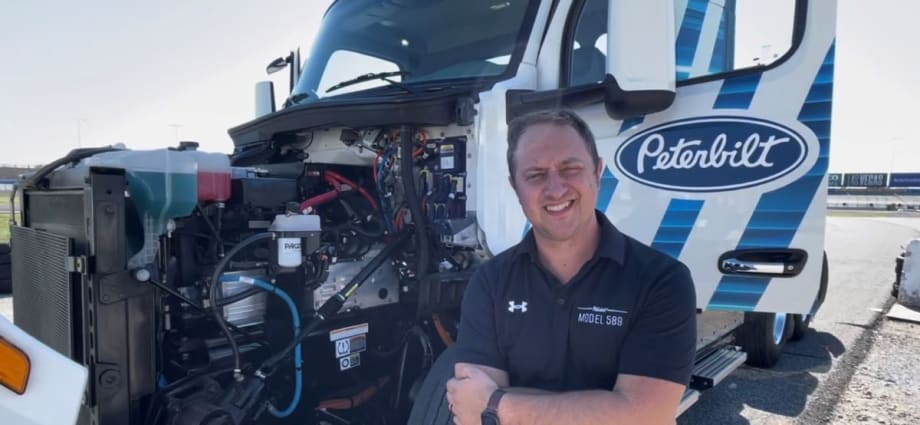
Patrick Wallace, marketing manager, electric vehicles, Peterbilt, discusses the coming wave of CARB regulations during a customer event at the Texas Motor Speedway in November, 2023.
Photo: Jack Roberts
If you’re running a trucking company in the middle of the United States, or Canada, you might look at the diesel exhaust emissions regulations being enacted by the California Air Resources Board with some alarm. But you probably think it will be a very long time before those regulations affect your business. And, in the meantime, you figure, we just won’t go to California anymore.
But that head-in-the-sand approach isn’t going to work, warns Patrick Wallace, marketing manager, electric vehicles, Peterbilt. Because while you may decide you’re not going to California, California is definitely coming to you.
HDT: Let’s start with where things stand right now: We’ve got CARB states. And we’ve got non-CARB states. But it’s not going to stay that way for long, is it?
Wallace: No. The emission laws that will soon affect the entire country are already on the books. And it’s just a matter of time before those laws affect every fleet in the U.S. And that time is coming a lot sooner than most fleet managers realize.
HDT: What are those laws and how are they starting to affect fleets?
Wallace: The first regulation that impacts the entire country is the CARB’s Advanced Clean Truck regulation. This is the law that features the electric vehicle sales requirement.
What that means is that Peterbilt and its dealers must meet the standards set by this regulation as a prerequisite to sell vehicles in California and all CARB-following states. This regulation is fully approved by CARB and its EPA waiver has already been granted.
ACT is already being phased in for CARB-compliant states. Beginning next year, Peterbilt and its dealers must sell a specific percentage of zero emission vehicles into California and other CARB states. The percentages start 9% of vocational trucks, and 5% of heavy-duty tractors in 2024. The percentages continue to increase year over year, finally reaching 100% in 2040.
It's important to remember that ACT has been adopted by more states than just California. Ten other states have officially adopted CARB zero-emission regulations with varied implementation in coming years. And for perspective, note that California and those 10 other states represent nearly a quarter of Peterbilt’s annual sales. So we’re already talking about a lot of fleets and a lot of electric vehicles.
HDT: But there are regulations that will also directly affect fleets?
Wallace: Yes. Next, we have the Advanced Clean Fleets regulation. This is the fleet purchasing requirement that our customers must achieve. At this time this regulation is still in the rulemaking process. CARB is making changes to it. But we expect it to be released any day now.
The ACF rule features a series of levers that require fleets to purchase zero emission vehicles. There are three primary categories: The first is drayage starting in 2024. All trucks added to the port registry must be zero emissions.
The second are public fleets. All new vehicle purchases by city, county, special district and state agencies must be 50% zero emissions in 2024 and 100% zero emissions in 2027.
And finally, the one that affects most of your readers, private fleets. And in CARB states, beginning next year, 100% of private fleet purchases starting in 2024 must be zero-emission vehicles.
HDT: But there are some options available for private fleets that can’t, or don’t want to go 100% ZEV next year?
Wallace: Yes. There is a more phased-in approach for some fleets. One thing to consider here is that existing fleet makeup is considered. It’s not just about new truck purchases. And there is a waiver for any vehicle with a front axle rating over 12,500 lbs.
So, if you’re operating day cab tractors, sleeper cab tractors and specialty vehicles, you can still purchase diesel trucks. And we think this is going to drive a lot of tractor sales with heavier-duty front axles.
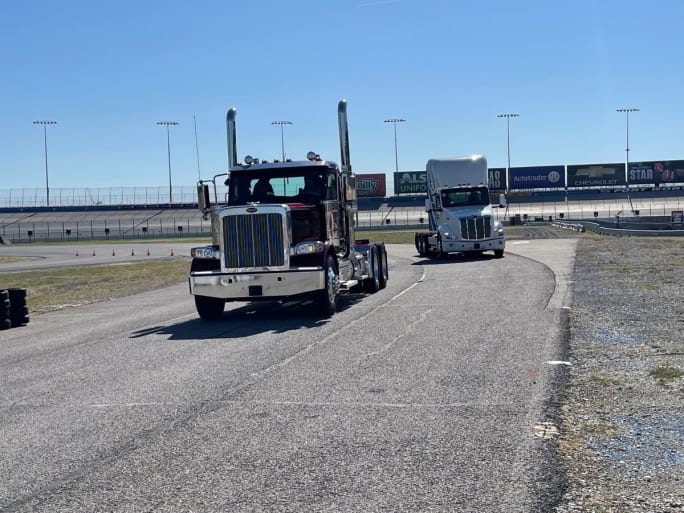
It's easy to focus on diesel trucks if you're not in a CARB state, says Patrick Wallace. But electric trucks are coming up fast. And the time to prepare is now -- no matter where you live.
Photo: Jack Roberts
The other is that this year and in future years, ACF requires customers to report their fleet composition to CARB. So, it is important that you start engaging your legal and operational teams now to make sure you're on top of this and that you are reporting and planning for the future.
HDT: And that’s just CARB regulations. There’s also EPA regulations, which will affect all 50 states.
Wallace: Right. It's not just California. In 2027, more stringent federal greenhouse gas requirements take effect across the entire U.S. And these regulations will compel OEMs to sell zero emission vehicles nationally. Even though the EPA ramp-up is less aggressive, this is something that all customers have to plan for, no matter what states you live, or operate in.
HDT: Which is why Peterbilt is urging its customers to start preparing now for these regulations – no matter where they live?
Wallace: Yes. The end customer journey to acquire, deploy and operate electric trucks can be a long process. We suggest you start with one or two trucks to gain some experience. You should plan on a minimum of six to nine months to learn about grants, charging and infrastructure and have your trucks built and getting a charger deployed.
HDT: In other words, learn the basics.
Wallace: Right. After that, the next step is getting real world experience and using that to develop your plan to scale up. This means figuring out when and how to charge your electric truck. Getting your drivers used to the trucks. And using optimizing route planning to get the most range possible on routes. You want to design routes that actually work well for these trucks. If you’re in a cold climate, you’ll also need to test the cold-weather performance of the trucks. Once you’ve done all that, you’ll be ready to plan for deployment of multiple trucks.
HDT: And that can be a fairly lengthy process?
Wallace: This part of the process can two years to complete. During this time you must also start on your major infrastructure project with the charters necessary to support your entire fleet of trucks. This alone could take a year and a half to accomplish. You need to start looking into incentives.
Finally, as you start to get your infrastructure available, you can deploy trucks.
All in all, this process takes a minimum of two to three years from your initial sales meeting before you can even put 10 or more electric trucks in service.
So the takeaway here — and one that we’re really stressing at Peterbilt — is that you have to start immediately if you want to have a fleet of EVs deployed by the time the ACF regulations become law.
HDT: Because 2027 is going to be here before you know it.
Wallace: Yes. This is not just what we’re telling fleets based in California. You need to start getting ready to begin your journey to EVs now. These deployments take a long time to complete. The best time start on them was yesterday. The second-best time is today.
Information is critical to make this transition. And we are here to help every step of the way. We want to empower Peterbilt customers to successfully navigate the coming regulations as quickly and easily as we possibly can.
More Fuel Smarts

How Volvo Updated Its D13 for EPA 2027 [Watch]
Volvo’s updated D13 promises lower emissions without sacrificing performance or fuel economy. Take a closer look at what changed inside the engine in this HDT Spotlight video.
Read More →
Diesel Price Spike Shortens Payback for Natural Gas Trucks, Report Says
Energy Vision estimates fleets could recover the higher purchase price of an RNG-fueled Class 8 tractor in 1.3 to 2.8 years under current fuel-price scenarios.
Read More →
Calstart Becomes Catalyst Mobility, Reflecting Broader Focus
Calstart is now Catalyst Mobility, reflecting the nonprofit’s growing national role in clean transportation, including zero-emission trucks, infrastructure and incentive programs.
Read More →

Record Diesel Prices Squeeze Trucking Fleets
Average U.S. diesel prices have climbed to nearly $6 a gallon, surpassing the 2022 record as tight refinery capacity and Middle East disruptions keep fuel costs elevated.
Read More →
How Fuel Delivery Shapes Engine Performance
Fuel delivery depends on more than what happens at the injector. For fleet, maintenance and technical professionals, looking at the full path from pump to injector can provide useful context for understanding engine performance.
Read More →
East Coast Port Launches $45M Electric Truck Push
The Port Authority of New York and New Jersey announced millions in incentives for zero-emission drayage trucks, yard tractors, and new charging hubs near the port.
Read More →
California Bill Could Shed Light on Electric Truck Prices
Why do battery-electric Class 8 trucks remain so expensive? A California bill headed to Gov. Gavin Newsom would give fleets and state agencies more visibility into what manufacturers charge.
Read More →
Detroit Opens Orders for EPA 2027 Engines
Detroit isn’t starting from scratch to meet EPA 2027 diesel emissions standards. Its Gen 6 DD13 and DD15 engines keep much of today’s platform while updating the fuel and aftertreatment systems.
Read More →
Zero-Emission Truck Corridor Planned for West Coast
California, Oregon, Washington, British Columbia and Baja California are coordinating plans for truck charging and hydrogen fueling from Canada to Mexico.
Read More →
A Closer Look at Kenworth’s Electric T880E Vocational Truck [Video]
Learn more about Kenworth's T880E battery-electric vocational truck at the Paccar Technical Center, including its range, applications, upfitting considerations, and PTO options, in this HDT Spotlight video.
Read More →