




7 ELD Tips for Roadcheck Inspection Blitz
A former law enforcement official gives his tips on how fleets can stay compliant with the ELD mandate during this year’s CVSA Roadcheck which will focus on hours of service violations.

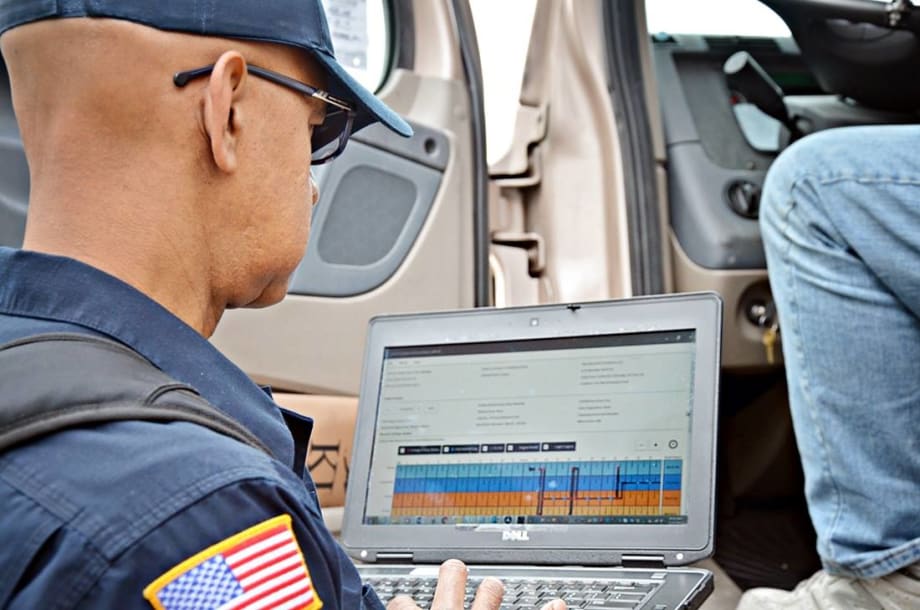
Make sure drivers know how to transfer ELD data roadside to enforcement officials.
Photo: FMCSA
The top driver-related violation from last year’s Roadcheck, the annual commercial vehicle inspection blitz, was for hours of service (32.3%), so the focus for this year’s event (June 5-7) is hours-of-service compliance. And of course, with the electronic logging mandate having been in effect for less than a year, there no doubt will be a lot of focus on ELD compliance as well.
Joe DeLorenzo, the chief enforcement official at the Federal Motor Carrier Safety Administration, said ELD compliance “seems to be going in the right direction.” Of all the inspections performed since April 1, he said, less than 1% of those inspections showed a violation for not having an ELD when required.
“We’ve definitely seen an improvement from December and from April,” he said. “More importantly, from about a year ago, hours of service violations are about half of what they were back then, according to our most recent analysis.”
Nevertheless, there are still plenty of opportunities for confusion at roadside, with continuing misconceptions about the difference between ELDs and grandfathered automatic onboard recording devices. So we spoke with John Seidl, a former enforcement official who now helps fleets stay compliant in his job as VP of risk services at Reliance Partners, about his top tips for fleets heading into Roadcheck when it comes to hours of service and ELDs.
1. Make sure drivers know whether they’re running an AOBRD or ELD
There have been anecdotal reports of confusion during roadside inspections relating to the fact that drivers subject to the ELD mandate could be running an ELD, or they could be running an automatic on-board recording device, or AOBRD, under a grandfather clause. But the regulations for ELDs and AOBRDs have some significant differences, including whether they must be able to transfer data at roadside, and even down to the documentation required to be kept in the truck.
AOBRDs are allowed to be used instead of ELDs up until December 2019 – if fleets were using them before the 2017 ELD deadline of Dec. 17. And the latest guidance allows a motor carrier that installed and required its drivers to use an AOBRD before Dec. 18, 2017, to install and use a new ELD-capable device that runs compliant AOBRD software until the December 2019 full compliance deadline.
2. Be able to prove it you’re running a grandfathered AOBRD.
How can a trucking company taking advantage of the grandfathering provision prove that it was requiring its drivers to use AOBRDs prior to the 2017 ELD compliance deadline? Seidl recommends printing a driver’s log for every truck they operated in December prior to the deadline and putting those in a file called “AOBRD evidence.” And give the drivers a copy to keep in the truck. (He also points out that since driver logs are only required to be kept for six months, the window to be able to do this is fast closing.)
He suggests that when an enforcement officials asks a driver for his ELD, that the driver be coached to respond something like, “Sir, I don’t have an ELD; I have an AOBRD because my company installed and used them prior to December, and here’s my proof.”
He also suggests that you print out a copy of the FMCSA’s ELD FAQs, in particular page 6, question 6, about enforcement procedures for AOBRDs. This explains that AOBRDs are to be enforced under the previous AOBRD regs, not the ELD ones.
3. Be ready to explain and prove your exemptions.
If you are operating under any ELD or hours of service/logbooks exemption, such as trucks with older engines, the air-mile radius exemptions, or the eight days in 30 exemption, Seidl recommends making sure drivers understand the exemption they are running under and can explain it to the officer, as well as having proof in the truck where applicable.
“Remind those drivers that are running time cards exactly why they’re running time cards,” he notes. For those running older engines, he said, while documentation is not required, it’s certainly a good idea. “If I’m an officer and I ask for proof and you don’t have it, now you’ve got to fight it later.”
4. Make sure drivers have the right documentation in the truck.
The requirements for what documentation must be kept in the truck is different for AOBRDs than it is for ELDs.
For AOBRDS, the regulations require:
(1) An instruction sheet describing in detail how data may be stored and retrieved from an automatic on-board recording system; and
(2) A supply of blank driver's records of duty status graph-grids sufficient to record the driver's duty status and other related information for the duration of the current trip.
Note that it does not say you need eight days of blank logs (although as a practical matter it would make sense to just have that many anyway), and the instruction sheet is fairly general.
For ELDs, however, you’ll need more:
(1) A user's manual for the driver describing how to operate the ELD;
(2) An instruction sheet for the driver describing the data transfer mechanisms supported by the ELD and step-by-step instructions for the driver to produce and transfer the driver's hours-of-service records to an authorized safety official;
(3) An instruction sheet for the driver describing ELD malfunction reporting requirements and recordkeeping procedures during ELD malfunctions; and
(4) A supply of blank driver's records of duty status graph-grids sufficient to record the driver's duty status and other related information for a minimum of 8 days.
Seidl notes that you don’t need the motor carrier’s ELD instruction book. And although the agency has said that electronic versions of this documentation is fine, make sure the driver knows how to access it.
5. If you’re running ELDs, make sure drivers know how to transfer the data file.
This has been one of the most common issues we’ve heard of during roadside inspections. Make sure drivers not only have an instruction sheet telling them how to do this, but that they also can actually complete this task.
6. Watch out for connectivity problems.
The biggest malfunction with bring-your-own-device ELDs or AOBRDs is connectivity issues, Siedl said, with Bluetooth not connecting properly to the device that transmits the data from the engine. “If you get pulled over and it’s not connected and the officer deems that to be a malfunction, you’d better have paper logs filled out,” Seidl says, to comply with the rules about “sensor failures” with AOBRDs or “malfunctioning devices” under the ELD rules. “Will people get cited for failing to complete paper logs during periods of malfunction or sensor failure? Yes,” Seidl said.
7. Hold off implementing new personal conveyance guidance.
The FMCSA on May 31 announced new guidance on personal conveyance rules under hours of service. Seidl predicts there will be a great deal of confusion with drivers, carriers, and enforcement officials in figuring out these new wrinkles and suggests that fleets hold off implementing policies allowing their drivers to take advantage of personal conveyance to find safe truck parking until after Roadcheck is over.
Related: Get Your Brakes Ready for Roadcheck
More Safety & Compliance

From One Generation to the Next: How Mentorship Builds Safer Truck Drivers
After three decades in trucking, Harold Perry shares what he's learned about driver safety, mentorship, and helping the next generation build confidence behind the wheel.
Read More →
FMCSA Pauses Biennial-Update Enforcement Amid Motus Transition
Carriers whose updates were due on or after June 1 have more time, while FMCSA works to stabilize its new registration system and warns of phishing sites impersonating its new carrier registration system, Motus.
Read More →
ZF Expands Commercial Vehicle Push in North America
ZF is expanding its North American commercial-vehicle presence with new transmission applications, electrification, trailer technology and autonomous-driving systems.
Read More →
Truck Drivers Need More Than Another Alert
Fleets have more visibility into truck health, safety events, and driver activity than ever. The next challenge is turning all that information into useful guidance for the person who has to decide what to do next.
Read More →
Tesla Wants a Self-Driving Semi. Are Cameras Enough?
Could Tesla’s camera-only autonomous driving technology work on an 80,000-pound Semi? In this commentary, HDT's Deborah Lockridge takes a look at Tesla, Cybercab, and how autonomous trucks see the road.
Read More →
What DOT’s Automated Vehicle Strategy Means for Trucking
The U.S. Department of Transportation issued a new automated-vehicle strategy that outlines plans for driverless-truck regulations, cross-state freight corridors, and federal safety standards.
Read More →
NYC Expands Speed, Pedestrian Safety Tech Across Fleet
New York City is expanding intelligent speed assistance and pedestrian-alert systems across its municipal fleet, moving the technologies from pilot programs into vehicle procurement and retrofit requirements.
Read More →
FMCSA Removes 110 Truck Driver Training Schools from Certified ELDT List
Federal regulators also are targeting more than 160 additional training providers and launching a nationwide audit of third-party CDL skills testers as part of a broader crackdown on trucking fraud.
Read More →
Beyond DOT Compliance: What Makes a Trucking Fleet Truly Safe?
A trucking fleet can follow every rule and still make unsafe decisions. The real test comes when safety conflicts with freight, productivity, or cost.
Read More →
Hours of Service Pilot Programs: FMCSA Readies for 2027 Rollout
Two pilot programs could eventually reshape hours-of-service rules, giving truck drivers options to pause their 14-hour clock or use longer split sleeper rest periods.
Read More →