The Centers for Disease Control and Prevention has released guidance for essential workers, including those in trucking, to allow them to continue work following potential exposure to the COVID-19 coronavirus – provided they remain asymptomatic and take additional precautions to protect themselves and the community.
CDC Issues Guidance for Essential Workers Possibly Exposed to COVID-19
CDC has released guidance for essential workers, including those in trucking, to allow them to continue work following potential exposure to the COVID-19 coronavirus.

Photo: Markus Spiske via Pexels
A potential exposure means having close contact within 6 feet of an individual with confirmed or suspected COVID-19, including the 48 hours before the individual became symptomatic.
The guidance covers "critical infrastructure workers," as defined by the Department of Homeland Security, such as healthcare workers, law enforcement, transportation and logistics workers, etc.
According to the CDC, workers who have potentially been exposed should adhere to the following practices prior to and during their work shift:
Pre-screen: Employers should measure the employee’s temperature and assess symptoms prior to them starting work. Ideally, temperature checks should happen before the individual enters the facility.
Regular monitoring: As long as the employee doesn’t have a temperature or symptoms, they should self-monitor under the supervision of their employer’s occupational health program.
Wear a mask: The employee should wear a face mask at all times while in the workplace for 14 days after last exposure. Employers can issue facemasks or can approve employees’ supplied cloth face coverings in the event of shortages.
Social distance: The employee should maintain 6 feet and practice social distancing as work duties permit in the workplace.
Disinfect and clean workspaces: Clean and disinfect all areas such as offices, bathrooms, common areas, shared electronic equipment routinely.
If the employee becomes sick during the day, CDC recommend they should be sent home immediately and the surfaces in their workspace cleaned and disinfected. Information on persons who had contact with the employee two days prior to symptoms should also be compiled.
Employers should implement the recommendations in the Interim Guidance for Businesses and Employers to Plan and Respond to Coronavirus Disease 2019 to help prevent and slow the spread of COVID-19 in the workplace. Additional information about identifying critical infrastructure during COVID-19 can be found on the DHS CISA website.

More Safety & Compliance

Aperia Expands Halo Platform with Steer-Tire Inflation System, Fifth-Wheel Integration
Aperia Technologies introduced a new automatic tire inflation system for steer axles and a partnership with Fontaine Fifth Wheel to integrate coupling status into its Halo Connect platform.
Read More →
Fleetworthy and HAAS Alert Expand Partnership Stopped Truck Protection Alerts
Fleetworthy and HAAS Alert expanded their partnership to deliver real-time digital alerts that warn motorists when commercial trucks are stopped roadside and notify truck drivers when approaching emergency responders.
Read More →
New Entrants, Chameleon Carriers, and Safety: Is It Too Easy to Start a Trucking Company?
More than 100,000 new trucking companies enter the industry each year, but regulators manage to audit only a fraction of them. That churn creates opportunities for inexperienced startups — and for “chameleon carriers” that shut down after safety violations and reappear under new identities. Read more from Deborah Lockridge in this commentary.
Read More →
Mack Introduces Mack Protect Collision Mitigation System for MD Series
Mack Trucks has expanded its proprietary Mack Protect collision mitigation platform to the Mack MD Series, bringing heavy-duty safety technology to medium-duty trucks operating in urban and regional environments.
Read More →
Smarter Maintenance Strategies to Keep Trucks Rolling
In today’s cost-conscious market, fleets are finding new ways to get more value from every truck on the road. See how smarter maintenance strategies can boost uptime, control costs and drive stronger long-term returns.
Read More →
Bison Transport, Mill Creek Motor Freight Win TCA Fleet Safety Awards Grand Prize
Two Canadian fleets earned the Grand Prize in the Truckload Carriers Association’s 2025 Fleet Safety Awards, recognizing the industry’s top safety performance based on accident frequency and safety programs.
Read More →
CVSA Issues New Inspection Guidance on ELD Tampering, False Logs
New guidance for commercial vehicle inspectors distinguishes between more traditional logbook violations and tampered ELD data that can result in mandatory 10-hour out-of-service orders.
Read More →
FMCSA Reinstates Field Warrior ELD to Registered Device List
One electronic logging device has been reinstated to the FMCSA's list of registered ELDs.
Read More →
Daimler Truck North America Adds 360-Degree Exterior Camera System to Vocational, Medium-Duty Trucks
Daimler’s new factory-installed system integrates side and forward-facing cameras with in-cab touchscreen to improve jobsite visibility and reduce upfit complexity.
Read More →
Kodiak Integrates HAAS Alert’s Safety Cloud into Autonomous Trucking Platform
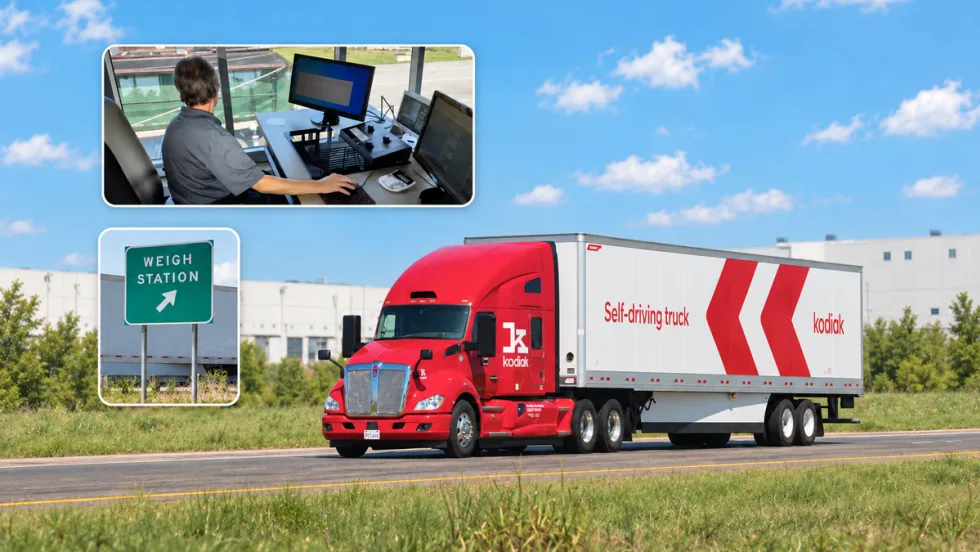
Kodiak has integrated HAAS Alert’s Safety Cloud platform into its autonomous vehicle control system to send real-time digital hazard alerts to nearby motorists.
Read More →