





Related: 3 Reasons AV Fleets Will Proliferate Private Sites First
Plus.ai and MnDOT Announce Autonomous Truck Winter Driver Trials
Autonomous truck developer Plus.ai has partnered with the Minnesota Department of Transportation to evaluate how autonomous trucks perform in harsh winter driving conditions.
October 14, 2019
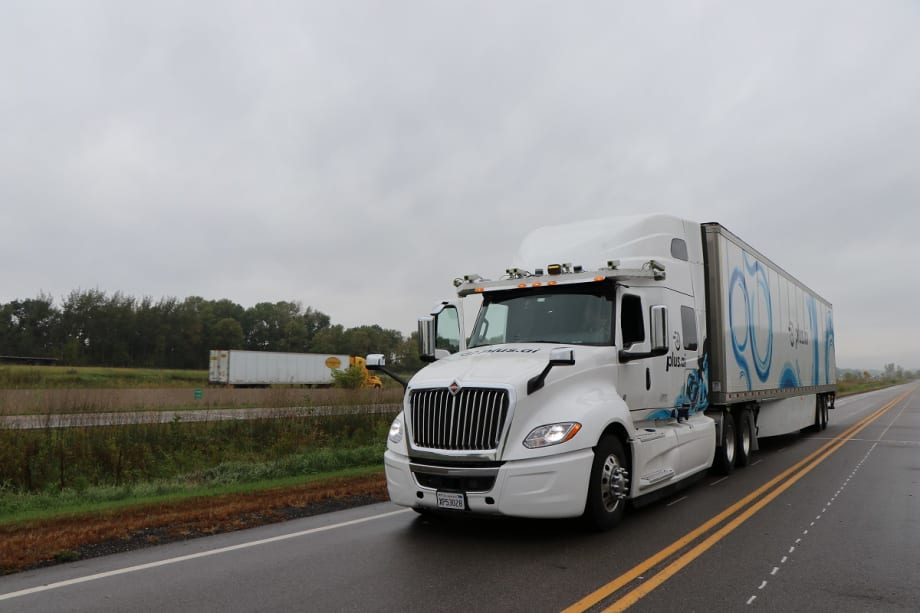
Autonomous technology developer Plus.ai is working with the Minnesota Department of Transportation to evaluate how self-driving trucks perform in harsh winter weather.
Photo courtesy Plus.ai
3 min to read
Can anything stop the advance of autonomous trucks? It turns out that Old Man Winter might just be able to.
Winter throws a constant barrage of sleet, snow, ice and fog and trucks. And currently those wintery mixes are more than enough to confound the camera and lidar systems autonomous trucks depend on to operate safely.
Obviously, working out better systems for winter operations is going to be critical for the success of autonomous trucks. And what better place to take the problem head-on than Minnesota? That must be the thinking at autonomous truck developer Plus.ai, which just announced a partnership with the Minnesota Department of Transportation (MnDOT), to evaluate autonomous driving performance in some of the country’s harshest winter weather.
The agreement is Minnesota’s first partnership with an autonomous trucking company to test on MnDOT’s MnROAD cold-weather pavement testing facility. Goals include information sharing between Plus.ai and MnDOT around self-driving truck performance in the toughest winter conditions, in order to inform public policy discussions.
“Commercializing Plus.ai’s self-driving trucks requires preparing them to drive in all climates, including the toughest winter road conditions that Minnesota experiences,” said Shawn Kerrigan, COO and Co-founder, Plus.ai. “We are thrilled with this public-private partnership with the Minnesota Department of Transportation to test and harden our autonomous trucks for extreme weather, as well as to support public policy and infrastructure considerations that pave the way for self-driving trucks
“As automation and emerging transportation technology evolve, the Minnesota Department of Transportation understands how critical it is to collaboratively share information and expertise with partners like Plus.ai,” added Kristin White, Executive Director of MnDOT’s Office of Connected and Automated Vehicles. “Learning how these vehicles operate in winter weather helps Minnesota advance safety innovation for everyone in the transportation system.”
According to MnDOT, a key benefit driving autonomous truck development is increased safety. The agency noted that large truck fatalities in the U.S. rose to an all-time high of 4,761 fatalities in 2017. In 2018, Minnesota saw 4,623 truck-involved crashes, according to the Minnesota Department of Public Safety. Winter weather is particularly challenging: Snowy, slushy or icy winter road conditions are responsible for vehicle accidents that kill over 1,300 people and injure more than 116,800 people every year, according to the U.S. Department of Transportation. More than 70 percent of U.S. roads are located in regions that experience snow.
Plus.ai said that testing in Minnesota with the assistance of MnDOT will allow its engineers to better understand how winter conditions affect the movement of its trucks in adverse conditions. Winter conditions are tough to handle for all vehicles, and snow is particularly challenging for trucks, which can weigh up to 80,000 pounds. The testing will begin with mapping the MnROAD closed test track, followed by rigorous performance testing of Plus.ai’s self-driving trucks.
More Safety & Compliance
PrePass, Kodiak Connect Driverless Trucks to Roadside Enforcement
The system will allow enforcement agencies to verify Enhanced Inspection information and decide whether Kodiak’s autonomous trucks can bypass roadside screening sites.
Read More →
From One Generation to the Next: How Mentorship Builds Safer Truck Drivers
After three decades in trucking, Harold Perry shares what he's learned about driver safety, mentorship, and helping the next generation build confidence behind the wheel.
Read More →
FMCSA Pauses Biennial-Update Enforcement Amid Motus Transition
Carriers whose updates were due on or after June 1 have more time, while FMCSA works to stabilize its new registration system and warns of phishing sites impersonating its new carrier registration system, Motus.
Read More →
ZF Expands Commercial Vehicle Push in North America
ZF is expanding its North American commercial-vehicle presence with new transmission applications, electrification, trailer technology and autonomous-driving systems.
Read More →
Truck Drivers Need More Than Another Alert
Fleets have more visibility into truck health, safety events, and driver activity than ever. The next challenge is turning all that information into useful guidance for the person who has to decide what to do next.
Read More →
Tesla Wants a Self-Driving Semi. Are Cameras Enough?
Could Tesla’s camera-only autonomous driving technology work on an 80,000-pound Semi? In this commentary, HDT's Deborah Lockridge takes a look at Tesla, Cybercab, and how autonomous trucks see the road.
Read More →
What DOT’s Automated Vehicle Strategy Means for Trucking
The U.S. Department of Transportation issued a new automated-vehicle strategy that outlines plans for driverless-truck regulations, cross-state freight corridors, and federal safety standards.
Read More →
NYC Expands Speed, Pedestrian Safety Tech Across Fleet
New York City is expanding intelligent speed assistance and pedestrian-alert systems across its municipal fleet, moving the technologies from pilot programs into vehicle procurement and retrofit requirements.
Read More →
FMCSA Removes 110 Truck Driver Training Schools from Certified ELDT List
Federal regulators also are targeting more than 160 additional training providers and launching a nationwide audit of third-party CDL skills testers as part of a broader crackdown on trucking fraud.
Read More →
Beyond DOT Compliance: What Makes a Trucking Fleet Truly Safe?
A trucking fleet can follow every rule and still make unsafe decisions. The real test comes when safety conflicts with freight, productivity, or cost.
Read More →