





Related: Volvo Offers Sneak Peek of All-New Class 8 Electric Tractor
Volvo to Sell Electric Class 8 Truck in the U.S. by End of 2020
The battery-electric version of Volvo Trucks North America’s VNR Class 8 regional hauler— dubbed the EVNR-- is now slated “to go on sale at the end of 2020,” according to VTNA President Peter Voorhoeve.
October 7, 2019
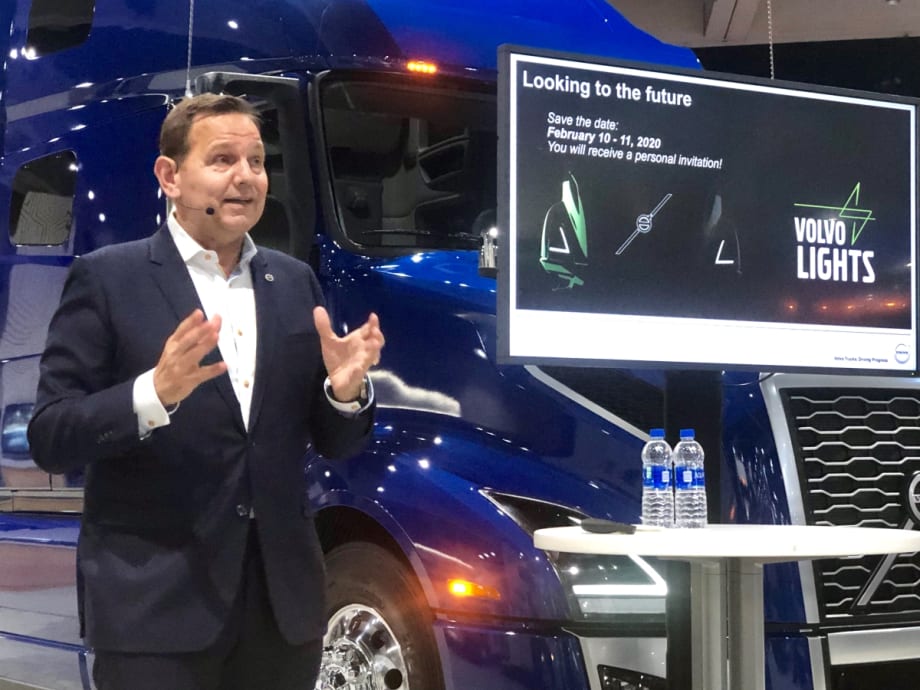
VTNA President Peter Voorhoeve said the rollout of the EVNR tractor will follow the company’s ongoing testing of battery-electric trucks with two California-based fleets.
Photo: David Cullen
5 min to read
The battery-electric version of Volvo Trucks North America’s VNR Class 8 regional hauler— dubbed the EVNR— is now slated “to go on sale at the end of 2020,” announced Peter Voorhoeve, the OEM’s president, at an Oct. 6 press conference at the American Trucking Associations’ annual Management Conference and Exhibition in San Diego.
“The future,” he said, “is happening today.” Voorhoeve said the EVNR launch will follow the company’s ongoing testing of battery-electric trucks with two California-based fleets as part of the Volvo Low Impact Green Heavy Transport Solutions (Volvo Lights) development program it’s conducting with California’s South Coast Air Quality Management District and over a dozen industry partners.
Most of the funding for the $90 million project is coming from the California Air Resources Board with about $4 million also coming from the SCAQMD.
Once the EVNR hits the market, it will “in the beginning be aimed at local and regional distribution fleets and for [short-haul] drayage operations,” Johan Agebrand, VTNA’s director of product marketing, told HDT.
VTNA did not release any further details on the EVNR’s specs, but at a September press event it stated that the truck has a conventional Volvo I-Shift automated transmission optimized for electric powertrains and uses large battery packs mounted on the frame rail ahead of the drive tires.
Turning to other advanced technology, Voorhoeve pointed out that Sweden-based Volvo Group all told now has “a million connected assets operating, including 560,000 Volvo trucks, with 200,000 of those operating in the U.S., Canada, and Mexico.
“Connectivity is how we secure more uptime,” he continued. “And along with better maintenance of vehicles, we also can drive sustainability.”
Voorhoeve took a few minutes to emphasize how the global OEM views this marketplace. “Volvo is a Swedish-originated brand. North America is our second-home market— and the largest market in which we sell trucks.”
As for the immediate prospects, he estimates that 2019 will finish with 325,000 new Class 8 truck orders in North America. Voorhoeve noted that he “sees the strong labor market and consumer spending as still driving GDP growth” in the U.S., although he allowed that overall economic growth here is “slowing down and that affects confidence.”
Voorhoeve reported that Volvo’s market share, August year to date, is up slightly from 13.5 to 13.9 in Canada; up more significantly in Mexico from 1.9 to 3.2; and down in the U.S. from 10.7 to 9.7, which he attributed to “starting a bit slow at the start of the year.”
'Taking It to the Next Level'
Looking ahead, he said the OEM is focusing on “taking it to the next level through our guiding principle of customer service.” He highlighted the fact that VTNA has already made “a decade of substantial investments in our dealer network,” which now numbers 435 locations. “Plus, there are the investments made by dealers themselves,” he added, noting that one dealership recently opened a 100-bay facility, vs. the typical high number of 30 bays.
In addition, Voohoeve pointed to the $400 million being invested over six years to expand and upgrade its New River Valley, Virginia, assembly plant. He noted that the project is being done “partly to have a place to build electric trucks” and will lead to over 700 new jobs at the plant.
“Our trucks are proudly assembled in the U.S.A,” he said, adding that they are “really ‘made in the U.S.A. if you take into account their entire manufacturing process.”
Voohoeve said the company is also continuing to invest in its centralized Uptime Center, pointing out that its staff can “see virtually whatever is going on with [customer] trucks wherever they are” and can provide over-the-air reprogramming of connected components, including changing the shift patterns of its I-Shift automated manual transmissions to match new duty cycles.
“The truck is no longer a mechanical box,” he remarked, “it’s a high-tech environment.”
VTNA also announced at the press conference that it has partnered with telematics provider Geotab to offer an integrated electronic logging device solution for all Volvo-powered trucks of model year 2015 and newer.
The solution couples Volvo’s factory-fit telematics device with Geotab’s ELD application and uses a cloud-based system for more reliable data capture and delivery, compliance with Federal Motor Carrier Safety Administration regulations, and full compatibility with Android and iOS platforms.
Accessing ELD data through the MyGeotab portal enables fleet managers to keep track of fleet compliance with real-time data insights through a user-friendly interface where they can view detailed reports on driver logs, violation alerts and running reports on the status of the fleet, among other things.
Geotab Drive for Volvo Trucks’ cloud-based system provides customers with more reliable ELD data-capture capabilities. Reliable and robust, this solution helps to keep HOS data safe and secure, and avoids potential pitfalls associated with other solutions that are hardwired, require pairing, or ask drivers to download data records onto a USB, according to VTNA.
Volvo Trucks began partnering with Geotab in 2016 to improve telematics capabilities in its trucks. The OEM’s onboard telematics hardware ties in with Geotab’s ELD platform for “the most seamless and efficient solution possible,” noted VTNA’s Agebrand.
VTNA’s sister company Mack Trucks separately announced at the ATA meeting that it is rolling out Geotab Drive for Mack Trucks. “Mack Trucks is pleased to work with Geotab to use existing cloud-based technology for reporting ELD information and helping fleets ensure they are maintaining driver hours of services compliance,” said David Pardue, vice president of connected vehicle and contract services, in a news release.“ Cloud-based data reporting simplifies the process for customers, and because it does not require them to purchase a new ELD device or for them to be reliant on hardware devices or a wireless connection, it makes data collection more reliable.”
Pardue added that the telematics device, factory-installed in every Mack vehicle, sends engine data and positional data to the cloud, which then generates automatic duty status logs. A driver can choose to enter duty status logs manually through the Geotab Drive app on a mobile device, which will then be consolidated into an accurate record of duty status.
More Fuel Smarts

How Volvo Updated Its D13 for EPA 2027 [Watch]
Volvo’s updated D13 promises lower emissions without sacrificing performance or fuel economy. Take a closer look at what changed inside the engine in this HDT Spotlight video.
Read More →
Diesel Price Spike Shortens Payback for Natural Gas Trucks, Report Says
Energy Vision estimates fleets could recover the higher purchase price of an RNG-fueled Class 8 tractor in 1.3 to 2.8 years under current fuel-price scenarios.
Read More →
Calstart Becomes Catalyst Mobility, Reflecting Broader Focus
Calstart is now Catalyst Mobility, reflecting the nonprofit’s growing national role in clean transportation, including zero-emission trucks, infrastructure and incentive programs.
Read More →

Record Diesel Prices Squeeze Trucking Fleets
Average U.S. diesel prices have climbed to nearly $6 a gallon, surpassing the 2022 record as tight refinery capacity and Middle East disruptions keep fuel costs elevated.
Read More →
Sponsored•September 9, 2026
How Fuel Delivery Shapes Engine Performance
Fuel delivery depends on more than what happens at the injector. For fleet, maintenance and technical professionals, looking at the full path from pump to injector can provide useful context for understanding engine performance.
Read More →
East Coast Port Launches $45M Electric Truck Push
The Port Authority of New York and New Jersey announced millions in incentives for zero-emission drayage trucks, yard tractors, and new charging hubs near the port.
Read More →
California Bill Could Shed Light on Electric Truck Prices
Why do battery-electric Class 8 trucks remain so expensive? A California bill headed to Gov. Gavin Newsom would give fleets and state agencies more visibility into what manufacturers charge.
Read More →
Detroit Opens Orders for EPA 2027 Engines
Detroit isn’t starting from scratch to meet EPA 2027 diesel emissions standards. Its Gen 6 DD13 and DD15 engines keep much of today’s platform while updating the fuel and aftertreatment systems.
Read More →
Zero-Emission Truck Corridor Planned for West Coast
California, Oregon, Washington, British Columbia and Baja California are coordinating plans for truck charging and hydrogen fueling from Canada to Mexico.
Read More →
A Closer Look at Kenworth’s Electric T880E Vocational Truck [Video]
Learn more about Kenworth's T880E battery-electric vocational truck at the Paccar Technical Center, including its range, applications, upfitting considerations, and PTO options, in this HDT Spotlight video.
Read More →