





Related: Amazon Targets Parcel Fees with New Delivery Network
FedEx Ending Ground Delivery Contract with Amazon
FedEx won’t renew its contract with Amazon for ground delivery when it expires at the end of the month, after letting its U.S. air-delivery contract with Amazon run out earlier this summer.
August 7, 2019
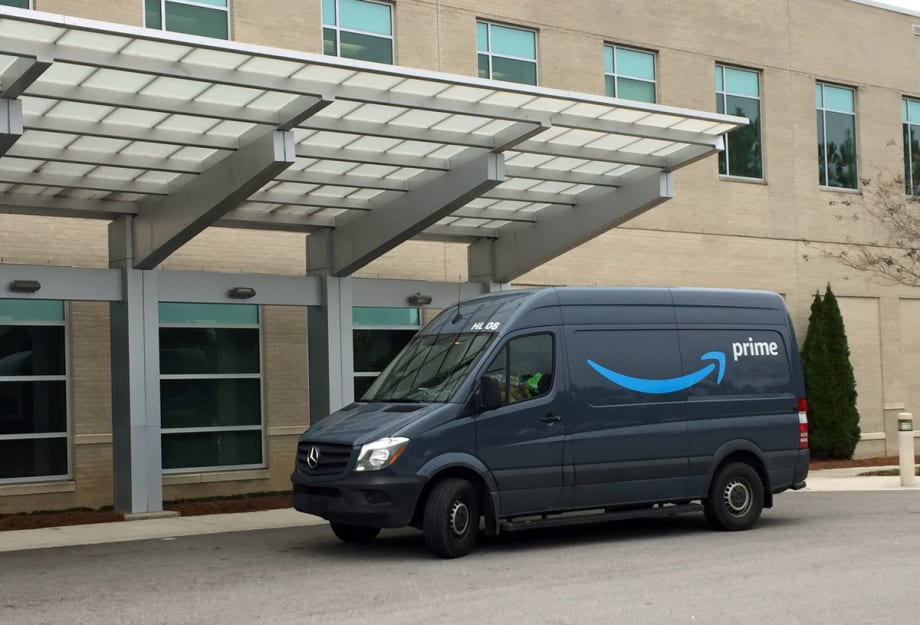
Amazon has been building out its own logistics and delivery network, leading some to view it as competition to companies such as UPS and FedEx.
Photo by Deborah Lockridge
3 min to read
FedEx won't renew its contract with Amazon for ground delivery when it expires at the end of the month, the parcel delivery company has announced.
Just two months ago, FedEx said it wouldn’t renew its U.S. air-delivery contract with Amazon. At that time, it said in a statement that it would be focusing on "serving the broader e-commerce market," with U.S. package volume from online shopping expected to double by 2026.
FedEx will still have a contract with Amazon for international deliveries. And Amazon still could use FedEx, but it wouldn't be under a contract that gives it discounted rates.
Responding to HDT’s request for comment on the ground-delivery decision, FedEx said in an e-mail, "This change is consistent with our strategy to focus on the broader e-commerce market, which the recent announcements related to our FedEx Ground network have us positioned extraordinarily well to do."
Customers such as Walmart and Target want to grow their own e-commerce businesses.
FedEx recently added Saturday ground deliveries and it will add Sundays next year to offer seven-day residential delivery domestically.
Amazon has been building out its own logistics network, with hundreds of fulfillment centers, leased jets for next-day air delivery, and its own contractor-based last-mile delivery fleet, which some have compared to the contractor-based ground unit at FedEx. An order for 20,000 Mercedes-Benz Sprinter cargo vans for the Delivery Service Partner program are scheduled to be delivered by the end of 2019.
It’s also still developing drones for last-mile delivery and it’s even testing an autonomous delivery robot.
When asked to comment on the FedEx move, Amazon replied in an e-mail, "We are constantly innovating to improve the carrier experience, and sometimes that means reevaluating our carrier relationships. FedEx has been a great partner over the years and we appreciate all their work delivering packages to our customers."
The Wall Street Journal reports that Amazon will redistribute packages among its other carriers and its own network and doesn't expect disruptions to its new Prime one-day shipping speeds.
"It's not unexpected, because Amazon is building its own infrastructure, from air to long haul to last mile," said Wally Stegall, technical fellow at Morey. "FedEx has been pulling away for some time because Amazon is bypassing FedEx, USPS, UPS, and others. More carriers are starting to follow the Amazon model."
Nic Farhi, partner in global strategy consulting firm OC&C Strategy Consultants, predicts the move will cost FedEx in the short term, as the Amazon package volume comes out of their fixed-cost system – although timing it around the holiday season peak will mitigate that effect until 2020.
"In the long run, we think this is a smart strategic move," Farhi said. "Amazon’s huge investment in last mile fulfillment enables very rapid delivery, which consumers love. Any retailer unwilling to piggyback off Amazon’s last mile, which is almost any larger retailer, desperately needs an alternative which can compete on speed, and FedEx is a logical partner."
More Fleet Management

Sponsored•September 16, 2026
Color Match Smarter: Tools That Restore & Perform
For fleet managers and collision repair professionals keeping heavy-duty trucks on the road, getting the color right the first time isn't just about appearance — it's about efficiency, turnaround time, and bottom-line results. Discover how today's digital color tools are transforming the repair process from guesswork to precision.
Read More →
FMCSA Pauses Biennial-Update Enforcement Amid Motus Transition
Carriers whose updates were due on or after June 1 have more time, while FMCSA works to stabilize its new registration system and warns of phishing sites impersonating its new carrier registration system, Motus.
Read More →
Sponsored•September 14, 2026
2026 Blueprint for Countering Smarter Supply Chain Theft
Cargo theft is no longer just the cost of doing business. It's a multi-billion-dollar criminal enterprise exploiting vulnerabilities across your fleet, drivers, and supply chain.
Read More →


Sponsored•September 1, 2026
How Telematics Improves Visibility, Control, and Performance in Refrigerated Fleets
Explore how telematics help refrigerated fleets improve visibility, uptime, efficiency, compliance, and cargo protection across connected cold chain operations.
Read More →
What the U.S.-Canada Trade War Means for Trucking
Escalating U.S.-Canada tariffs could disrupt cross-border freight, reduce truck volumes, raise costs, and create new uncertainty for carriers on both sides of the border.
Read More →
What Are Trucking’s Top Concerns for 2026?
The American Transportation Research Institute wants to know what's worrying trucking fleet managers, drivers, and other stakeholders in its annual Industry Issues survey.
Read More →
American Trucking Associations Looks for a New Leader
ATA President and CEO Chris Spear abruptly left his job at the association on August 21, at a pivotal time for the trucking industry.
Read More →
Public Wi-Fi Cybersecurity Risks: How Truck Drivers and Fleets Can Protect Their Data
Public Wi-Fi can expose truck drivers and fleets to credential theft, malware, and other cyber threats. Here’s how to reduce the risk on the road.
Read More →
For Nicky Cupp, Fleet Innovation Starts With Frustration
HDT Truck Fleet Innovator Nicky Cupp turns everyday pain points at Fraley & Schilling into opportunities for better technology and smarter processes.
Read More →
Adam Buttgenbach’s Approach to Electric Trucks: Start With Where They Fit
HDT Truck Fleet Innovator Adam Buttgenbach helped PepsiCo build one of North America’s largest EV fleets by focusing on where electric trucks make operational sense.
Read More →