




Amazon's Latest Drone Design Aims for 30-Minute Deliveries
Amazon unveiled its latest drone design at the company’s re:MARS Conference that is capable of delivering packages to customers in less than 30 minutes, though it's not certain exactly when they will be deployed in the real world.

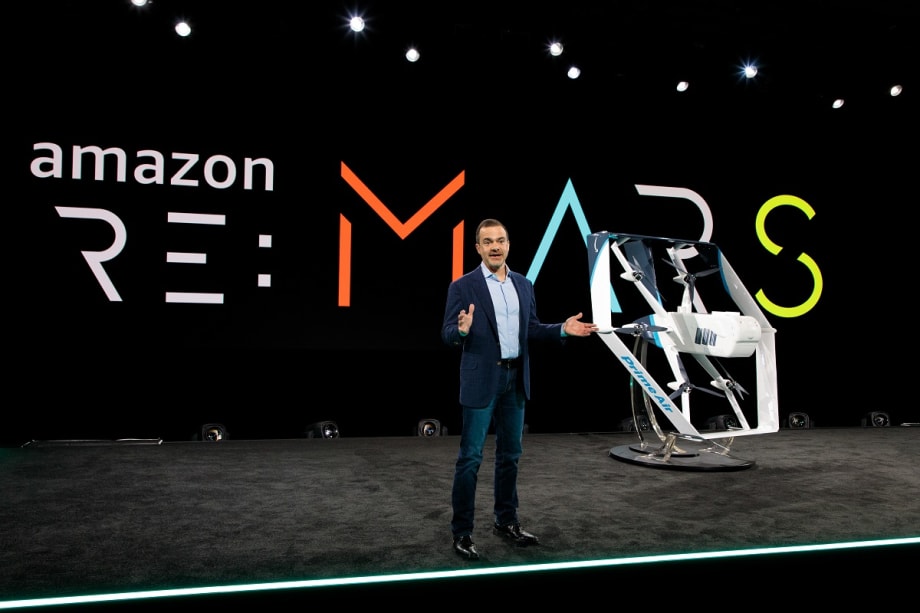
Amazon's latest drone design aims to be capable of delivering packages weighing up to five pounds for distances of 15 miles.
Photo via Amazon
Amazon unveiled its latest drone design at the company’s re:MARS (Machine Learning, Automation, Robotics and Space) Conference that is capable of delivering packages to customers in less than 30 minutes.
In its drone design, Amazon has been working towards creating a machine that can fly up to 15 miles on a charge and deliver packages under five pounds to customers within a 30-minute time window.
To accomplish this, the new drone has advanced features for better efficiency, stability and safety. The drone is capable of vertical takeoffs and landings but has aerodynamic properties of a fixed wing aircraft. The blades are fully shrouded, both for aerodynamic efficiency and safety.
With artificial intelligence capabilities, the drone is able to prevent collisions with objects and adjust to environmental changes automatically. It can identify both static and moving objects coming at it from any direction using sensors and advanced algorithms that gives the drone a full 360-degree, three dimensional view of its surroundings.
The drone is also better able to detect wires in low-altitude flight, especially useful for navigating neighborhoods and yards. The drone will not land if people, animals or obstacles enter into its intended landing zone.
Amazon gave no concrete details about when or if it planned to start using the drone in real-world operations, but in a Verge article Amazon’s consumer worldwide CEO Jeff Wilke said that it would be seen delivering packages to customers in a matter of months.
The Federal Aviation Administration granted the e-commerce giant approval to test its drone delivery in 2015 but so far it is not certain when the company will gain the necessary certification to use it in regular package delivery.
More Fleet Management

Color Match Smarter: Tools That Restore & Perform
For fleet managers and collision repair professionals keeping heavy-duty trucks on the road, getting the color right the first time isn't just about appearance — it's about efficiency, turnaround time, and bottom-line results. Discover how today's digital color tools are transforming the repair process from guesswork to precision.
Read More →
FMCSA Pauses Biennial-Update Enforcement Amid Motus Transition
Carriers whose updates were due on or after June 1 have more time, while FMCSA works to stabilize its new registration system and warns of phishing sites impersonating its new carrier registration system, Motus.
Read More →
2026 Blueprint for Countering Smarter Supply Chain Theft
Cargo theft is no longer just the cost of doing business. It's a multi-billion-dollar criminal enterprise exploiting vulnerabilities across your fleet, drivers, and supply chain.
Read More →


How Telematics Improves Visibility, Control, and Performance in Refrigerated Fleets
Explore how telematics help refrigerated fleets improve visibility, uptime, efficiency, compliance, and cargo protection across connected cold chain operations.
Read More →
What the U.S.-Canada Trade War Means for Trucking
Escalating U.S.-Canada tariffs could disrupt cross-border freight, reduce truck volumes, raise costs, and create new uncertainty for carriers on both sides of the border.
Read More →
What Are Trucking’s Top Concerns for 2026?
The American Transportation Research Institute wants to know what's worrying trucking fleet managers, drivers, and other stakeholders in its annual Industry Issues survey.
Read More →
American Trucking Associations Looks for a New Leader
ATA President and CEO Chris Spear abruptly left his job at the association on August 21, at a pivotal time for the trucking industry.
Read More →
Public Wi-Fi Cybersecurity Risks: How Truck Drivers and Fleets Can Protect Their Data
Public Wi-Fi can expose truck drivers and fleets to credential theft, malware, and other cyber threats. Here’s how to reduce the risk on the road.
Read More →
For Nicky Cupp, Fleet Innovation Starts With Frustration
HDT Truck Fleet Innovator Nicky Cupp turns everyday pain points at Fraley & Schilling into opportunities for better technology and smarter processes.
Read More →
Adam Buttgenbach’s Approach to Electric Trucks: Start With Where They Fit
HDT Truck Fleet Innovator Adam Buttgenbach helped PepsiCo build one of North America’s largest EV fleets by focusing on where electric trucks make operational sense.
Read More →