





Related: EPA Green-Lights Audit of Controversial Glider Kit Emissions Study
Report Clears EPA 2017 Glider-Emissions Study
An audit by the Environmental Protection Agency’s independent Office of the Inspector General says the agency's testing of glider kit emissions, which found they produced significantly more emissions than new vehicles, “complied with standard practices.”
August 2, 2019
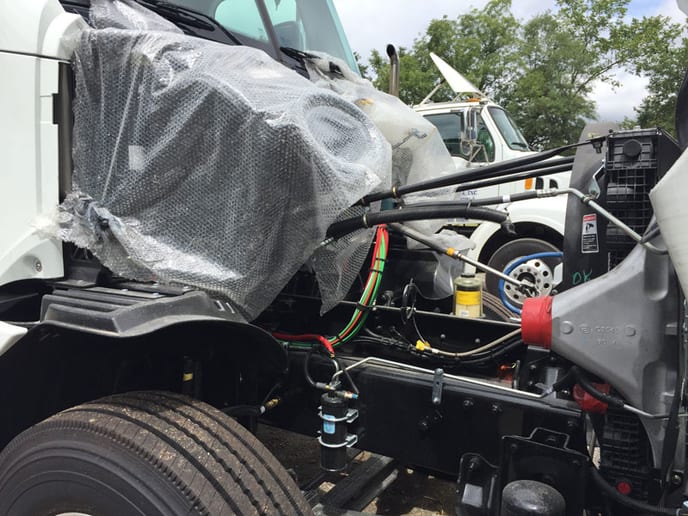
An audit by the U.S. Environmental Protection Agency’s independent Office of the Inspector General has found that the glider vehicle testing conducted by the agency “complied with standard practices.”
Photo: Deborah Lockridge
4 min to read
It took a while, but an audit by the U.S. Environmental Protection Agency’s independent Office of the Inspector General has found that the glider vehicle testing conducted by the agency, which found that glider-kit vehicle put out significantly more emissions than new trucks, “complied with standard practices.”
The OIG said on July 31 that the audit stemmed from Congressional requests made in the summer of 2018 that had “raised concerns about glider vehicle testing conducted by the EPA in 2017. In response to the congressional requests, the OIG conducted an audit to examine the selection, acquisition and testing of glider vehicles at the EPA’s National Vehicle and Fuel Emissions Laboratory, as well as the EPA’s planning for this testing.”
The testing that’s been at the heart of the controversy was part and parcel to the November 20, 2017, EPA report titled “Chassis Dynamometer Testing of Two Recent Model Year Heavy-Duty On-Highway Diesel Glider Vehicles.” The key finding of the testing was, per the EPA 2017 report, that “The NOx, CO, HC, and PM emissions from the glider vehicles were significantly higher than the newer model year tractors [tested against for comparison] over all cycles.”
Critics of the study alleged that Volvo Group had undue influence with some employees at the agency, provided glider kits for testing, and that the testing was done without the approval or knowledge of agency leadership.
“The IG report puts to rest the unfounded accusations from the glider industry that a truck OEM influenced the outcomes of the glider testing results by the EPA,” Glen Kedzie, environmental affairs counsel for the American Trucking Associations, told HDT.
“We’re pleased with the inspector general’s conclusion,” John Mies, vice president of corporate communications for Volvo Trucks North America, told HDT. “We’ve said all along that all of our communication and cooperation with the EPA on this issue was entirely appropriate and part of a broad trucking industry advocacy effort.”
Glider kits have been around for decades and were originally were designed to allow refurbishing wrecked vehicles. But they gained popularity as a way for truck owners to avoid early-generation low-emissions engines that were plagued with maintenance problems and reduced fuel efficiency.
A proposed loophole
A proposal to allow a glider kit loophole to the greenhouse gas emissions /fuel economy regulations drew criticism from all sorts of stakeholders, including environmental groups, truck and engine makers, the American Trucking Associations, some large fleets such as FedEx and PepsiCo, two former EPA administrators, some state attorneys general, and some Democratic senators.
The back story to all the back and forth on glider kits dates all the way back to October 2016. That’s when EPA and the National Highway Traffic Safety Administration issued the final GHG/Fuel Efficiency Phase 2 rule. Among other things, this rule required engines in new “glider” vehicles to meet the emissions standards for the year the vehicle was assembled, rather than for the year in which the engine powering it was manufactured.
Then in July 2017, after glider kit-maker Fitzgerald Glider Kits petitioned the agency to do so, EPA announced it intended to revisit the glider kit provisions. In November, 2017, it issued its official rulemaking proposal, which sought to repeal emission requirements for glider vehicles, glider engines, and glider kits. That repeal proposal has yet to become a final rule.
Fitzgerald cited a separate study by Tennessee Tech saying the remanufactured engines used in glider kits performed as well as OEM engines certified under EPA emissions standards. That study has since been discredited, with the universiy saying some of the conclusions of its study of glider kit emissions were not accurate.
Audit results
What the just-released OIG audit report states is that “EPA’s selection and testing of the donated glider vehicles in 2017 was consistent with Clean Air Act authority, standard EPA practices, and relevant policies and procedures.”
And although the OIG found that EPA did not improperly attain glider-test comparison vehicles from Volvo Trucks North America to be used for the testing, the report does state that “EPA did not fully adhere to its delegation of authority related to the acceptance of donated property under the Clean Air Act” and should instead have made sure the process was “more transparent.”
The audit also determined that:
EPA employees followed normal procedures in submitting the November 2017 glider vehicle test report to a public rulemaking docket.
There was “no evidence that EPA staff deleted materials potentially responsive to Freedom of Information Act requests or records within the scope of our audit that were related to the EPA’s 2017 glider vehicle testing.”
There was also “no evidence that a former Office of Transportation and Air Quality Center Director violated ethics restrictions either while serving as a federal employee or post federal employment.”
The OIG noted that it also has an audit under way that’s related to the ongoing development of the EPA’s November 2017 proposed rulemaking to repeal glider emission requirements.
According to the OIG, it is a part of the EPA, but “Congress provides our funding separate from the agency, to ensure our independence.”
More Fuel Smarts

How Volvo Updated Its D13 for EPA 2027 [Watch]
Volvo’s updated D13 promises lower emissions without sacrificing performance or fuel economy. Take a closer look at what changed inside the engine in this HDT Spotlight video.
Read More →
Diesel Price Spike Shortens Payback for Natural Gas Trucks, Report Says
Energy Vision estimates fleets could recover the higher purchase price of an RNG-fueled Class 8 tractor in 1.3 to 2.8 years under current fuel-price scenarios.
Read More →
Calstart Becomes Catalyst Mobility, Reflecting Broader Focus
Calstart is now Catalyst Mobility, reflecting the nonprofit’s growing national role in clean transportation, including zero-emission trucks, infrastructure and incentive programs.
Read More →

Record Diesel Prices Squeeze Trucking Fleets
Average U.S. diesel prices have climbed to nearly $6 a gallon, surpassing the 2022 record as tight refinery capacity and Middle East disruptions keep fuel costs elevated.
Read More →
Sponsored•September 9, 2026
How Fuel Delivery Shapes Engine Performance
Fuel delivery depends on more than what happens at the injector. For fleet, maintenance and technical professionals, looking at the full path from pump to injector can provide useful context for understanding engine performance.
Read More →
East Coast Port Launches $45M Electric Truck Push
The Port Authority of New York and New Jersey announced millions in incentives for zero-emission drayage trucks, yard tractors, and new charging hubs near the port.
Read More →
California Bill Could Shed Light on Electric Truck Prices
Why do battery-electric Class 8 trucks remain so expensive? A California bill headed to Gov. Gavin Newsom would give fleets and state agencies more visibility into what manufacturers charge.
Read More →
Detroit Opens Orders for EPA 2027 Engines
Detroit isn’t starting from scratch to meet EPA 2027 diesel emissions standards. Its Gen 6 DD13 and DD15 engines keep much of today’s platform while updating the fuel and aftertreatment systems.
Read More →
Zero-Emission Truck Corridor Planned for West Coast
California, Oregon, Washington, British Columbia and Baja California are coordinating plans for truck charging and hydrogen fueling from Canada to Mexico.
Read More →
A Closer Look at Kenworth’s Electric T880E Vocational Truck [Video]
Learn more about Kenworth's T880E battery-electric vocational truck at the Paccar Technical Center, including its range, applications, upfitting considerations, and PTO options, in this HDT Spotlight video.
Read More →