





Related: FMCSA Chief Martinez at ATA: Safety Better Served by Working With Industry
ATA Chief Spear Details Trucking Lobby’s Battle Plans
Trucking has “unfinished business in Washington” that must be achieved despite “our foes [who] continue to sow the seeds of distrust and mistruths, spreading their own narrative about our industry,” declared American Trucking Associations President and CEO Chris Spear in a rallying speech on Oct. 29 at ATA’s annual Management Conference and Exhibition in Austin, Texas.
October 29, 2018
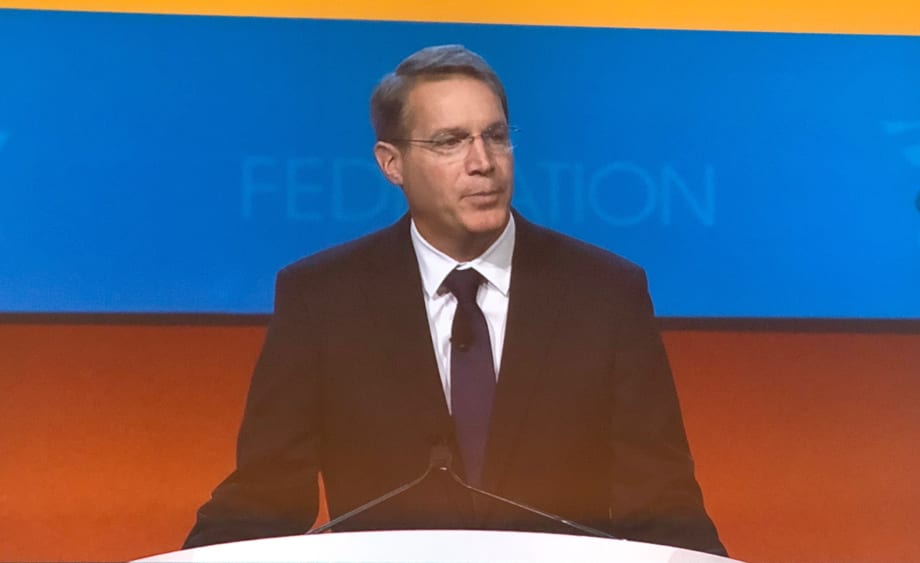
American Trucking Associations President and CEO Chris Spear speaks to attendees at ATA's 2018 Management Conference and Exhibition in Austin, Texas, on Oct. 29.
Photo: David Cullen
7 min to read
Despite continuing to benefit from federal tax reform and a booming economy, trucking has “unfinished business in Washington” that must be achieved despite “our foes [who] continue to sow the seeds of distrust and mistruths, spreading their own narrative about our industry,” declared American Trucking Associations President and CEO Chris Spear in a rallying speech on Oct. 29 at ATA’s annual Management Conference and Exhibition in Austin, Texas.
In his wide-ranging state of the industry address, Spear laid out the trucking lobby’s ongoing campaigns, including those to attain federal preemption of meal and rest break rules, push for hours-of-service reform, encourage infrastructure investment, secure further trade agreements, and drive adoption of workforce development policies.
Spear said ATA’s efforts over the past four years to legislatively resolve the issue of California’s right to set its own meal and rest rules for truckers “could be best described as trench warfare. Over four years, we’ve fought this California-born battle on Capitol Hill.”
He laid the blame for that squarely on Congress. “We’ve witnessed a nexus between lawmakers’ willingness to do their job and Congress becoming a sanctuary for obstruction.” He explained that “having exhausted every legislative option available,” last month ATA filed a petition with the Secretary of Transportationseeking preemption on the grounds that California’s meal and rest breaks impede federal safety standards.
“The sheer lack of available parking alone has forced our drivers to park in unsafe conditions, putting themselves and the motoring public at an elevated risk,” he argued. “Obstruction is no substitute for the truth. Approval of ATA’s petition will put safety first, preserve interstate commerce, and deliver justice on behalf of our industry. And I am confident that justice will soon prevail.”
Of ELDs and HOS
As for other hot regulatory action, Spear started off by calling “the ELD fight one of the toughest-fought battles. I’m proud of ATA for holding the line. The rule is now in effect and with less than one percent of drivers inspected being cited for not having an electronic logging device when required, hours of service violations have now reached an all-time low.”
With the ELD mandate under way (the grandfather clause allowing use of AOBRDs expires at the end of 2019), Spear declared “now is the time for the Federal Motor Carrier Safety Administration to make sensible changes to the federal HOS regulations.”
He pointed out that ELDs “make more data available than before, enabling ATA to advocate common-sense improvements to these rules and allowing us to tighten the reigns on detention time. Coupled with ATRI’s recent report on hours of service flexibility, we now have the tools to produce measurable results.”
Spear commended FMCSA Administrator Ray Martinez “for his leadership, his willingness to listen to our industry, and for acknowledging the need for flexibility. We look forward to helping his agency shape this outcome in the coming months.”
Spear made it plain that illicit drug use and impaired operation remain critical policy issues for all in trucking. “We’ve seen nine states and Canada legalize recreational marijuana, all while the nation fights the tragic spread of opioid use. This reality points again to our values and how this great industry can advocate a safe and drug-free workforce.” He said ATA is working with federal regulators to finally allow hair testing as an alternative to urinalysis for employment screening and is “calling on FMCSA to press forward with the Drug Clearinghouse and make sensible, corrective changes to CSA.”
Spear also noted that ATA and FMCSA are working together to further develop the Department of Transportation’s recently released 3.0 Automated Vehicle guidance. “Commercial vehicles have a say in this debate, where improvements in safety, efficiency and productivity can accelerate voluntary adoption of driver-assist technologies,” he stated.
On trade, he said that “ATA has been at the table on trade educating negotiators on how 76% of NAFTA freight relies on trucking.” He commended President Trump and U.S. trade negotiators for reaching an agreement with Mexico, one that “holds U.S. investments in Mexican trucking companies harmless,” and reaching terms with Canada. He said the new US-Mexico-Canada Agreement will govern nearly $1.2 trillion in trade that will “bring certainty to our industry and the American economy—and allow this administration to now fully focus on reaching new agreements with Europe and China.”
The Year for Infrastructure
Turning to the still dismal state of the nation’s highway infrastructure, Spear said ATA is “now well-positioned for an infrastructure debate, which we expect to occur in 2019.” He did not elaborate as to whether lawmakers on Capitol Hill will be more likely to come together on infrastructure funding next year, but he did say that “the premise of our Build America Fund [initiative] now has the support of the business community, including the U.S. Chamber of Commerce, as the most conservative and immediate way to fund and fix our nations’ ailing roads and bridges.”
The ATA initiative calls for a 20-cent user fee to be collected on wholesale purchases of motor fuel to pay for repairs and improvements.
“The Build America Fund is real money, not fake funding like P3s [public-private partnerships] and asset recycling,” said Spear, the latter referring to adding tolls to highways. “Our proposal is less than 1 cent on the dollar to administer, shores up the near-broke Trust Fund, and doesn’t add a dime to our nation’s deficit. Name one proposal that does all that; I’m all ears. Fact is, the Build America Fund is the only true fix, putting real money on the table.”
Stating that “this debate couldn’t come at a more critical time, Spear said, “Congress must have the courage to vote in favor of funding their constituents’ roads and bridges. It’s our responsibility to remain engaged… and hold our elected officials accountable. If we’re going to win this fight, we have to accept it for what it is-- a full contact sport.”
He added that when it comes to highway funding, ATA’s “voice is not only being heard on Capitol Hill, but in the courts. This year, ATA and three carriers filed suit in U.S. District Court against the State of Rhode Island, arguing that the state’s truck-only tolls are unconstitutional.”
Noting that ATA has an “obligation to flank our state association executives and protect the federation from flawed, and potentially contagious tolling policies that could eventually have national implications,” he said ATA intends to “ramp up its Litigation Center and leverage our full ability to influence outcomes.” He added: “I’ve told our legal team to bring me targets.”
Younger Drivers at the Wheel
Last but certainly not least, Spear also addressed trucking’s chronic worker shortages. “With a strong economy, our industry’s challenges just got bigger. The chronic driver and technician shortage is now top-fold, national news-- fueled by consumer confidence, a well above-average retirement age, and erroneous claims that our trucks will soon be driverless,” he said. “Beyond the goodwill that comes from engaging our nation’s youth, the fact is we also need to attract the next generation of drivers and technicians.”
Spear devoted a large stretch of his speech to advocate for allowing 18-year-olds to drive commercial vehicles interstate. “Building on FMCSA’s pilot project that allows 18- to 21 year-olds with military truck driving experience to drive trucks as civilians in interstate commerce, ATA is advocating the Drive-Safe Act, ”which is a bipartisan proposal that would require 400 hours of on-duty, apprenticeship-based training, including 240 hours of drive-time with an accompanying experienced driver in the cab in order for an 18- to 21-year-old to operate across state lines.
“Moreover,” Spear stated, “all trucks used for training in this program would need to be equipped with safety technology, including active braking collision mitigation systems, a video event capture system, and a speed governor set at 65 mph or below. Despite all that, some of the so-called safety groups oppose this proposal outright.”
But, he asked rhetorically, “where were these same safety groups when 48 states passed laws allowing an 18-year-old to drive a commercial vehicle intrastate? Not one of these 48 states have all these training and technology requirements ATA is seeking at the federal level… We can no longer afford to wait until drivers come our way. We must be allowed to compete for the same talent as other industries, and teach them to safely and responsibly operate this equipment."
More Fleet Management

Why This Trucking Recovery Is Different
Freight demand remains sluggish, but rising costs and tougher enforcement have taken enough capacity out of the market to change the outlook for motor carriers.
Read More →
Platform Science Adds Dispatch and Safety Tools
Four additions to PS Fleet help fleets monitor loads, manage driver coaching, share truck locations and adjust video system settings.
Read More →
PrePass Intelligence Mines Fleet Bypass, Toll and Safety Data
PrePass Intelligence helps fleets measure bypass savings, flag potential toll overcharges, and spot suspicious transactions by combining data from separate systems.
Read More →
Motive Adds AI Agents for Fleet Operations
New tools automate follow-up on fleet data, from maintenance work orders to driver alerts, with two-way voice conversations planned for later this year.
Read More →
Can You Beat Our Trucking Trivia Challenge?
Test your truck knowledge with 19 trivia questions from Heavy Duty Trucking Exchange. Can you keep up with the fleet pros?
Read More →
BeyondTrucks Adds Rules Checks to Dispatch
New Compatibility Engine checks driver qualifications, equipment requirements and fleet policies before loads are dispatched.
Read More →
Diesel Prices Hijack Trucking’s Worry List
ATRI’s annual survey finds cautious optimism about freight, but diesel costs, litigation, and insurance continue to squeeze fleets. Drivers have different priorities on several issues.
Read More →
Nomination Deadline Extended for HDT Emerging Leaders
Just a few more days to nominate accomplished trucking fleet professionals under 40 who are making an impact and helping lead the industry forward for the HDT Emerging Leaders award. Deadline extended to October 20!
Read More →
What Will ATA’s New Leader Bring to Trucking's Table?
Incoming President and CEO Mark Colson’s record in Alabama offers clues about his priorities and approach following Chris Spear’s abrupt departure as the head of the American Trucking Associations.
Read More →
Volvo, Waabi Start Commercial Autonomous Operations in Texas
Volvo VNL Autonomous trucks, powered by the Waabi Driver, are hauling freight directly to third-party facilities for a customer in Texas.
Read More →