




How GHG Phase 2 Will Change the Way You Spec Trucks
Faced with compliance pressures, truck makers will be pushing technologies that promote fuel efficiency — even if it’s something fleets don’t want.

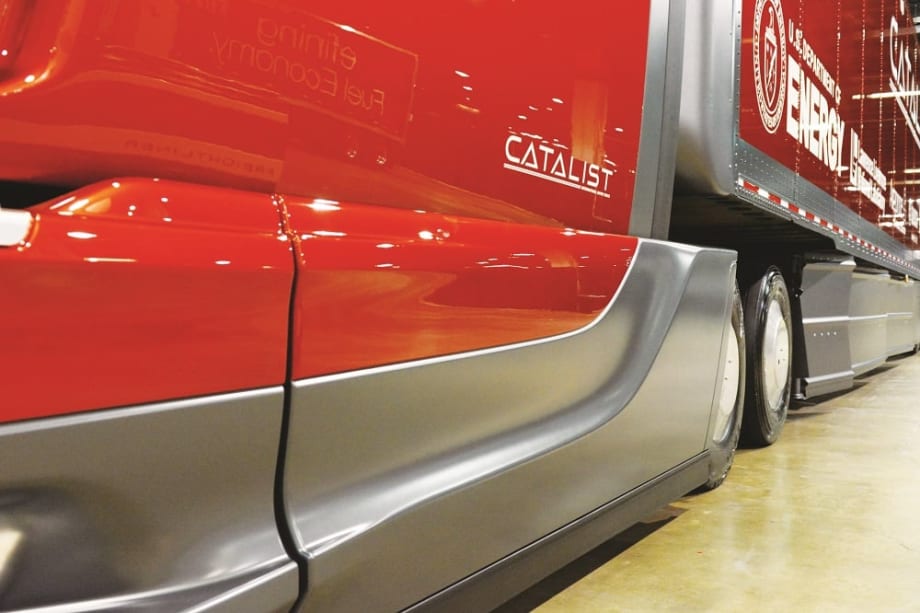
Advanced aerodynamics, as seen on SuperTrucks such as Navistar’s Catalist, will be top picks to help OEMs meet the on-highway GHG reduction requirements.
Photo: Jim Park
Model-year 2021 trucks will be on the road about 24 months from now. These will be the first medium- and heavy-duty trucks covered by the second phase of a comprehensive set of standards jointly adopted by the U.S. Environmental Protection Agency and the National Highway Traffic Safety Administration to reduce greenhouse gas emissions and improve fuel efficiency.
Those rules will change the way fleets spec trucks.
Finalized in August 2016, the second phase of the rule builds on Phase 1 regulations and increases the stringency of engine and vehicle CO2 standards in MY 2021, 2024, and 2027. By 2027, the new standards will have reduced CO2 emissions and fuel consumption compared to Phase 1 by up to 25% for tractors (including the engine efficiency improvements), up to 24% for vocational vehicles, and up to 16% for heavy-duty pickup trucks and vans.
The regulation requires certification at a vehicle level as well as at the engine level. To meet the Phase 2 regulations, manufacturers will need to integrate the right combination of technologies across the entire vehicle. By using the EPA’s Greenhouse Gas Emissions Model tool, manufacturers can simulate all the parameters of the powertrain to see which combinations will meet the regulations.
“The GEM tool simulates both powertrain attributes, such as engine fuel efficiency, predictive cruise control, axle ratio, etc., and vehicle attributes, such as aerodynamics and tire rolling resistance,” explains Andrea Best, Cummins’ on-highway product manager. “The GEM tool not only helps manufacturers meet the Phase 2 regulations, but also helps customers configure a more efficient vehicle.”
According to Darren Gosbee, Navistar’s vice president of engineering, truck makers will face pressure from customers to build the truck they want — but they could also be constrained in what they can offer by the need to comply with the regulation’s corporate average GHG number.
“The fate of our corporate average GHG number lies in our customers’ hands, but we still have to comply with the corporate average number,” says Gosbee. “That means we have to control either the option mix that the customers select, or the GHG number for the options that they could potentially select. Under the worst-case scenario, OEMs could require that certain options be selected on a vehicle even if the customer doesn’t want them. It’s like a selection chart. You tick off what you want, that generates a number, and that number goes into our corporate averaging algorithm.”
Customers wanting the classic styling of a long-nose conventional will still be able to buy one (depending on the OEM) but will be, in Gosbee’s words, “highly discouraged” from buying such a truck.
Mack Trucks Director of Product Strategy Roy Horton says the credit system is not meant to eliminate truck models. Each OEM has to maintain a positive credit balance or they will have to take corrective actions, which could include penalties of up to $37,000 per non-compliant truck. On-highway specs will produce a high percentage of credit-generating vehicles, so most OEMs will be able to afford to sell a few credit-debiting vehicles.
“It’s in the OEMs’ best interest to push the aero features, but I don’t see anyone being talked out of the truck they want to buy,” Horton says. “The highway guys will want most of the aero options, but some, like flatbed haulers, for example, might steer away from things like tall sleepers and chassis fairings and that sort of thing. Some options just won’t work in certain applications. OEMs will find ways to incentivize certain features to help drive the market toward the more efficient technologies.”
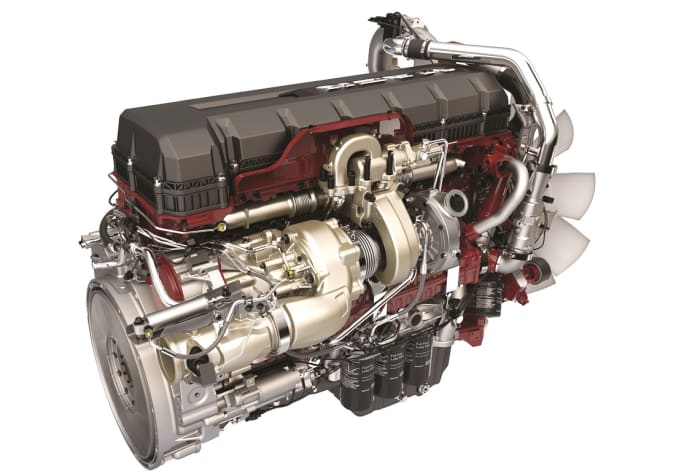
Advanced technologies such as waste heat recovery will play a role in 2021 and beyond. It’s already available in some products, such as the turbo-compound option offered by Mack and Volvo.
Photo courtesy Mack Trucks
Engine and vehicle standards
The GHG Phase 2 regulations contain specific standards for both the engine and the vehicle, and they are further divided into three application classes: tractors, vocational trucks, and heavy-duty pickup trucks and vans (or medium-duty trucks.)
On the engine side, OEMs will be working to improve combustion efficiency as well as the gas exchange process (how efficiently you get the outside air into the combustion chamber and back out again). They’ll also work to reduce parasitic or friction losses within the engine (oil and water pumps, engine gear train, piston rings, etc.).
Fleets can look forward to advancements such as high-efficiency turbochargers; low-restriction aftertreatment systems, EGR coolers, and charge-air coolers; and low-restriction intake and exhaust ports in the cylinder heads; low-friction bearings, piston rings, etc., as well as material surface treatments to reduce friction between moving parts.
“Volvo does not see any big technological shift [with GHG Phase 2] versus today’s engine technology for 2021 at least,” says Johan Agebrand, Volvo Trucks director of product marketing. “Some manufacturers may have to do something to meet ’24 and ’27, probably in the waste heat recovery side. We already have that in our turbo-compound option.”
Such improvements to engines will apply across the board, with all manufacturers trying to optimize their engines — on-highway, vocational and medium-duty — to meet the regulations.
The vehicle side will be equally challenging, especially for the vocational and medium-duty domains.
For one thing, aerodynamics will be a big credit-generator for on-highway vehicles, but they’re meaningless for the other categories, because those trucks don’t spend enough time above 50 mph. For vocational and medium-duty, it’s about weight reduction, reducing parasitic losses, and maximizing drivetrain efficiency. OEMs will be leaning toward low-rolling-resistance tires and tire pressure monitoring systems, high-efficiency axles and powertrain enhancements.
“Mild hybridization is going to be the big area that we’ll see in the medium-duty environment,” says Gosbee. “Energy recovery and more efficient electric technology is what is going to help medium-duty get to the GHG number, and transmissions will factor in as well.”
It comes down to the relative efficiencies of torque-convertor automatics vs dual-clutch automated vs. manual with direct or overdrive gearing. Manual is most efficient but the least popular in medium-duty, Gosbee says.
How much will all this cost?
All the changes coming our way between 2021 and 2027 are of course targeted at lowering GHG emissions and improving fuel efficiency. The changes will add cost to the vehicle, but all the OEMs we spoke with agreed that the fuel savings will offset the cost.
“Customers can spec their trucks to best meet the needs of their particular application, and in doing so will achieve real-world fuel economy savings which will enable us to meet the GHG Phase 2 regulations,” says Kary Schaefer, general manager, Freightliner and Detroit product marketing and strategy.
At least this time around, there’s enough flexibility in the regulation that OEMs will be able to target technologies that better suit the application.
“Of course, matching efficient technologies to customer needs is critical,” says Cummins’ Best. “Technologies that benefit a long-haul heavy-duty truck may not be the right solutions for stop-and-go medium-duty trucks and buses.”
Two years isn’t a long time in terms of vehicle technology evolution, and with the pressure of compliance penalties for OEMs, you can bet they are busy today drawing up specifications for trucks covered by GHG Phase 2.
Related: Avoid Headaches by Spec'ing the Right Truck
More Equipment

How Volvo Updated Its D13 for EPA 2027 [Watch]
Volvo’s updated D13 promises lower emissions without sacrificing performance or fuel economy. Take a closer look at what changed inside the engine in this HDT Spotlight video.
Read More →
Michelin Tire Improves Efficiency and Durability for Regional Fleets
The Michelin X Multi Energy D2 is a regional haul drive tire engineered to help fleets improve fuel efficiency, durability and traction in demanding stop-and-go operations.
Read More →
ZF Expands Commercial Vehicle Push in North America
ZF is expanding its North American commercial-vehicle presence with new transmission applications, electrification, trailer technology and autonomous-driving systems.
Read More →
Tesla Wants a Self-Driving Semi. Are Cameras Enough?
Could Tesla’s camera-only autonomous driving technology work on an 80,000-pound Semi? In this commentary, HDT's Deborah Lockridge takes a look at Tesla, Cybercab, and how autonomous trucks see the road.
Read More →
Kodiak: Driverless Long-Haul Truck Launch on Track for 2026
Kodiak AI says its driverless long-haul safety case is 93% complete and it remains on track to begin commercial operations by year-end 2026.
Read More →
What DOT’s Automated Vehicle Strategy Means for Trucking
The U.S. Department of Transportation issued a new automated-vehicle strategy that outlines plans for driverless-truck regulations, cross-state freight corridors, and federal safety standards.
Read More →
East Coast Port Launches $45M Electric Truck Push
The Port Authority of New York and New Jersey announced millions in incentives for zero-emission drayage trucks, yard tractors, and new charging hubs near the port.
Read More →
PlusAI Going Public to Fund Autonomous Truck Launch
A SPAC deal could provide PlusAI with up to $300 million as it works toward a 2027 commercial launch of factory-built autonomous trucks.
Read More →
NHTSA Moves to Rewrite Truck Fuel-Economy Rules
The National Highway Traffic Safety Administration says it lacks authority to regulate medium- and heavy-duty truck engines separately from complete vehicles, but the existing standards have not yet been eliminated.
Read More →
Detroit Opens Orders for EPA 2027 Engines
Detroit isn’t starting from scratch to meet EPA 2027 diesel emissions standards. Its Gen 6 DD13 and DD15 engines keep much of today’s platform while updating the fuel and aftertreatment systems.
Read More →