




Container Imports Drop Following Summer Pre-Tariff Surge
Following a near-record peak this summer, import cargo volume at the nation’s major container ports is expected to steadily decline for the remainder of the year amid rising tariffs.

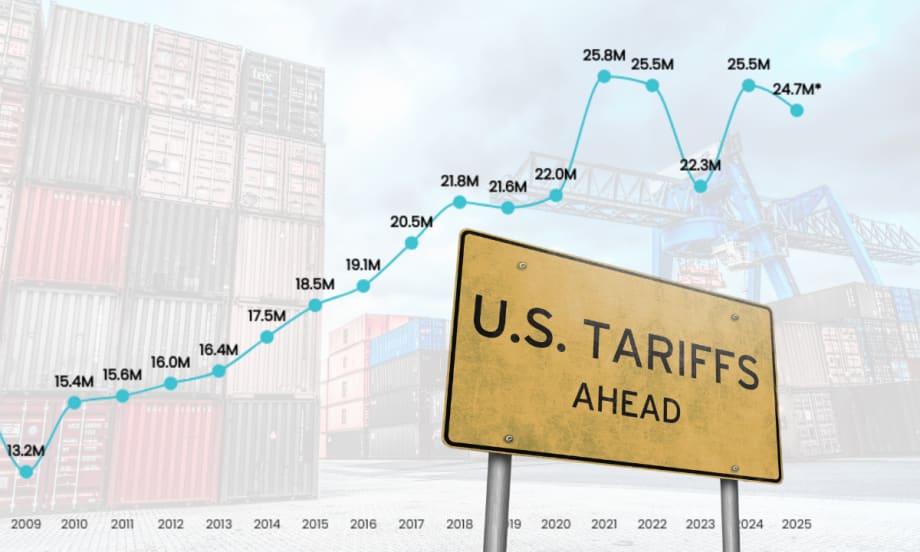
Retailers stocked up as much as they could ahead of tariff increases, but trade policy uncertainty makes it impossible to make long-term plans.
HDT Graphic
Following a near-record peak this summer, import cargo volume at the nation’s major container ports is expected to steadily decline for the remainder of the year amid rising tariffs, according to the Global Port Tracker report released September 9 by the National Retail Federation and Hackett Associates.
“We have seen the implementation of reciprocal tariffs across the globe, with a number of key trading partners being subjected to tariffs higher than the earlier 10% tariffs,” said Jonathan Gold, NRF VP for supply chain and customs policy, in a news release.
In addition, he said, there are an increasing number of sectoral tariffs affecting a wider range of products.
“Retailers have stocked up as much as they can ahead of tariff increases,” Gold said, “but the uncertainty of U.S. trade policy is making it impossible to make the long-term plans that are critical to future business success.”
The Current Tariff Situation
While “reciprocal” tariffs on a number of countries took effect in early August, a federal appeals court later ruled against President Donald Trump’s use of the International Emergency Economic Powers Act to impose the tariffs, but left them in place while the ruling is under appeal to the Supreme Court.
Meanwhile, Trump delayed an increase in tariffs on China by 90 days to Nov. 10 so trade negotiations could continue.
Trump also announced an additional 25% tariff on India that took effect near the end of August, bringing the additional tariff rate to 50%.
“Tariffs have had a significant impact on trade,” Hackett Associates Founder Ben Hackett said. “The trade outlook for the final months of the year is not optimistic.”
Details on Container Port Import Numbers
U.S. ports covered by Global Port Tracker handled 2.36 million Twenty-Foot Equivalent Units, or TEUs — one 20-foot container or its equivalent — in July, although numbers for New York/New Jersey, Port Everglades and Miami were estimated because they have not yet reported their data.
That was up 20% from June as retailers brought in merchandise ahead of tariffs set to take effect in August, and up 1.8% year over year. It would be the second-busiest month on record, topped only by 2.4 million TEU in May 2022.
Ports have not yet reported numbers for August, but Global Port Tracker projected the month at 2.28 million TEU, down 1.7% year over year but higher than the 2.2 million TEU expected before the postponement of China tariffs and the new tariff on India.
Projected Container Imports for the Rest of 2025
September: 2.12 million TEU, down 6.8% year over year
October:1.95 million TEU, down 13.2% year over year
November: 1.74 million TEU, down 19.7% year over year
December: 1.7 million TEU, down 20.1% year over year for the slowest month since 1.62 million TEU in March 2023.
While the falling monthly totals are related to tariffs, the year-over-year percentage declines are both because of this year’s early peak season and because imports in late 2024 were elevated by concerns about port strikes.
The first half of 2025 totaled 12.53 million TEU, up 3.6% year over year.
The full year is forecast at 24.7 million TEU, down 3.4% from 25.5 million TEU in 2024.
January 2026 is forecast at 1.8 million TEU, down 19.1% year over year.
More About Global Port Tracker
Global Port Tracker, which is produced for NRF by Hackett Associates, provides historical data and forecasts for the U.S. ports of Los Angeles/Long Beach, Oakland, Seattle and Tacoma on the West Coast; New York/New Jersey, Port of Virginia, Charleston, Savannah, Port Everglades, Miami and Jacksonville on the East Coast, and Houston on the Gulf Coast.
Hackett Associates provides consulting, research and advisory services to the international maritime industry, government agencies and international institutions.
More Fleet Management

Color Match Smarter: Tools That Restore & Perform
For fleet managers and collision repair professionals keeping heavy-duty trucks on the road, getting the color right the first time isn't just about appearance — it's about efficiency, turnaround time, and bottom-line results. Discover how today's digital color tools are transforming the repair process from guesswork to precision.
Read More →
FMCSA Pauses Biennial-Update Enforcement Amid Motus Transition
Carriers whose updates were due on or after June 1 have more time, while FMCSA works to stabilize its new registration system and warns of phishing sites impersonating its new carrier registration system, Motus.
Read More →
2026 Blueprint for Countering Smarter Supply Chain Theft
Cargo theft is no longer just the cost of doing business. It's a multi-billion-dollar criminal enterprise exploiting vulnerabilities across your fleet, drivers, and supply chain.
Read More →


How Telematics Improves Visibility, Control, and Performance in Refrigerated Fleets
Explore how telematics help refrigerated fleets improve visibility, uptime, efficiency, compliance, and cargo protection across connected cold chain operations.
Read More →
What the U.S.-Canada Trade War Means for Trucking
Escalating U.S.-Canada tariffs could disrupt cross-border freight, reduce truck volumes, raise costs, and create new uncertainty for carriers on both sides of the border.
Read More →
What Are Trucking’s Top Concerns for 2026?
The American Transportation Research Institute wants to know what's worrying trucking fleet managers, drivers, and other stakeholders in its annual Industry Issues survey.
Read More →
American Trucking Associations Looks for a New Leader
ATA President and CEO Chris Spear abruptly left his job at the association on August 21, at a pivotal time for the trucking industry.
Read More →
Public Wi-Fi Cybersecurity Risks: How Truck Drivers and Fleets Can Protect Their Data
Public Wi-Fi can expose truck drivers and fleets to credential theft, malware, and other cyber threats. Here’s how to reduce the risk on the road.
Read More →
For Nicky Cupp, Fleet Innovation Starts With Frustration
HDT Truck Fleet Innovator Nicky Cupp turns everyday pain points at Fraley & Schilling into opportunities for better technology and smarter processes.
Read More →
Adam Buttgenbach’s Approach to Electric Trucks: Start With Where They Fit
HDT Truck Fleet Innovator Adam Buttgenbach helped PepsiCo build one of North America’s largest EV fleets by focusing on where electric trucks make operational sense.
Read More →