




NACFE: Fleet Fuel Efficiency Technology Adoption Rates Rising
The North American Council for Freight Efficiency’s 10th Annual Fleet Fuel study has found rapidly rising fuel efficiency performance for long-haul fleets.


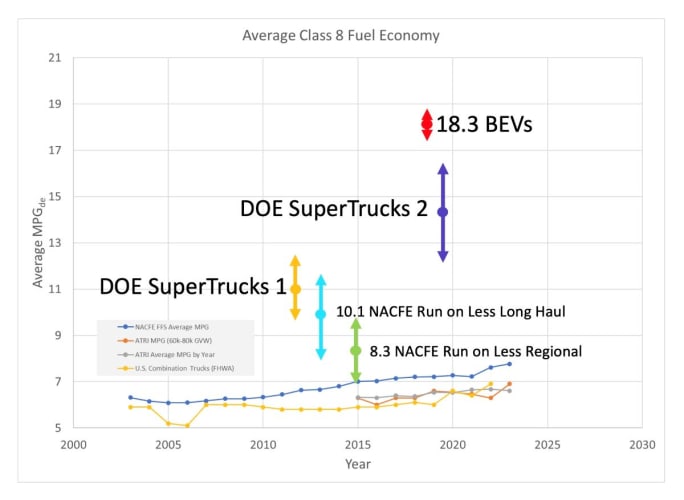
NACFE's 2024 Fleet Fuel Study found that while fleets in the study had an average MPG of 7.8, the national average is 6.9.
Graphic: NACFE
The North American Council for Freight Efficiency’s 10th Annual Fleet Fuel study has found rapidly rising fuel efficiency performance for long-haul fleets.
The average fuel mileage of the study fleets improved to 7.62 mpg in 2022 and 7.77 mpg in 2023, a year-over-year improvement of 4.2% and 2.0% respectively, NACFE’s 2024 Fleet Fuel Study has found.
According to the study, fleet-wide fuel efficiency of the fleets participating in The North American Council for Freight Efficiency’s (NACFE) Fleet Fuel Study increased rapidly in 2022 and 2023 after a period of little gains from 2018 to 2021.
The average MPG of the study fleets improved to 7.62 in 2022 and 7.77 in 2023, a year-over-year improvement of 4.2% and 2.0% respectively.
The average MPG of the study fleets improved to 7.62 in 2022 and 7.77 in 2023, a year-over-year improvement of 4.2% and 2.0% respectively.
Technology Adoption on the Rise
For 11 years, NACFE has studied the adoption rate of 86 technologies that improve freight efficiency to provide real-world insight on what fleets are doing to get more miles from a gallon of diesel fuel and is based on the premise that regardless of the cost, fuel represents a significant portion of a fleet’s total operating costs.
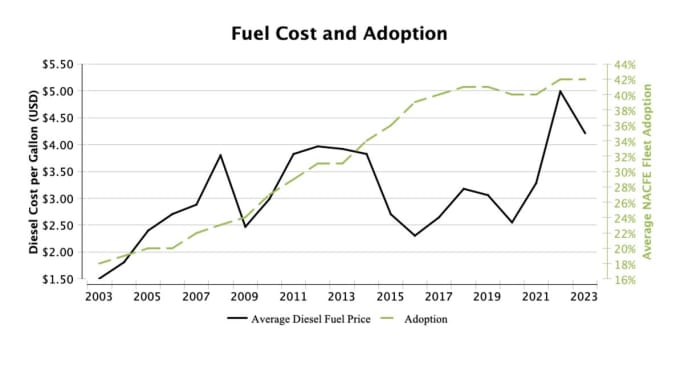
Fuel efficiency adoption rates have remained high, regardless of fuel price fluctuations, the study found.
Graphic: NACFE
“The trucking industry has made tremendous progress on improving MPG,” said Mike Roeth, NACFE’s executive director. “While the fleets in the Fleet Fuel Study had an average MPG of 7.8, the national average is 6.9. And that’s a huge improvement that the industry should be very proud of!”
“We found that fleets are increasing their adoption of these technologies, and that they are enjoying improved fuel economy as a result,” says Yunsu Park, NACFE’s director of engineering and the study’s lead author. The overall adoption rate for the technologies studied in this report has grown from 17% in 2003 to 42% in 2023.
The increased adoption rate of the studied technologies which results in better MPG meant that the 14 fleets operating 75,000 trucks saved $512 million in 2023 compared to the average truck on the road.
Long-Haul's Messy Middle
The study notes that fleets adopt different technologies and do so at different rates. However, the more technologies a fleet adopts, the greater the opportunity to improve fuel economy and save on the annual cost of fuel for the fleet. If a fleet goes all in, they are more likely to see the biggest savings and that will lead to increased profits.
Fleets with a higher overall adoption rate of all technologies achieve better fuel economy than ones with lower adoption.
The adoption rate groups are as follows.
Less than 30%
30 to 39%
40 to 49%
50% and higher
Fleets with the highest adoption rates consistently achieve the highest MPG. Of note is that early in the study, very few fleets had adoption rates greater than 30% and none were above 50%. In fact, the first fleet did not achieve an average adoption rate above 50% until 2014. The mix has shifted very rapidly over the years.
A wide array of fuel efficiency technology options are finding their way into long-haul fleets today.
Graphic: NACFE
Since 2016, more than half of the FFS participating fleets have had an average adoption rate above 40%.
Study conclusions include:
Fleet-wide fuel efficiency of the fleets participating in the FFS increased rapidly in 2022 and 2023 after a period of little gains from 2018 to 2021.
A shift to regional haul and shorter routes lowers average MPG. Shorter routes, by their nature, result in lower MPG as trucks spend a greater proportion of their day driving non-interstate routes and local roads. The cost of fuel, while on a downward trend from a recent peak in 2022, continues to be an important issue for fleets.
The focus on decarbonization may be stretching resources. The impact of OEMs investing in zero-emissions vehicles may be the reason that the rate of increase in the adoption of fuel-saving technologies among the study participants has slowed over the last five years.
Truck speeds continue to stay high. Speed is a very significant predictor of fuel efficiency for all vehicles.
There was some pushback on ZEV technology in the trucking industry in 2024. But Rick Mihelic, director of emerging technologies for NACFE, believes fuel efficiency is now a major design driver at truck OEMs.
“Some of the new truck engines scheduled for 2027 are showing some improvements,” he noted. “But the reason we call the next few years the ‘messy middle’ is that you're going to see a lot of experimentation and investigation in these different powertrains. And once the first new vehicles are out, you’ll see OEM engineers focus on making them better. So, I think we’re going to see significant improvements in powertrains over the next few years.”
More Fuel Smarts

Cummins Adjusts 2027 Engine Rollout After EPA Proposal
The engine maker will gradually introduce its new Model Year 2027 diesel engines while continuing to offer current models during the transition, citing the EPA's proposed emissions rule changes.
Read More →
EPA Proposal Could Ease 2027 Truck Costs and Buying Uncertainty
The proposal doesn't change the tougher NOx standard, but it would revise key implementation requirements that manufacturers say have driven up costs and complicated fleet purchasing decisions.
Read More →
Cummins, Paccar Ease DEF Derates After EPA Guidance
Updated diesel engine software gives truck operators more time to address emissions-system issues while staying compliant with EPA emissions standards.
Read More →
Maintenance in the Messy Middle Part 3: Biodiesel
Biodiesel can reduce emissions, improve fuel-system lubricity and use existing diesel infrastructure. But NACFE’s Messy Middle maintenance report says fleets must actively manage storage, cold-weather operation, filters and oil drain intervals to avoid problems.
Read More →
Enhance Fleet Performance with High-Efficiency Auxiliary Power Units
Drive sustainable cost savings while increasing driver comfort during short- and long-haul logistics operations.
Read More →
Maintenance in the ‘Messy Middle’ Part 2: Renewable Diesel Fuel
NACFE's latest Messy Middle Powertrain Service & Maintenance report says renewable diesel gives fleets an opportunity to reduce carbon emissions without changing trucks, fueling infrastructure or maintenance practices. But technicians still need to understand several important operational differences.
Read More →
The Diesel Engine Enters NACFE’s ‘Messy Middle’
NACFE’s new Messy Middle Powertrain Service & Maintenance report says keeping modern diesel engines running now depends as much on software, diagnostics and data as traditional mechanical service.
Read More →
DTNA Software Update Gives Truckers More Time Before DEF Derates Take Effect
The changes reflect EPA guidance aimed at reducing downtime caused by emissions-system faults while maintaining compliance requirements.
Read More →
New Agentic Predictive Maintenance Report Demonstrates How Degraded Aftertreatment Systems Waste Fuel
Questar analyzed a large mixed-class fleet and discovered it was wasting as much as $30 in fuel per vehicle, per day, because of mechanically degraded aftertreatment systems.
Read More →
New York City's Microhub Project is Delivering Results
Trucking, last-mile delivery companies, and environmental advocates like what they are seeing so far with New York's microhub program.
Read More →