




New Data Implies Tighter Freight Capacity Than Official Job Numbers Suggest
Despite the chronically sluggish freight market, payroll employment in for-hire trucking rose in November and was basically on par with job levels a year earlier. Or was it? FTR's Avery Vise explains.
December 13, 2024


Are trucking employment numbers setting the stage for rate recovery?
Image: HDT Graphic
3 min to read
Despite the chronically sluggish freight market, payroll employment in for-hire trucking rose in November and was basically on par with job levels a year earlier. Or was it?
The November employment numbers were an estimate published December 6 by the Bureau of Labor Statistics in the monthly jobs report. However, BLS will revise its estimates in early February — and it appears that the revision will show a smaller workforce.
Although payroll employment and the driver supply are not the same, drivers make up the majority of payroll workers in trucking. Presumably, they account for most changes in the workforce, as most other job positions do not rise and fall with freight demand.
Therefore, fewer jobs than currently reported suggests tighter freight capacity, which means that trucking companies might be better positioned for a recovery in rates in 2025 than the current BLS figures imply.
Why Are BLS’ Employment Numbers Off?
The day before the latest jobs report, BLS published its full data from the Quarterly Census of Employment and Wages (QCEW) for the second quarter.
The monthly jobs report that garners so much attention is based on sampling estimates. In contrast, the QCEW is a more comprehensive accounting of employment levels. But the QCEW takes time to compile. So, each February, the BLS uses the QCEW data to recalibrate its estimates.
For example, in February of this year, the BLS benchmark revision resulted in a 33,000-job reduction in the trucking estimate released just a month earlier.
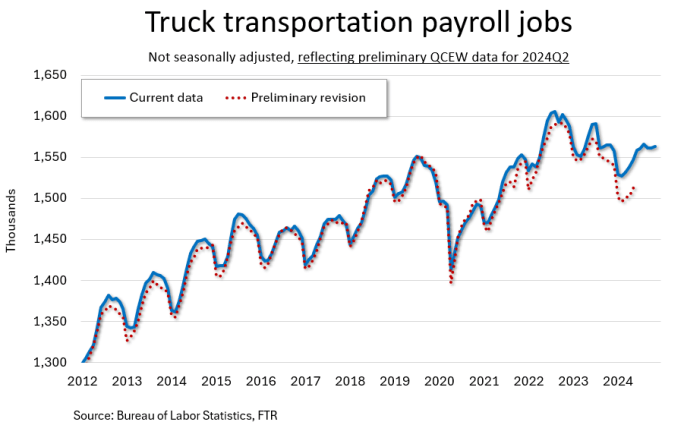
This graph shows how the published job estimates vary from the more accurate but lagging QCEW figures.
Source: FTR
According to the preliminary QCEW data, as of June, trucking employment was nearly 41,000 payroll jobs below the currently published BLS estimate for that same month.
The published estimates for that month show trucking employment down 2% year over year but up 4.1% compared to February 2020 (the month immediately prior to pandemic lockdowns and their huge distortion of employment.)
The QCEW estimate for the second quarter shows payroll jobs down 3.4% year over year and up just 1.9% compared to February 2020.
About half of the preliminary revision comes from general freight truckload, which had nearly 22,000 fewer employees in June than what BLS currently reports, according to the QCEW.
If the revised estimate holds, truckload employment in June was down 4.2% year over year, not 1.6% as currently reported in the official data.
The QCEW estimates for local operations — both general freight and specialized — also are notably weaker than current official estimates. However, the census data implies that less-than-truckload jobs are underreported modestly in the currently published data.
A Caveat Regarding Employment Data in Trucking
The just-released QCEW data is good news for trucking companies, but there’s a big caveat. The BLS payroll data captures only firms that have employees. Most very small trucking firms — those that accounted for the surge in new motor carrier entries in 2020 and 2021 — are not employer firms.
Although the surge in the carrier population peaked in the fall of 2022, FTR’s analysis of Federal Motor Carrier Safety Administration data indicates that the market still has more than 91,000 active for-hire carriers than it had before the pandemic, an increase of nearly 36%.
Most of those operations have only a few trucks, but even if payroll employment in trucking were no higher than it was in February 2020, the driver supply clearly is still significantly higher than it was then.
Trucking capacity might be down from its peak, but it hasn’t plummeted.
Subscribe to Our Newsletter
More Fleet Management

Geotab Links Fleet Card to Vehicle Data
The new card combines fuel discounts with telematics-based purchase controls. Geotab’s analysis also points to potential savings from choosing lower-priced fuel stops.
Read More →
How MFA Helps Protect Trucking Fleets
Multi-factor authentication adds protection when passwords are stolen. Here’s how it works and where fleets should start.
Read More →
How Better Freight Data Helps Trucking Teams Get Ahead of Disruption
Trucking and logistics teams have plenty of data. The problem is getting the right information in front of the right people soon enough to act. Better-connected data can help teams spot trouble earlier and make smarter decisions before small problems become big ones.
Read More →

Trimble: Taking Artificial Intelligence in Trucking Beyond Faster Tasks
At Insight 2026, Trimble executives argued that fleets may need to redesign workflows to get more from AI as it introduced new products and enhancements. AI’s value will depend on how fleets combine automation with their people's knowledge.
Read More →
Sponsored•September 28, 2026
Build a bulletproof fleet: Uniting ELDs and dash cams for total compliance
An ELD can prove compliance, but it cannot always prove what happened on the road. Discover how uniting accurate ELD data with AI-powered dash cam video can help your fleet strengthen compliance, defend against liability, protect drivers and reduce operational costs.
Read More →
Nominations Open for HDT Emerging Leaders
Heavy Duty Trucking is looking for accomplished trucking fleet professionals under 40 who are making an impact and helping lead the industry forward.
Read More →
Why Private Fleets Are Taking More Freight
Private fleets are putting their own trucks on demanding customers and high-cost lanes as companies seek greater control over service, costs, and capacity.
Read More →
Sponsored•September 16, 2026
Color Match Smarter: Tools That Restore & Perform
For fleet managers and collision repair professionals keeping heavy-duty trucks on the road, getting the color right the first time isn't just about appearance — it's about efficiency, turnaround time, and bottom-line results. Discover how today's digital color tools are transforming the repair process from guesswork to precision.
Read More →
FMCSA Pauses Biennial-Update Enforcement Amid Motus Transition
Carriers whose updates were due on or after June 1 have more time, while FMCSA works to stabilize its new registration system and warns of phishing sites impersonating its new carrier registration system, Motus.
Read More →
Sponsored•September 14, 2026
2026 Blueprint for Countering Smarter Supply Chain Theft
Cargo theft is no longer just the cost of doing business. It's a multi-billion-dollar criminal enterprise exploiting vulnerabilities across your fleet, drivers, and supply chain.
Read More →