




Knight Transportation Testing Cummins’ X15N Natural Gas Powertrains in California
Arizona-based Knight Transportation, part of Knight-Swift Transportation Holdings, has been testing Cummins’ new X15N natural gas engine in Southern California.

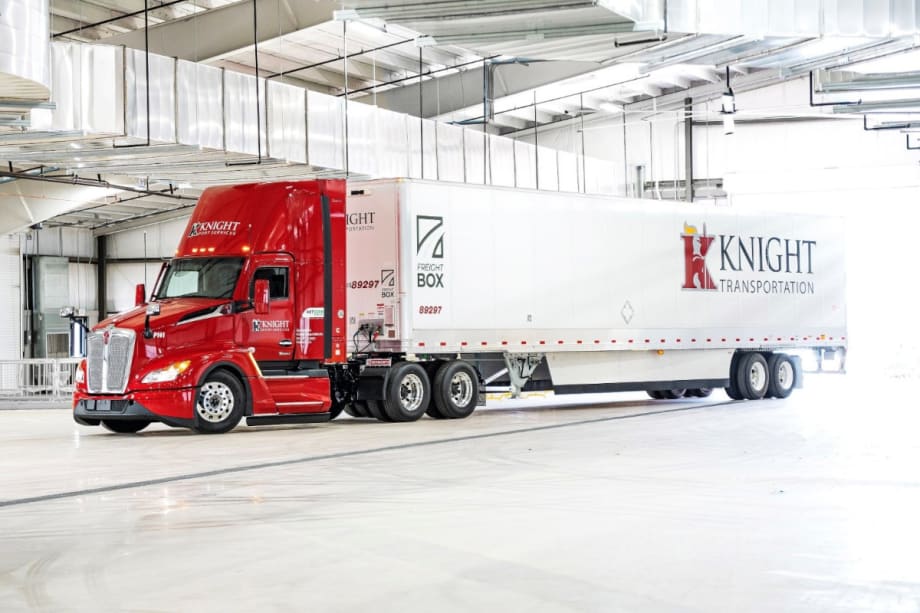
Knight Transportation is testing Cummins’ X15N powertrain in California.
Photo: Knight Transportation
Arizona-based Knight Transportation, part of Knight-Swift Transportation Holdings, has been testing Cummins’ new X15N natural gas engine in Southern California. The truck is fueled by ultra-low carbon renewable natural gas (RNG) by Clean Energy’s station in Carson, California.
The field testing with Knight-Swift will continue through full production of the X15N powertrain in 2024. Knight Swift’s goal is to reduce CO2 emissions generated from the KNX fleet by 50% by 2035.
“We must ensure we are utilizing the most reliable and efficient technologies possible that help us reduce our carbon footprint,” said Dave Williams, Knight-Swift Transportation’s senior vice president of equipment and government relations. “We value our collaboration with Cummins and are encouraged by what we have seen so far with the 15L renewable natural gas technology.”
Coming to market in 2024, the Cummins X15N natural gas engine is expected to deliver diesel-like ratings, durability, and reliability to allow fleets to significantly reduce their carbon footprint without sacrificing capability.
“Arizonans understand how critical equipment costs are to running a business. Renewable natural gas is something we can utilize now with very measurable benefits to both the environment and the economy. This investment will help Arizona truckers adopt low-cost advanced technology,” said Congresswoman Debbie Lesko, who represents Arizona’s 8th Congressional District and serves on the U.S. House Committee on Energy and Commerce.
Negative carbon intensity RNG is created by trapping methane at its biogenic source, preventing it from escaping to the atmosphere, and turning it into transportation-grade renewable fuel, said Derick Turbide, Clean Energy vice president.
“The feedback in the development process is invaluable to the product's long-term success for our customers. The suite of integrated Cummins technologies used on these trucks from engine, aftertreatment, and fuel storage to transmission, axles, and the digital features that pull them all together in their most optimized form demonstrates the value of our next generation of product to our customers,” said José Samperio, vice president North American On-Highway Business, Cummins.
More Fuel Smarts

How Volvo Updated Its D13 for EPA 2027 [Watch]
Volvo’s updated D13 promises lower emissions without sacrificing performance or fuel economy. Take a closer look at what changed inside the engine in this HDT Spotlight video.
Read More →
Diesel Price Spike Shortens Payback for Natural Gas Trucks, Report Says
Energy Vision estimates fleets could recover the higher purchase price of an RNG-fueled Class 8 tractor in 1.3 to 2.8 years under current fuel-price scenarios.
Read More →
Calstart Becomes Catalyst Mobility, Reflecting Broader Focus
Calstart is now Catalyst Mobility, reflecting the nonprofit’s growing national role in clean transportation, including zero-emission trucks, infrastructure and incentive programs.
Read More →

Record Diesel Prices Squeeze Trucking Fleets
Average U.S. diesel prices have climbed to nearly $6 a gallon, surpassing the 2022 record as tight refinery capacity and Middle East disruptions keep fuel costs elevated.
Read More →
How Fuel Delivery Shapes Engine Performance
Fuel delivery depends on more than what happens at the injector. For fleet, maintenance and technical professionals, looking at the full path from pump to injector can provide useful context for understanding engine performance.
Read More →
East Coast Port Launches $45M Electric Truck Push
The Port Authority of New York and New Jersey announced millions in incentives for zero-emission drayage trucks, yard tractors, and new charging hubs near the port.
Read More →
California Bill Could Shed Light on Electric Truck Prices
Why do battery-electric Class 8 trucks remain so expensive? A California bill headed to Gov. Gavin Newsom would give fleets and state agencies more visibility into what manufacturers charge.
Read More →
Detroit Opens Orders for EPA 2027 Engines
Detroit isn’t starting from scratch to meet EPA 2027 diesel emissions standards. Its Gen 6 DD13 and DD15 engines keep much of today’s platform while updating the fuel and aftertreatment systems.
Read More →
Zero-Emission Truck Corridor Planned for West Coast
California, Oregon, Washington, British Columbia and Baja California are coordinating plans for truck charging and hydrogen fueling from Canada to Mexico.
Read More →
A Closer Look at Kenworth’s Electric T880E Vocational Truck [Video]
Learn more about Kenworth's T880E battery-electric vocational truck at the Paccar Technical Center, including its range, applications, upfitting considerations, and PTO options, in this HDT Spotlight video.
Read More →