Motor Carriers and Logistics Companies Offer Shippers More Options than Ever
Whether freight is handled by motor carrier, broker, or 3PL, the options for how to move it are growing as the players and their roles evolve and intermingle.
David Cullen・[Former] Business/Washington Contributing Editor
Along with traditional carriers and newer 3PL providers and brokerage firms, shippers may choose to contract with a carrier to set up a dedicated operation or field their own private fleet to handle some or all of their freight movements.
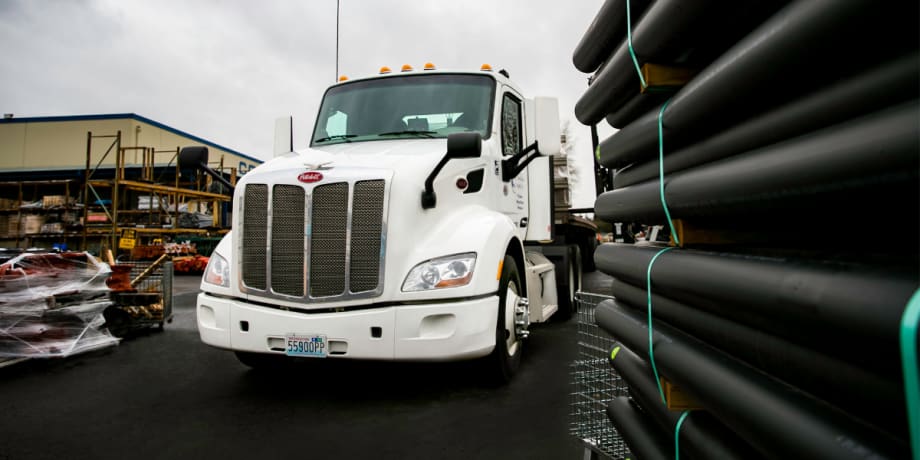
Photo: PacLease
7 min to read
A cornucopia of shipper-carrier arrangements drives freight movement nationwide. Shippers can select how to move their freight from a broader range of service offerings than ever, as motor carriers and other asset- and non-asset-based service providers work nimbly and quickly to meet shipper requirements while dealing with various market forces.
Ad Loading...
The key business relationships that shippers work with for freight movement consist chiefly of the following:
Turning freight over to common carriers on a contract or spot-rate basis.
Contracting separately with such carriers to operate dedicated routes.
Establishing or growing a private fleet to handle some or all freight in-house.
Working with an independent or carrier-owned brokerage or third-party logistics provider (3PL) to manage and haul freight with asset- or non-asset-based services.
Ad Loading...
The Role of the Freight Market
This article is Part 3 in a series, "How Freight Movement is Changing," exploring how logistics trends are affecting trucking.
The first consideration for shippers and carriers alike when building their business plans should be the dynamics of the freight marketplace. Changing market conditions can cause shippers to change their mix of logistics providers. For example, it affects decisions to expand or contract a private fleet or whether to sign dedicated contracts with carriers or turn to brokers and the spot market.
For instance, freight volumes are currently being impacted by everything from price inflation and the driver shortage to how well the supply chain has snapped back since the height of the pandemic.
Truckload freight volumes dropped in February, and load-to-truck ratios, which indicate demand for truckload services on the spot market, hit their lowest points since May 2020, according to DAT Freight & Analytics.
The upshot is the pricing environment for truckload services weakened further, with national average spot van and refrigerated rates dropping to levels not seen since September 2020.
Economist Chris Brady, principal of Commercial Motor Vehicle Consulting, explains that spot rates are weak because total freight has slowed substantially — they’re running below contract rates. As a result, he sees economic growth “likely remaining sluggish at best during the second half of the year as the economy continues to adjust to higher interest rates.
Ad Loading...
“With the likelihood of a soft freight environment,” he continues, “fleets will adjust truck-investment spending. Otherwise, fleet capacity utilization will trend to low levels. On the other hand, if capacity utilization goes too low, then adjustments in fleets’ investment spending plans will be swift and large, resulting in large cancellations in truck orders.”
All this means that critical variables could quickly change, explains DAT, so “the need for flexibility never goes away.”
Three factors currently affecting freight rates, capacity, and the choices of how to move freight:
Inflation remaining “stubbornly high.”
Diesel prices that remain close to the pre-2022 record price set in 2008.
The Fed keeps interest rates high — the latest a “dramatic increase” of 0.75% — suggesting there will be “a recession of some degree in 2023.”
All three market trends “lead to lower consumer demand for goods, reducing transportation volumes across all modes… The dampening of demand for truckload services has been evident for months,” DAT states. “The truck market has been inverted, where average national spot rates are below contract rates, since April 2022.”
Ad Loading...
"There's a fine line between carriers and 3PLs. They are both doing each other's work."
— Chris Brady, Commercial Motor Vehicle Consulting.
The Traffic Manager
“When you think of a traffic manager [at a shipper], his job is to move the product as cheaply as possible,” Brady says. “Now, with the slowdown in the freight market, spot rates are below general contract rates, and the capacity is there, so your mantra is to lock in contract rates.
“But if spot rates are lower than contract, the traffic manager may shift some freight to the spot market, but not at the cost of damaging relationships with carriers. The carrier knows how much capacity it can assign, and their contracts generally run for a year, with adjustments.”
Spot vs. contract rates are linked, he explains. “Spot gets high when capacity is tight, giving fleets leverage to raise their contract rates.”
He adds that going beyond merely setting rates, a carrier can commit to setting up a dedicated fleet operation to handle specific routes within certain parameters.
Brady says today’s spot market is also served by “all the big carriers having brokerage arms that farm out what they can’t handle to third parties. While most brokers deal with small fleets, they may also get calls from larger carriers. Yet some big carriers, like C.R. England, are not shifting as much outside but keeping it with their assets. All is fluid.”
Ad Loading...
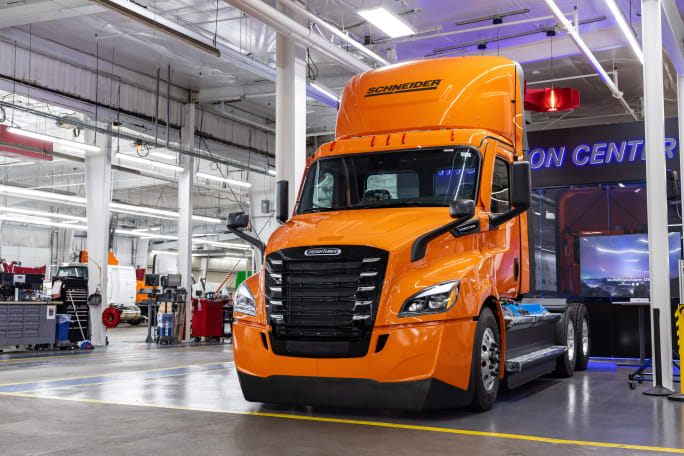
Like many other brand-name motor carriers with deep roots in trucking, Schneider National now offers shippers a full plate of services, from over-the-road hauls to dedicated operations, logistic solutions, and a freight brokerage.
Photo: Schneider National
The Growing Role of 3PLs
The role of third-party logistics providers is growing in the U.S. freight market, given the number of new entrants in this arena and the many brand-name common carriers that have launched complementary logistics and brokerage operations.
“Increases in supply chain complexity have driven many companies to engage the help of 3PLs as logistics and regulatory specialists,” points out Armstrong & Associates, a 3PL consulting firm. “In addition, the COVID-19 pandemic has made companies further realize the complexity of supply chains. As a result, the demand for end-to-end outsourcing continues to rise, and organizations are increasingly open to engaging 3PLs to manage their logistics and supply chain requirements.”
The 3PL “handles freight while acting as the shipper’s traffic manager,” explains economist Chris Brady, principal of Commercial Motor Vehicle Consulting. “They select the carriers, so it’s a form of outsourcing for shippers. A 3PL manages assets. They outsource, but that doesn’t mean they only put all the shipper’s freight on their trucks. For them, it’s more about managing lanes and leveraging the activity in those lanes.”
He also points to the trend of 3PLs buying carriers.
“A 3PL will act when they see an opportunity, such as buying a fleet in a high-density lane to help keep their trucks full. After that, it’s all merging into a blur,” Brady says. “If anything, there’s a fine line between carriers and 3PLs. They are both doing each other’s work.”
Ad Loading...
FTR’s Vise points out that 3PLs “want stress in the market that will drive shippers to go beyond their contracted carriers,” including when the driver shortage is acute.
He also says it’s important to distinguish between 3PLs and brokers. “A 3PL is managing the complete transportation of the freight. At the same time, a broker may do that or move the freight.”
Private and Dedicated Fleets
As for private fleets and the shippers that run them, Brady says operating these are “more of a financial decision, as well as often to have employees who can drive a truck and set up displays and serve as salespersons on their assigned routes. The private fleet gives them greater control. However, some shippers may outsource work, like hauling freight to distribution centers.”
The number of private fleets “tends to stay steady, so it’s hard to get a handle on big or slight increases,” says FTR’s Vise. “Equipment costs can affect this decision, as well as whether they will own trailers. A big part of private fleet operations is handling short hauls, including between plants and distribution centers and then on to stores.”
"The need for flexibility never goes away." — DAT Freight & Analytics
He says that if equipment ownership costs become too high, a private fleet may turn to leasing power equipment and its maintenance.
Ad Loading...
“Switching to a dedicated operation may make sense,” Vise contends. “Given current market conditions, this is a good time to consider alternatives. The worst time to do it would be at the top of the market.”
However, Vise says that “dedicated can be looked at for the wrong reasons” as a freight-movement solution. For example, a shipper may get interested in being dedicated at the top of the market as a cost-containment tool. But that’s when carriers are running strong and may not be willing to accept a contract price for dedicated service.
“Shippers all tend to see dedicated as a way to solve a problem, such as wanting high-touch freight handled properly,” he continues. “Ideally, they would like to do it themselves but cannot. Or they have less desirable freight, say with no backhauls, to move. Shippers also want predictability. They work under a budget and want to get it right. Opting for dedicated service can get them close to where they want to be.”
For fleet managers and collision repair professionals keeping heavy-duty trucks on the road, getting the color right the first time isn't just about appearance — it's about efficiency, turnaround time, and bottom-line results. Discover how today's digital color tools are transforming the repair process from guesswork to precision.
Carriers whose updates were due on or after June 1 have more time, while FMCSA works to stabilize its new registration system and warns of phishing sites impersonating its new carrier registration system, Motus.
Cargo theft is no longer just the cost of doing business. It's a multi-billion-dollar criminal enterprise exploiting vulnerabilities across your fleet, drivers, and supply chain.
Explore how telematics help refrigerated fleets improve visibility, uptime, efficiency, compliance, and cargo protection across connected cold chain operations.
Escalating U.S.-Canada tariffs could disrupt cross-border freight, reduce truck volumes, raise costs, and create new uncertainty for carriers on both sides of the border.
The American Transportation Research Institute wants to know what's worrying trucking fleet managers, drivers, and other stakeholders in its annual Industry Issues survey.
HDT Truck Fleet Innovator Adam Buttgenbach helped PepsiCo build one of North America’s largest EV fleets by focusing on where electric trucks make operational sense.