





More results of the 2022 HDT/Work Truck Fleet Safety Survey.
What Safety Technologies Appeal to Different Types of Fleets?
Heavy Duty Trucking and Work Truck's safety survey breaks down the top safety technologies fleets are adopting based on fleet size and type.
October 7, 2022

Looking at vehicle size, safety technologies that respondents said were currently in use show a big difference when it comes to backup cameras, with 55% of fleets with Class 3-6 using them but 23% of fleets with Class 8 trucks.
Source: HDT/WT 2022 Safety Survey
3 min to read
Top 10 Current Safety Technologies
In HDT’s August Fact Book, we reported results from our second annual safety survey, conducted jointly with our sister fleet brand, Work Truck. There we looked at the adoption and implementation plans of various safety technologies, analyzing the results by fleet size.
For this issue we’re looking at the results considering a couple of other factors:
vehicle size operated by the fleet.
Whether a fleet is for-hire or private.
The median number of vehicles in fleets surveyed was 75, while 20% had fleets between 100 and 259.
Among the respondents, 81% said they have Class 8 trucks in their fleet. About 40% operate Class 7 and 41% Class 6 trucks.
Among survey respondents, 40% were in private fleets and 37% were in for-hire fleets. (The remainder were primarily government fleets.)
Some respondents operate more than one class of truck. (Which is why we see air disc brakes showing up as a safety tech used by fleets with Class 3-5 trucks when those trucks don’t use air brakes.)
Looking at vehicle size, safety technologies that our respondents said were currently in use show a big difference when it comes to backup cameras, with 55% of fleets with Class 3-6 using them but 23% of fleets with Class 8 trucks.
Speed limiters (53%) and air disc brakes (59%) were most commonly used among fleets with Class 8 trucks.
While air disc brakes topped the list of current safety technologies used by respondents both this year and last year, compared to the 2021 survey, speed limiters jumped from fourth to second place, driven primarily by fleets with 50 to 249 vehicles.
When asked which safety technologies the fleet’s surveyed plan to implement within the next year, looking at total numbers, backup cameras were the top choice.
In last year’s survey, forward-facing in-cab cameras were the most commonly cited technology fleets planned to adopt in the coming year, followed by backup cameras and dual-facing in-cab cameras.
Looking more closely, fleets with Class 3-6 trucks in their fleet, at 31%, were more likely to be planning to implement backup cameras than those with Class 8 at 21%.
Side blindspot monitoring appeared to be more important for those with lighter-duty trucks in their fleets, 19-20% among those with Class 3-6, but only 15% for those with Class 8.
Considering that fleets with smaller vehicles are probably more likely to be operating in more congested urban areas, that’s not surprising.
Top 10 Safety Technology Plans for the Next Year
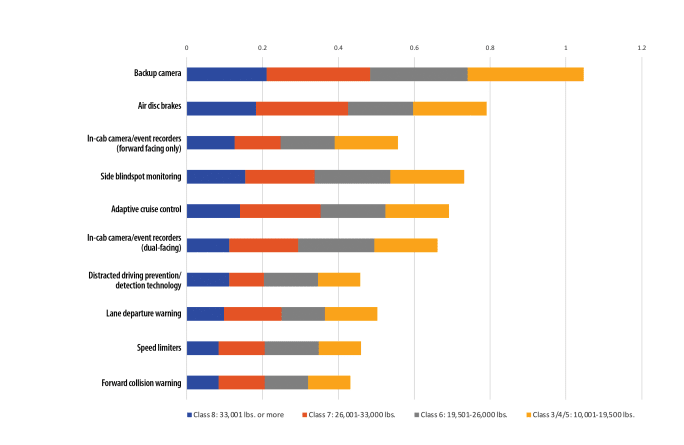
Fleets with Class 3-6 trucks in their fleet, at 31%, were more likely to be planning to implement backup cameras than those with Class 8 at 21%.
Source: HDT/WT 2022 Safety Survey
HDT also looked at some questions based on whether the fleet was for-hire or private.
Private fleets almost always were more likely to be planning to implement additional safety technologies in the next year, with the top ones being:
Backup cameras, 31%, compared to 8% by for-hire fleets.
Air disc brakes, 26%, compared to 8% by for-hire fleets.
Forward-facing cameras, 20%, compared to 16% among for-hire fleets.
Side blindspot monitoring, 17%, compared to 14% among for-hire fleets.
Adaptive cruise control, 20%, compared to 8% for for-hire fleets.
Dual-facing in-cab cameras, 14%, vs. 8% of for-hire respondents.
The only safety technologies that for-hire fleets were more likely to plan to implement than private fleets were fatigue monitoring, 11%, compared to 6% among private fleets, and rollover prevention, 5% versus 3%.
This article appeared in the October 2022 issue of Heavy Duty Trucking.
Subscribe to Our Newsletter
More Safety & Compliance

FMCSA Pauses Biennial-Update Enforcement Amid Motus Transition
Carriers whose updates were due on or after June 1 have more time, while FMCSA works to stabilize its new registration system and warns of phishing sites impersonating its new carrier registration system, Motus.
Read More →
ZF Expands Commercial Vehicle Push in North America
ZF is expanding its North American commercial-vehicle presence with new transmission applications, electrification, trailer technology and autonomous-driving systems.
Read More →
Truck Drivers Need More Than Another Alert
Fleets have more visibility into truck health, safety events, and driver activity than ever. The next challenge is turning all that information into useful guidance for the person who has to decide what to do next.
Read More →
Tesla Wants a Self-Driving Semi. Are Cameras Enough?
Could Tesla’s camera-only autonomous driving technology work on an 80,000-pound Semi? In this commentary, HDT's Deborah Lockridge takes a look at Tesla, Cybercab, and how autonomous trucks see the road.
Read More →
What DOT’s Automated Vehicle Strategy Means for Trucking
The U.S. Department of Transportation issued a new automated-vehicle strategy that outlines plans for driverless-truck regulations, cross-state freight corridors, and federal safety standards.
Read More →
NYC Expands Speed, Pedestrian Safety Tech Across Fleet
New York City is expanding intelligent speed assistance and pedestrian-alert systems across its municipal fleet, moving the technologies from pilot programs into vehicle procurement and retrofit requirements.
Read More →
FMCSA Removes 110 Truck Driver Training Schools from Certified ELDT List
Federal regulators also are targeting more than 160 additional training providers and launching a nationwide audit of third-party CDL skills testers as part of a broader crackdown on trucking fraud.
Read More →
Beyond DOT Compliance: What Makes a Trucking Fleet Truly Safe?
A trucking fleet can follow every rule and still make unsafe decisions. The real test comes when safety conflicts with freight, productivity, or cost.
Read More →
Hours of Service Pilot Programs: FMCSA Readies for 2027 Rollout
Two pilot programs could eventually reshape hours-of-service rules, giving truck drivers options to pause their 14-hour clock or use longer split sleeper rest periods.
Read More →
New Guide Offers Pet Safety Tips for Truck Drivers
Hundreds of thousands of pets travel in truck cabs. A new safety guide from Volvo Trucks and the Center for Pet Safety offers practical advice for truck drivers who bring dogs and cats along for the ride.
Read More →