




What's in Biden Administration EV Plans for Trucks?
You may have seen the White House announcement about its progress in electrifying the country's cars. What about medium- and heavy-duty trucks?

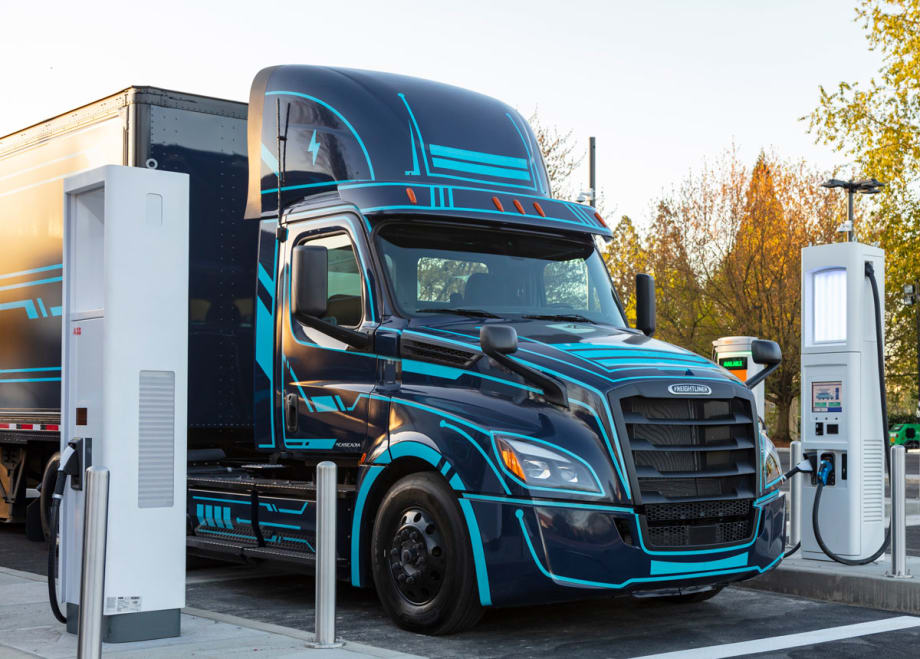
The battery-electric truck arena isn't as far along as that for light-duty BEVs, making developing federal charging standards premature, according to FHWA.
Photo: Daimler Truck North America
The Biden administration on Feb. 15 announced new electric-vehicle charging standards, funding for various EV-related projects, and efforts in the private sector to accelerate the electrification of America’s cars. While some funding was announced for zero-emissions infrastructure for major freight corridors, the new charging standards did not address medium- and heavy-duty charging needs.
The steps announced by the White House aim to help the U.S. reach its goal of electrifying 50% of new car sales by 2030 and to build a national network of 500,000 public EV chargers by that time. (There are about 130,000 public chargers today.)
Zero-Emission Freight Corridor Projects
The Department of Energy announced $7.4 million in funding for seven projects to develop medium-and heavy-duty EV charging and hydrogen corridor infrastructure plans across 23 states.
The DOE-funded projects will focus on electrification plans for essential and heavily trafficked domestic freight corridors, including those serving Northern and Southern California, the Eastern Seaboard, the Northeast, Southwest, and much of the Midwest.
The projects, administered by DOE’s Vehicle Technologies Office and Hydrogen and Fuel Cell Technologies Office, will advance the Biden administration’s decarbonization goals by accelerating the deployment of medium- and heavy-duty EV charging and refueling infrastructure to reduce emissions from freight corridors and the depots, ports, and other facilities those corridors service.
The selected projects are:
Calstart: East Coast Commercial ZEV Corridor
This project will launch an intensive strategic planning effort to spur the deployment of commercial medium- and heavy-duty zero-emission vehicle infrastructure through the development of an East Coast Commercial ZEV Corridor along the I-95 freight corridor from Georgia to New Jersey.
Cummins: MD-HD ZEV Infrastructure Planning with Focus on I-80 Midwest Corridor
This project will develop an extensive two-phase MD-HD EV Charging and H2 Fueling Plan for the Midwest I-80 corridor serving Indiana, Illinois, and Ohio, to support 30% of the MD-HD fleet using ZEV technologies by 2035.
Gas Technology Institute: Houston to Los Angeles (H2LA)–I-10 Hydrogen Corridor Project
This project will develop a flexible and scalable blueprint plan for an investment-ready hydrogen fueling and heavy-duty freight truck network from Houston to LA (H2LA) along I-10, including the Texas Triangle region, and in the process develop methodology for future corridor plans across the country.
Los Angeles Cleantech Incubator: First to Last Mile — Creating an Integrated Goods Movement Charging Network around the I-710 Corridor
This project will create a plan for innovative infrastructure solutions at industrial facilities and commercial zones along critical freight arteries feeding into Southern California’s I-710 freeway. The project will explore how private sector fleets can establish an integrated network that leverages existing industrial and commercial real estate assets while providing greatest benefit to municipalities and communities.
National Grid: Northeast Electric Highways Study
This project will forecast electric charging demand at traffic stops on freight corridors across Maine, Massachusetts, New Hampshire, Vermont, Rhode Island, Connecticut, New York, Pennsylvania, and New Jersey to help inform a blueprint for future large-scale, least-cost deployment of commercial EV charging and serve as an exemplar for other regions.
Rocky Mountain Institute: San Francisco and Bay Area Regional Medium-and Heavy-Duty Electrification Roadmap
This project will create a roadmap for charging infrastructure to support the full electrification of three key trucking market segments — drayage, regional haul, and long-haul — in the Bay Area of California.
Utah State University:Wasatch Front Multi-Modal Corridor Electrification Plan - Greater Salt Lake City Region
This project will develop a community, state and industry supported plan that will improve air quality in the underserved communities most impacted by high-density medium- and heavy-duty traffic in the greater Salt Lake City region.
New EV Charging Standards
The Department of Transportation, in partnership with the Department of Energy, finalized new standards on charging reliability along highway corridors — but those standards do not yet address medium- and heavy-duty trucks.
Until now, there were no comprehensive standards for the installation, operation, or maintenance of EV charging stations, and disparities exist among EV charging stations in key areas, such as connector types, payment methods, data privacy, speed and power of chargers, reliability, and the overall user experience.
The new national standards are aimed to make charging “a predictable and reliable experience.”
But not for big trucks. Not yet.
In its final rule, the DOT's Federal Highway Administration said that although it received comments on its earlier proposed rules asking it to address various aspects of medium- and heavy-duty charging, it decided not to broaden the rule to include minimum standards for MD/HD EV charging infrastructure, “primarily so as not to preempt the pace of the technological innovation.”
Many commenters supported specifically addressing the needs of MD/HD EVs in addition to the needs of EV passenger vehicles. Some commenters said that by not specifically addressing the unique needs of MD/HD EV charging in the regulation, FHWA would be de facto discouraging investment in medium- and heavy-duty electric vehicles.
Several commenters recommended that funding be set aside specifically for MD/HD EV charging infrastructure. Some requested separate minimum standards to address the unique needs of MD/HD EV charging.
Several commenters identified that the MD/HD EV sector is less evolved than the light-duty EV charging sector and that, because this portion of the industry is still in its infancy, there may be a need to continue to monitor technological developments before solidifying certain requirements specific to MD/HD EV needs.
For instance, in its proposed standards, The FHWA received a comment that the regulation should include a definition for Megawatt Charging Standard (MCS), which has yet to be finalized but is anticipated to serve as the industry standard connector type for charging heavy-duty trucks.
The FHWA responded that MD/HD charging technologies are more nascent than light-duty charging technologies.
“This final rule does not preclude the use of MCS; however, since the industry standard for MCS, SAE J3271, has not yet been finalized, FHWA has intentionally not revised this final rule to incorporate MCS in an effort to not inadvertently create restrictions on these emerging technologies at this time.”
While many medium-duty vehicles will likely charge at fleet depots and operate under hub-and-spoke business models where they would not venture significant distances from their base locations, FHWA noted, a growing sector of MD/HD vehicles will require on-corridor charging. Some commenters suggested that the new charging requirements be designed to consider the future accommodation of power demands and site use/circulation needs of long-haul trucking.
The FHWA agreed that site design for charging stations would include many important considerations; however, it said, the site design recommendations were all either governed by other laws or authorities or require complex decisions in order to accommodate context-specific needs.
“However, FHWA strongly encourages states and other designated recipients to consider recommendations in addition to and beyond those provided … Some considerations could include allowing for one or more pull-through charging stations and on-site circulation and ingress/egress design that accommodates medium- and heavy-duty vehicles that may access the site for charging.”
Corporate Commitments
Also included in the announcement was a roundup of commitments from companies such as General Motors, EVgo, Pilot, Hertz, and bp to expand their charging networks by up to 100,000 public charging ports in the next two years.
Most of those announcements were light-duty/automotive charging, but Forum Mobility, a zero-emission trucking solutions provider, announced a $400 million commitment to deploy over 1,000 DC fast-chargers. The charging infrastructure will serve the thousands of heavy-duty electric trucks projected to begin operating at the San Pedro and Oakland ports in California over the next decade.
More Fuel Smarts

Wex Adds Cardless Fuel Payments for Over-the-Road Customers
A new fuel card feature for Wex customers offers convenience and security.
Read More →
New California Law Could Shed Light on Electric Truck Prices
Why do battery-electric Class 8 trucks remain so expensive? A California bill signed by Gov. Gavin Newsom would give fleets and state agencies more visibility into what manufacturers charge.
Read More →
How Volvo Updated Its D13 for EPA 2027 [Watch]
Volvo’s updated D13 promises lower emissions without sacrificing performance or fuel economy. Take a closer look at what changed inside the engine in this HDT Spotlight video.
Read More →

Diesel Price Spike Shortens Payback for Natural Gas Trucks, Report Says
Energy Vision estimates fleets could recover the higher purchase price of an RNG-fueled Class 8 tractor in 1.3 to 2.8 years under current fuel-price scenarios.
Read More →
Calstart Becomes Catalyst Mobility, Reflecting Broader Focus
Calstart is now Catalyst Mobility, reflecting the nonprofit’s growing national role in clean transportation, including zero-emission trucks, infrastructure and incentive programs.
Read More →
Record Diesel Prices Squeeze Trucking Fleets
Average U.S. diesel prices have climbed to nearly $6 a gallon, surpassing the 2022 record as tight refinery capacity and Middle East disruptions keep fuel costs elevated.
Read More →
How Fuel Delivery Shapes Engine Performance
Fuel delivery depends on more than what happens at the injector. For fleet, maintenance and technical professionals, looking at the full path from pump to injector can provide useful context for understanding engine performance.
Read More →
East Coast Port Launches $45M Electric Truck Push
The Port Authority of New York and New Jersey announced millions in incentives for zero-emission drayage trucks, yard tractors, and new charging hubs near the port.
Read More →
Detroit Opens Orders for EPA 2027 Engines
Detroit isn’t starting from scratch to meet EPA 2027 diesel emissions standards. Its Gen 6 DD13 and DD15 engines keep much of today’s platform while updating the fuel and aftertreatment systems.
Read More →
Zero-Emission Truck Corridor Planned for West Coast
California, Oregon, Washington, British Columbia and Baja California are coordinating plans for truck charging and hydrogen fueling from Canada to Mexico.
Read More →