





Related: Volvo Group Invests in Wireless Electric Vehicle Charging
Volvo’s Eco-Drive Uses Traffic Signal Data to Make Efficient Speed Recommendations
Volvo Group demonstrated its Eco-Drive technology on two connected freight corridors in Southern California to show how the technology integrates traffic signal data with vehicle dynamics to provide real-time speed recommendations.
March 18, 2019
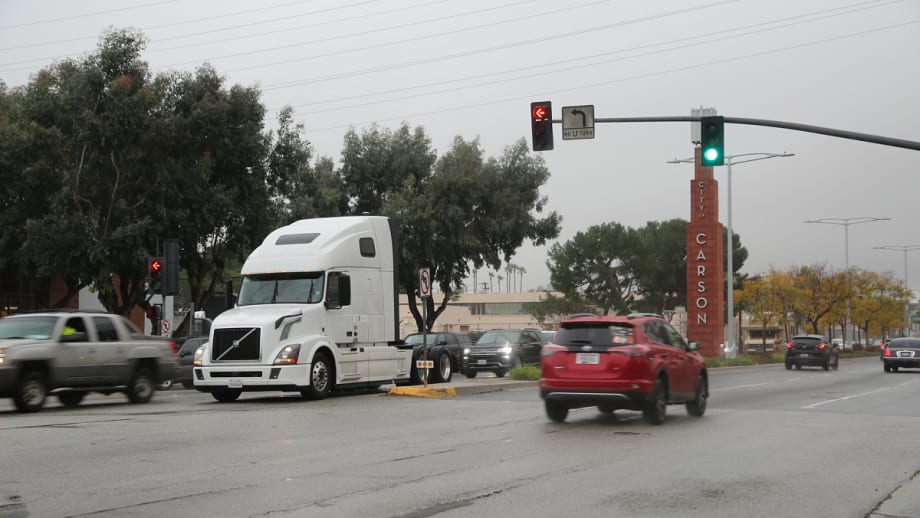
Volvo VNL equipped with prototype Eco-Drive technology during testing near the San Pedro Bay ports in Southern California.
Photo courtesy Volvo Group
2 min to read
Volvo Group demonstrated its Eco-Drive technology on two connected freight corridors in Southern California to show how the technology integrates traffic signal data with vehicle dynamics to provide real-time speed recommendations.
The combined technologies are designed to mitigate harsh driving maneuvers and reduce the impact of freight movement in the surrounding communities in high commercial traffic areas.
Volvo Group collaborated closely with several key California stakeholders to demonstrate Eco-Drive technology as part of its involvement in the Zero Emission Drayage Truck Demonstration Project. The project, led by the South Coast Air Quality Management District, is funded by the California Climate Investments program to reduce key criteria pollutants, greenhouse gases and petroleum usage.
The Eco-Drive demonstration was held in the city of Carson, California, not far from the twin ports of Los Angeles and Long Beach. A Volvo VNL equipped with the Eco-Drive technology rode along the connected corridors to show how the technology would work in real-world applications.
The event marks the beginning of a 12-month technology assessment and design refinement period for two distinct Eco-Drive concepts: an integrated visual advisory developed jointly by University of California Riverside Center for Environmental Research and Technology (UCR-CERT) and the Volvo Group, and a smartphone-based audible feedback developed by UCR-CERT. Both Eco-Drive concepts will be evaluated on arterials near the San Pedro Bay ports in Southern California, and aim to reduce emissions and energy use to improve the health and quality of life in communities disproportionately affected by heavy truck traffic.
“Evaluating connected vehicle technologies in real-world environments is an essential part of the development process, even in this early exploration phase. Involving these stakeholders will help collectively identify and overcome the barriers to deploy and scale up the technology,” said Pascal Amar, principal investigator for the project at Volvo Group. “We recognize that in an increasingly digitally driven society, such partnerships are required to address technical and political challenges simultaneously. Together we can build a truly intelligent transportation ecosystem, which enables our vision to drive emission reductions, improve road safety and quality of life for the surrounding communities.”
More Fuel Smarts

How Volvo Updated Its D13 for EPA 2027 [Watch]
Volvo’s updated D13 promises lower emissions without sacrificing performance or fuel economy. Take a closer look at what changed inside the engine in this HDT Spotlight video.
Read More →
Diesel Price Spike Shortens Payback for Natural Gas Trucks, Report Says
Energy Vision estimates fleets could recover the higher purchase price of an RNG-fueled Class 8 tractor in 1.3 to 2.8 years under current fuel-price scenarios.
Read More →
Calstart Becomes Catalyst Mobility, Reflecting Broader Focus
Calstart is now Catalyst Mobility, reflecting the nonprofit’s growing national role in clean transportation, including zero-emission trucks, infrastructure and incentive programs.
Read More →

Record Diesel Prices Squeeze Trucking Fleets
Average U.S. diesel prices have climbed to nearly $6 a gallon, surpassing the 2022 record as tight refinery capacity and Middle East disruptions keep fuel costs elevated.
Read More →
Sponsored•September 9, 2026
How Fuel Delivery Shapes Engine Performance
Fuel delivery depends on more than what happens at the injector. For fleet, maintenance and technical professionals, looking at the full path from pump to injector can provide useful context for understanding engine performance.
Read More →
East Coast Port Launches $45M Electric Truck Push
The Port Authority of New York and New Jersey announced millions in incentives for zero-emission drayage trucks, yard tractors, and new charging hubs near the port.
Read More →
California Bill Could Shed Light on Electric Truck Prices
Why do battery-electric Class 8 trucks remain so expensive? A California bill headed to Gov. Gavin Newsom would give fleets and state agencies more visibility into what manufacturers charge.
Read More →
Detroit Opens Orders for EPA 2027 Engines
Detroit isn’t starting from scratch to meet EPA 2027 diesel emissions standards. Its Gen 6 DD13 and DD15 engines keep much of today’s platform while updating the fuel and aftertreatment systems.
Read More →
Zero-Emission Truck Corridor Planned for West Coast
California, Oregon, Washington, British Columbia and Baja California are coordinating plans for truck charging and hydrogen fueling from Canada to Mexico.
Read More →
A Closer Look at Kenworth’s Electric T880E Vocational Truck [Video]
Learn more about Kenworth's T880E battery-electric vocational truck at the Paccar Technical Center, including its range, applications, upfitting considerations, and PTO options, in this HDT Spotlight video.
Read More →