




Volvo: Building Trust in Trucking's Technology Transformation
Volvo’s Three-Pillar Decarbonization Plan focuses on a completely diesel-free trucking industry by 2050.

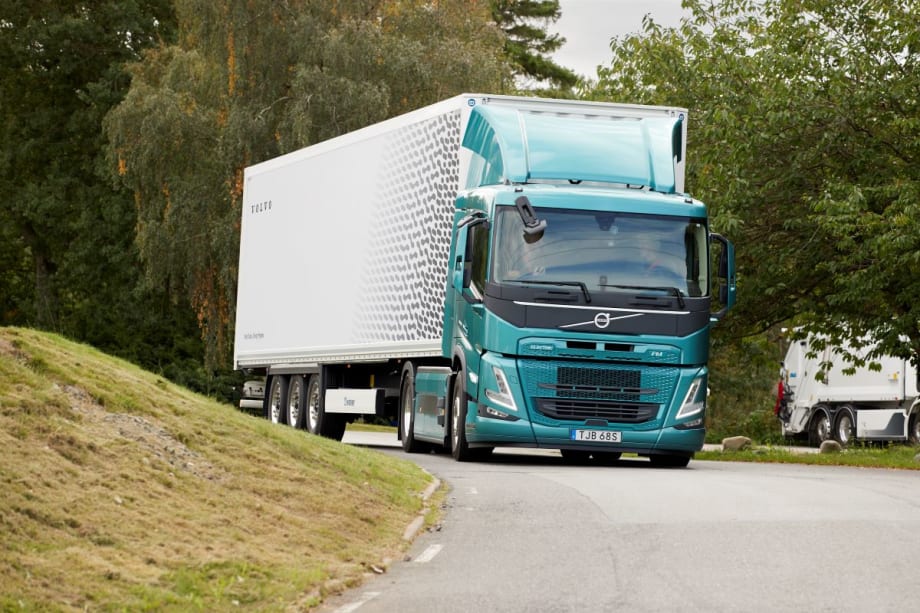
HDT Executive Editor Jack Roberts takes a Volvo battery-electric FM model around the company's test track in Gothenburg, Sweden.
Photo: Volvo Group
There is electricity in the air at the Volvo Trucks headquarters in its home city of Gothenburg, Sweden. It pulses through the building and reverberates down hallways, glassed-in conference rooms, spotless research labs, and outward to top secret test facilities hidden away in the dense Scandinavian forests. All companies have a vision and a purpose.
And Volvo’s unwavering focus today is to quite literally help save the planet: To stem the increasing effects of climate change and hopefully reverse it, thereby securing a safe and prosperous future for all of humanity.
Spend only a few minutes inside Volvo Group headquarters and you pick up on this electricity. You see it and hear it everywhere you go at various Volvo facilities around the country. The sense of purpose, the unwavering commitment to the mission is reflected everywhere. But it’s a sense of purpose tempered with reality: The hour is late. Too much time has been wasted. The transformation ahead for trucking — and indeed the entire planet — is massive. And things are not moving along nearly as fast as they need to.
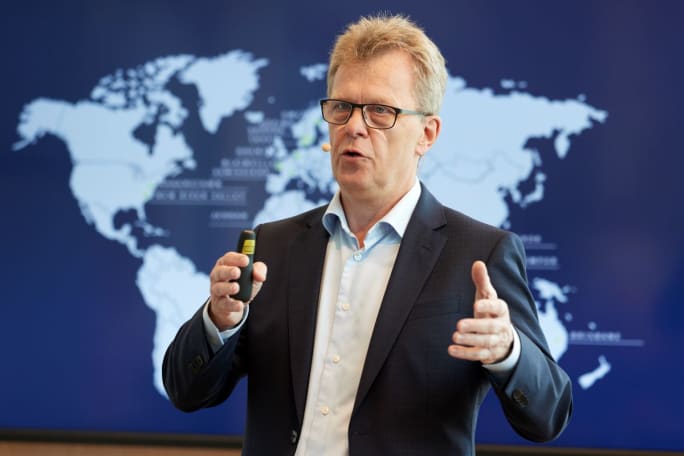
Volvo Trucks President Roger Alm discusses the OEM's Three-Pillar Decarbonization Plan with North American journalists at Volvo Group headquarters in Gottenburgh, Sweden.
Photo: Volvo Group
But there is confidence and pride in the air, too. Pride in the great strides Volvo has already made in moving trucking forward toward a net zero future. And confidence that, although the climate change challenge is among the greatest in history, the green, sustainable future is possible. Volvo will be a major player in helping all of mankind get there.
The mission is important enough that Volvo invited North American trucking journalists to its Swedish homeland in early September for a first-hand look at the people, the ideas, the philosophies, and the technologies it is employing to reach a net zero trucking industry by 2050 — a mere 27 years from now.
Volvo Group President Roger Alm took the opportunity to brief Canadian and American journalists on the OEMs’ “Three-Pillar Approach to Decarbonization,” and give some sneak peeks at some of the technology it will soon be bringing to market around the globe.
A Million-Truck Transition
In his opening remarks, Alm painted an unflinching picture of the peril the planet is in and stressed Volvo’s responsibility to act as a leader and an agent of change for good in the coming years.
“Climate has a great impact on everything we do,” Alm said. “And things are getting worse. We see violent thunderstorms, heavy rain and rising temperatures now. Soon, the earth will add another billion people to its population, which will also have an impact on climate.
"We need to change our way of living. If we don’t, future generations will not have blue skies and sunny days. We need to produce safe trucks that allow for safe ways of living. We have a huge responsibility as an OEM and truck manufacturer — and a bigger responsibility as individuals — to face the biggest change ever. Doing so will have a huge benefit for human beings all over the world.”
Volvo’s climate change goals are well documented. Alm stated again that in 2030, fully half of all vehicles produced by Volvo will feature zero-emission powertrains and sometime in late 2039 or so, Volvo will produce its final fossil fuel-powered truck. In 2040, Alm said, Volvo’s entire product line will be 100% emissions-free. Just 10 years after that, Volvo intends for diesel-powered trucks to quite literally be museum pieces. Alm said the OEM will have replaced every diesel truck it has ever sold with an emissions-free model by 2050.
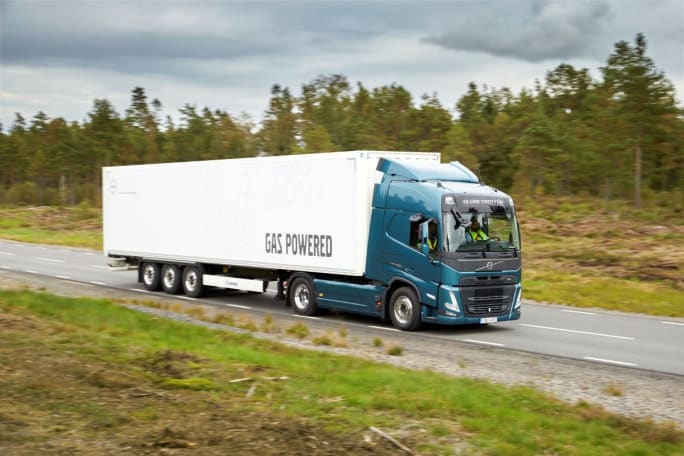
Volvo is working on alternate fuels for internal combustion engines and demonstrated that with this RNG-powered FM model.
Photo: Volvo Group
Volvo’s Three-Pillar Decarbonization Plan reflects those technology goals. This includes battery-electric trucks, fuel-cell-electric trucks, and conventional internal combustion engine technology adapted to run on zero- and near-zero renewable fuels. Alm noted that which fuels fleets use will ultimately depend on legislation designating which ones can be used.
Hydrogen, he said, is the most exciting ICE fuel technology. However, currently, a direct-injection hydrogen ICE requires a pilot-ignition shot of diesel fuel for combustion, and it’s unknown if even using a small amount of diesel in those engines will be allowed.
And because the climate crisis is such a major threat, Alm noted that Volvo is collaborating with some of its fiercest competitors in the global truck market to expedite the development of new, emission-free vehicle technologies.
"We have a higher purpose here to save this planet for future generations," Alm said. "Future generations won't care if diesel fuel is used to transport goods. They want a good world to live in. We, and Daimler, and Traton, and other competitors understand that. We need to join forces to give them the technology to create that better world. And once we have done that, we will return to competing in the market just as we have always done."
In 2022, Volvo sold a record 147,000 trucks, Alm said, with the U.S. and Canada receiving the majority of that volume. Should Volvo duplicate that volume seven years from now, approximately 75,000 of those trucks sold will have some kind of zero-emission powertrain — be it battery-electric, fuel cell battery electric or zero-emission internal combustion engine.
But those numbers pale in comparison to the total number of Volvo trucks on the road today — and in the future. It is Volvo’s intention to replace every single one with a zero-emissions powertrain.
“That is over 1.2 million Volvo heavy-duty trucks on the road around the globe,” Alm emphasized. “It will take strong cooperation with our customers to make that transformation happen. We talk to our customers every day. I personally talk with our customers nearly every single day to talk about how we can make this transformation happen.
"We should have started yesterday, and every additional day we wait is a loss. And we need stronger political support for these goals and infrastructure to support these new products."
To do this, Alm said, an ecosystem that can support zero-emissions vehicles needs to be created to give truck buyers the peace of mind that will allow them to make the transition away from fossil fuels.
“This will cost money,” Alm added. “Which is why Volvo is investing more money than ever before in net zero technologies. This will not stop. Volvo will continue to invest in the transformation that is coming.”
More Fleet Management

Why Private Fleets Are Taking More Freight
Private fleets are putting their own trucks on demanding customers and high-cost lanes as companies seek greater control over service, costs, and capacity.
Read More →
Color Match Smarter: Tools That Restore & Perform
For fleet managers and collision repair professionals keeping heavy-duty trucks on the road, getting the color right the first time isn't just about appearance — it's about efficiency, turnaround time, and bottom-line results. Discover how today's digital color tools are transforming the repair process from guesswork to precision.
Read More →
FMCSA Pauses Biennial-Update Enforcement Amid Motus Transition
Carriers whose updates were due on or after June 1 have more time, while FMCSA works to stabilize its new registration system and warns of phishing sites impersonating its new carrier registration system, Motus.
Read More →


2026 Blueprint for Countering Smarter Supply Chain Theft
Cargo theft is no longer just the cost of doing business. It's a multi-billion-dollar criminal enterprise exploiting vulnerabilities across your fleet, drivers, and supply chain.
Read More →
How Telematics Improves Visibility, Control, and Performance in Refrigerated Fleets
Explore how telematics help refrigerated fleets improve visibility, uptime, efficiency, compliance, and cargo protection across connected cold chain operations.
Read More →
What the U.S.-Canada Trade War Means for Trucking
Escalating U.S.-Canada tariffs could disrupt cross-border freight, reduce truck volumes, raise costs, and create new uncertainty for carriers on both sides of the border.
Read More →
What Are Trucking’s Top Concerns for 2026?
The American Transportation Research Institute wants to know what's worrying trucking fleet managers, drivers, and other stakeholders in its annual Industry Issues survey.
Read More →
American Trucking Associations Looks for a New Leader
ATA President and CEO Chris Spear abruptly left his job at the association on August 21, at a pivotal time for the trucking industry.
Read More →
Public Wi-Fi Cybersecurity Risks: How Truck Drivers and Fleets Can Protect Their Data
Public Wi-Fi can expose truck drivers and fleets to credential theft, malware, and other cyber threats. Here’s how to reduce the risk on the road.
Read More →
For Nicky Cupp, Fleet Innovation Starts With Frustration
HDT Truck Fleet Innovator Nicky Cupp turns everyday pain points at Fraley & Schilling into opportunities for better technology and smarter processes.
Read More →