





Listen on HDT Talks Trucking:How to Build an Electric Medium-duty Fleet
Zero-Emission Trucks: Poised for Growth
You might be surprised by the number of zero-emission medium- and heavy-duty trucks that have been deployed in the U.S., given the amount of media coverage given to them.
February 3, 2022
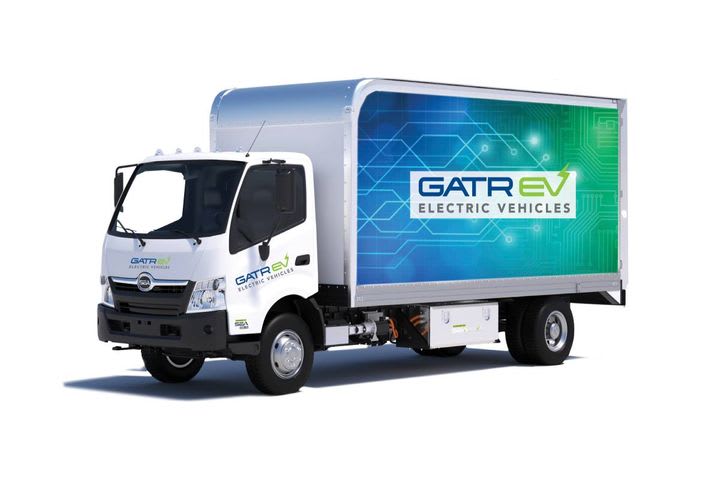
Of available ZET models, 65% were produced by manufacturers that either repower existing chassis or produce their own chassis and powertrains for existing vehicle frames (such as Motiv Power, Lightning eMotors, and Sea Electric.
Photo: GATR EV
6 min to read
You might be surprised by the number of zero-emission medium- and heavy-duty trucks that have been deployed in the U.S., given the amount of media coverage given to them. The number of these commercial vehicles that have been deployed thus far is still a drop in the bucket, according to a new report — but that number is poised to grow significantly.
As of the end of 2021, 1,215 zero-emission vans and trucks had been deployed in U.S., according to Calstart, a national nonprofit working to increase the number of green vehicles. That’s only 0.005% of the country’s registered medium- and heavy-duty trucks, but the report notes that another 140,000 are on order.
These findings are from Calstart’s new inventory of Class 2b through Class 8 zero-emission trucks in the U.S., “Zeroing in on Zero-Emission Trucks,” funded by the California Air Resources Board Hybrid and Zero-Emission Truck and Bus Voucher Incentive Project.
The report provides insight on market trends as the industry prepares for an injection of federal funding for charging infrastructure, multiple states implement clean truck regulations, and California prepares to release an additional $873 million in purchase incentives for commercial vehicles and infrastructure.
“Key factors, such as model availability, technical capability, and vehicle cost, are changing rapidly and show that ZETs are ready to deploy across multiple commercial vehicle market segments,” said the report.
How Many Zero-Emission Trucks Have Been Deployed?
The report sought to quantify and track the number of deployed medium- and heavy-duty zero-emission vehicles over time. Not all those 1,215 that have been deployed are still in use, as it also includes defunct EV manufacturers such as Smith Electric Vehicle.
Medium-duty trucks, cargo vans, and medium-duty step vans made up the majority of deployments, accounting for 75%. Yard tractors are the second largest segment, with 20%.
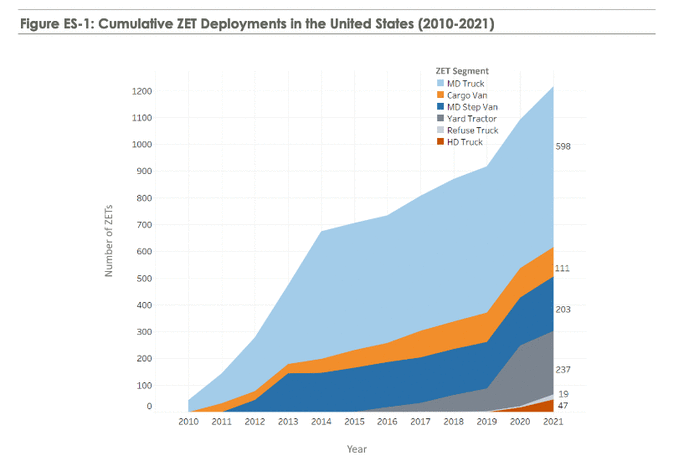
As of December 2021, 1,215 ZETs have been deployed in the United States. For context, Europe has deployed over 2,300 MHD ZETs and China has deployed over 20,000.
Graph: Calstart
Heavy-duty trucks made up only 4% of the total, but this number is expected to grow due to increasing truck model availability and an abundance of orders. Most zero-emission HD trucks deployed as of December 2021 were engaged in large pilot projects to demonstrate their ability to satisfy fleet duty cycles.
While refuse trucks only made up 2% of deployments, they were in a wide variety of states, including Idaho, Maine, and Maryland, where total zero-emission truck deployment numbers are generally low. Refuse trucks in these states were mostly funded by state allocations of the Environmental Protection Agency’s Diesel Emission Reduction Act (DERA) grants and Volkswagen Settlement Funds, which fund the replacement of diesel vehicles.
Pickup trucks are not currently represented in these numbers, because there have been no zero-emission commercial pickup truck deployments to date — but that will soon change. While Rivian has begun to ship its Class 2b R1T pickup truck to customers, all known shipments as of December 2021 were for personal use. However, Ford’s F150 Lightning commercial use pickup truck is expected to start shipping to customers in 2022 and GM’s Chevy Silverado EV is expected the following year.
Currently, the zero-emission truck population is almost entirely battery-electric, reports Calstart. While there are numerous hydrogen fuel-cell trucks under development and used in demonstration/testing programs, they are a small percentage of the ZET population.
Notably, 15% of deployed zero-emission heavy-duty trucks employ fuel-cell electric powertrains, believed to be a promising technology for longer-haul or regional trucking operations where battery range is a concern.
New Generation of Zero-Emission Truck Manufacturers
The report found there are 145 ZET models across 30 manufacturers are available for purchase, an increase of 625% from just two years ago and a very different landscape from early electric-truck deployments.
Many of the battery-electric models and companies that made up the early deployments are no longer in existence, which illustrates one reason many fleets are hesitant to adopt these new technologies. Without the maintenance and support of companies such as Smith EV and Chanje, it’s likely that many of those early deployments are no longer in operation. In fact, according to the report, more than 60% of ZETs that have been deployed in the United States are believed to be currently non-operational.
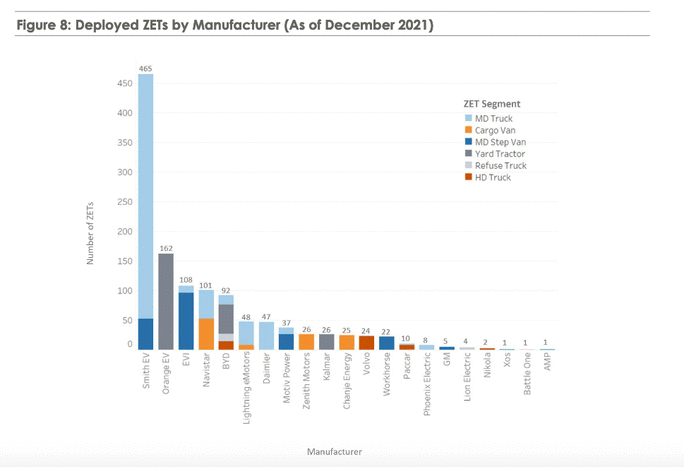
Many early deployments of zero-emission trucks were models from companies that are no longer in operation, such as Smith Electric.
Graph: Calstart
For instance, the manufacturer with the largest share is Smith EV, with 465 vehicles deployed between 2011-2014. But the company suspended production of its electric trucks in 2014 and in 2017 suspended all operations. At least 165 of these Smith EV MD trucks have been reported “non-operational” in California. The status of the other trucks around the country is unknown, but the report’s authors point out that without dedicated servicing from Smith EV, they have likely also been taken out of service.
Similarly, the majority of EVI, Navistar eStar, Chanje, and Workhorse vehicles are non-operational due to support or operational performance issues or were removed from service for additional testing.
A new generation of MD trucks and step vans has since emerged, built with improved battery chemistry, operational range, and performance capabilities.
Growing ZET Numbers
“The actual number of deployed vehicles is still quite low, and we do expect to see shifts in delivery dates and actual delivery of those on order as the market players continue to evolve,” said Kevin Walkowicz, senior director of truck programs at Calstart, in a news release. “However, the numbers demonstrate that there is demand that will support significant growth in the industry.”
Currently, another 140,000 zero-emission trucks are on order, with expected delivery times between one and 10 years. This number includes large pending orders such as Amazon’s commitment to purchase 100,000 delivery vehicles over the next eight years. In California, the state’s Hybrid and Zero-Emissions Vehicle Incentive Voucher Program has pending orders for about 1,200 ZETs (roughly double current ZET deployments in the state), and HVIP expects this number to continue to rise over the next few years.
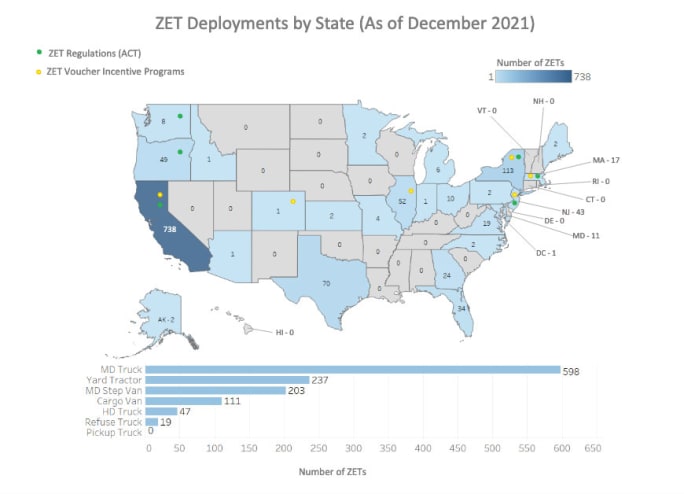
Zero-emission truck deployments are mostly found in states with regulations and/or funding incentives.
Graph: Calstart
In addition, 280 Class 8 battery-electric and fuel-cell electric drayage trucks will be deployed as a part of the joint California Air Resources Board and California Energy Commission Zero Emission Drayage Truck and Infrastructure Pilot Project.
The report also found 163 distinct and known zero-emission truck customers. The vast majority (78%) are private organizations such as third-party logistics and private fleets. The remaining 22% are public organizations, namely municipalities and school districts. Just 20 customers make up 50% of all current ZET deployments and are responsible for operating a cumulative 388,597 total fleet trucks, regardless of fuel type.
Not surprisingly, ZET deployments are concentrated in states with supportive policies and regulations (California, New York, New Jersey, and Illinois) or have received federal funds for ZET purchases (Texas, Oregon, Florida, Georgia, Virginia, and Massachusetts). California is by far the leader, with 61% of all ZET deployments to date. New York has the second highest concentration of ZETs (9.2%) behind California.
“Zeroing in on Zero-Emission Trucks” is based on data gathered from several sources, including market information providers, incentive program records, public press releases, and private correspondence with OEMs (original equipment manufacturers). As there is no centralized accounting of ZETs, it is important to note that figures contained in the report should not be considered static nor should any data on ordered vehicles be considered static, Calstart noted.
Subscribe to Our Newsletter
More Fuel Smarts

Why Diesel Price Relief Efforts May Fall Short
Diesel prices have eased from September’s record high, but doubts about additional Russian supply and limits on dyed-diesel tax relief mean trucking fleets still face expensive fuel. And prices could go higher.
Read More →
Why Small Fuel Savings Matter in Trucking
Can better fuel economy help pay for driver raises? In this podcast, GP Transco explains how small efficiency gains create room to reinvest in its people.
Read More →
How GP Transco Cuts Trucking Fuel Costs, a Tenth of a Gallon at a Time
What’s another tenth of a mile per gallon worth? GP Transco shares how equipment upgrades and driver coaching turn small gains into meaningful fuel savings.
Read More →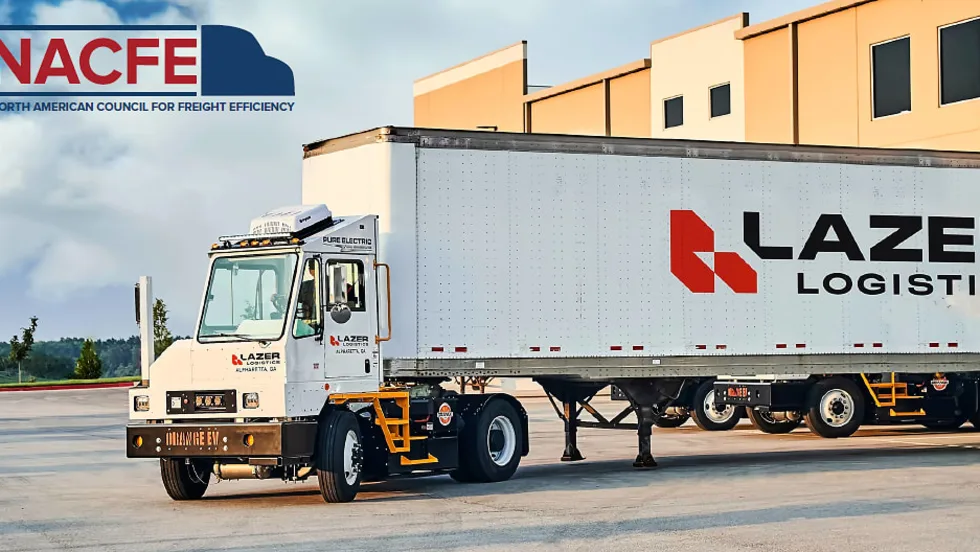
Electric Yard Tractors Move Beyond Pilots
Operating-cost savings have overtaken sustainability goals as the leading reason surveyed fleets are adopting battery-electric terminal tractors, according to new NACFE research.
Read More →
Geotab Links Fleet Card to Vehicle Data
The new card combines fuel discounts with telematics-based purchase controls. Geotab’s analysis also points to potential savings from choosing lower-priced fuel stops.
Read More →
Fleet Economics Shape Electric Truck Outlook
ACT Research expects costs, charging infrastructure, and technology improvements to drive zero-emission commercial vehicle adoption as federal regulations and incentives retreat.
Read More →
Wex Adds Cardless Fuel Payments for Over-the-Road Customers
A new fuel card feature for Wex customers offers convenience and security.
Read More →
New California Law Could Shed Light on Electric Truck Prices
Why do battery-electric Class 8 trucks remain so expensive? A California bill signed by Gov. Gavin Newsom would give fleets and state agencies more visibility into what manufacturers charge.
Read More →
How Volvo Updated Its D13 for EPA 2027 [Watch]
Volvo’s updated D13 promises lower emissions without sacrificing performance or fuel economy. Take a closer look at what changed inside the engine in this HDT Spotlight video.
Read More →
Diesel Price Spike Shortens Payback for Natural Gas Trucks, Report Says
Energy Vision estimates fleets could recover the higher purchase price of an RNG-fueled Class 8 tractor in 1.3 to 2.8 years under current fuel-price scenarios.
Read More →