




Traton Group Talks Electromobility, Partnerships at Innovation Day Event
At an Innovation Day event in Sweden, Traton Group outlined the company's plans to share technology between its divisions and invest in electromobility.

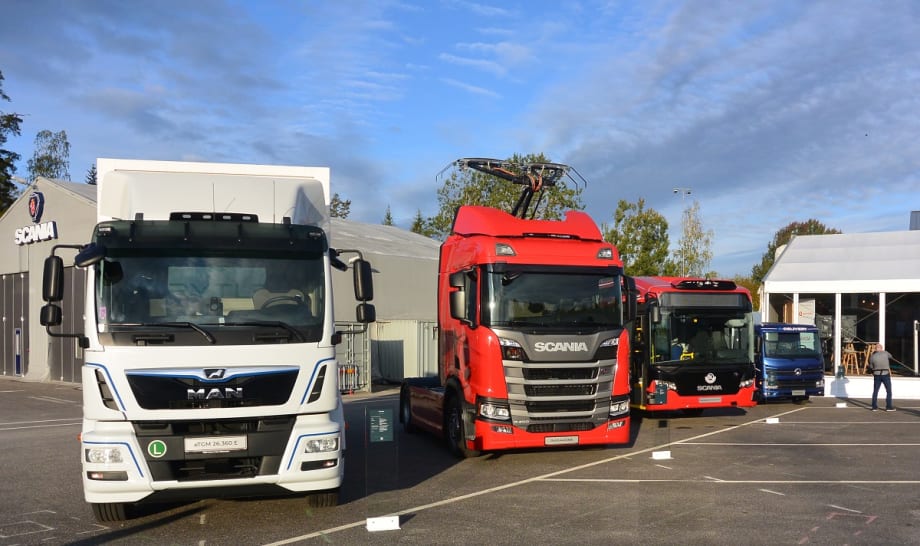
Traton plans to spend $1 billion on electro mobility. Over the next 10-15 years, one third of Traton’s truck and bus deliveries will be equipped with alternative power trains and most of them fully electric.
Photo: Sven-Erik Lindstrand
The Traton Group, previously known as Volkswagen Truck & Bus, held an Innovation Day inside the Scania Demo Center in Södertälje, Sweden, which was renamed the Traton Innovation Campus for the event.
Andreas Renschler, CEO of Traton and with a solid truck background from Daimler AG, began his speech with remarks about the UN Climate Summit held just a week earlier:
“The goal of saving our planet affects all people,” he said. “The reduction of carbon dioxide emissions is probably the greatest challenge humanity has ever faced. Transportation is a core element here, so this applies to our industry and our customers. The Traton Group is aware of the responsibility and strongly drives a change to sustainable and fossil-free transports.”
Renschler said that by 2025, within the group, Traton plans to spend $1 billion on electro mobility. Over the next 10-15 years, one third of Traton’s truck and bus deliveries will be equipped with alternative power trains and most of them fully electric.
“However, this will only be possible if the authorities in time contribute in establishing a functioning charging infrastructure along roads and preferably also financially support conversion into these vehicles,” Renschler continued.
Success factors
Renschler also presented Traton's global strategy for success and global expansion, which is mainly based on four pillars: product modularization, software and system development, collaboration within the group and customer-focused innovations.
Today, more than 2,000 engineers work in software alone, which is 30% of the group's combined technicians. Here, Traton's cloud-based logistics brand Rio plays an important role for better capacity utilization of trucks. Today, the utilization rate is only 50 – 60%, according to Renschler.
Cross-border cooperation
“Creative innovation is not just about finding brilliant ideas, it is also about uniting and connecting with the right people, including our customers,” said Renschler.
The collaboration with external partners such as Hino in Japan has resulted in the delivery of an electrified commercial truck in Brazil - equipped with e-driveline components from Hino.
“We have now received a huge order of 1,600 e-Delivery trucks from Ambev for beer distribution in Brazil,” said Renschler.
Key Customers
Christian Levin, Traton’s chief operating officer, held a dialogue on stage with key customer representatives such as Patrik Müller from the beer giant inBev, Helmut Schweighofer, CEO for DB Schenker Europe, and Daniel Mohlin from Nobina.
They emphasized the increasingly high demands placed on the vehicle fleets and emphasized the added value of the new modularization concepts of Traton.
Within the framework of Traton Group, MAN and Scania as brands have agreed on clear principles for joint development projects. This means common platforms for engines, gearboxes, axles and exhaust aftertreatment systems. These can then be modified by the individual brands. One of the two companies is given the management responsibility for each individual area.
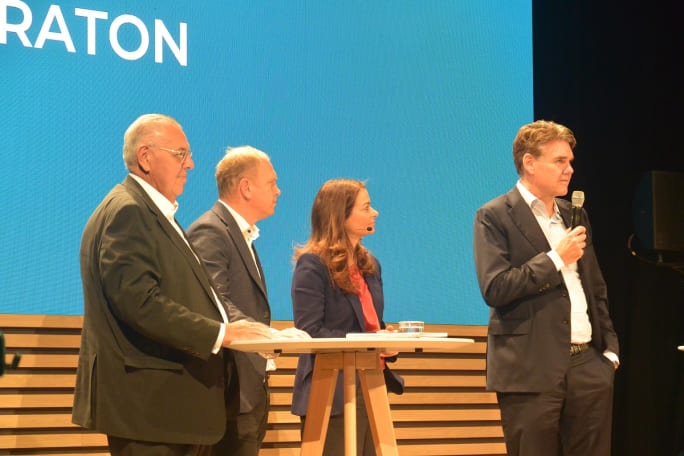
The managers of Traton's three brands: Roberto Cortes, Brazilian Volkswagen Caminhões e Ônibus, Henrik Henriksson, Scania and Joachim Drees, MAN with Traton's communications manager Julia Kroeber-Riel.
Photo: Sven-Erik Lindstrand
Powertrains
Progress has also been made in creating common solutions on the engine side. MAN has the lead engineering role, with management responsibility for the development of the smaller engines between 5 and 10-liters while Scania leads development of engines between 11-13 liters.
Scania is also responsible for exhaust aftertreatment systems for larger engines and MAN for the smaller and medium-sized ones. Scania is in charge of heavy gearboxes while MAN is responsible for medium and light gearboxes as well as all types of axles, driven and non-driven.
An upcoming common 13-liter diesel engine will soon be released called the CBE1, which stands for Common Base Engine. Around 120 engineers have worked on the development of this engine, which is likely to be launched next year at Scania and is expected to be adopted by MAN and Navistar at a later date.
More Equipment

How Volvo Updated Its D13 for EPA 2027 [Watch]
Volvo’s updated D13 promises lower emissions without sacrificing performance or fuel economy. Take a closer look at what changed inside the engine in this HDT Spotlight video.
Read More →
Michelin Tire Improves Efficiency and Durability for Regional Fleets
The Michelin X Multi Energy D2 is a regional haul drive tire engineered to help fleets improve fuel efficiency, durability and traction in demanding stop-and-go operations.
Read More →
ZF Expands Commercial Vehicle Push in North America
ZF is expanding its North American commercial-vehicle presence with new transmission applications, electrification, trailer technology and autonomous-driving systems.
Read More →
Tesla Wants a Self-Driving Semi. Are Cameras Enough?
Could Tesla’s camera-only autonomous driving technology work on an 80,000-pound Semi? In this commentary, HDT's Deborah Lockridge takes a look at Tesla, Cybercab, and how autonomous trucks see the road.
Read More →
Kodiak: Driverless Long-Haul Truck Launch on Track for 2026
Kodiak AI says its driverless long-haul safety case is 93% complete and it remains on track to begin commercial operations by year-end 2026.
Read More →
What DOT’s Automated Vehicle Strategy Means for Trucking
The U.S. Department of Transportation issued a new automated-vehicle strategy that outlines plans for driverless-truck regulations, cross-state freight corridors, and federal safety standards.
Read More →
East Coast Port Launches $45M Electric Truck Push
The Port Authority of New York and New Jersey announced millions in incentives for zero-emission drayage trucks, yard tractors, and new charging hubs near the port.
Read More →
PlusAI Going Public to Fund Autonomous Truck Launch
A SPAC deal could provide PlusAI with up to $300 million as it works toward a 2027 commercial launch of factory-built autonomous trucks.
Read More →
NHTSA Moves to Rewrite Truck Fuel-Economy Rules
The National Highway Traffic Safety Administration says it lacks authority to regulate medium- and heavy-duty truck engines separately from complete vehicles, but the existing standards have not yet been eliminated.
Read More →
Detroit Opens Orders for EPA 2027 Engines
Detroit isn’t starting from scratch to meet EPA 2027 diesel emissions standards. Its Gen 6 DD13 and DD15 engines keep much of today’s platform while updating the fuel and aftertreatment systems.
Read More →