





What Does the CARB-OEM Emissions Compromise Mean for Trucking?
Study: Electrification of Interstate Corridors Critical for Electric Truck Adoption
A new white paper produced by Uber Freight found that a nationwide, strategic, electric infrastructure plan — with an emphasis on Interstate highways — is essential for electric truck adoption by fleets.
December 14, 2023
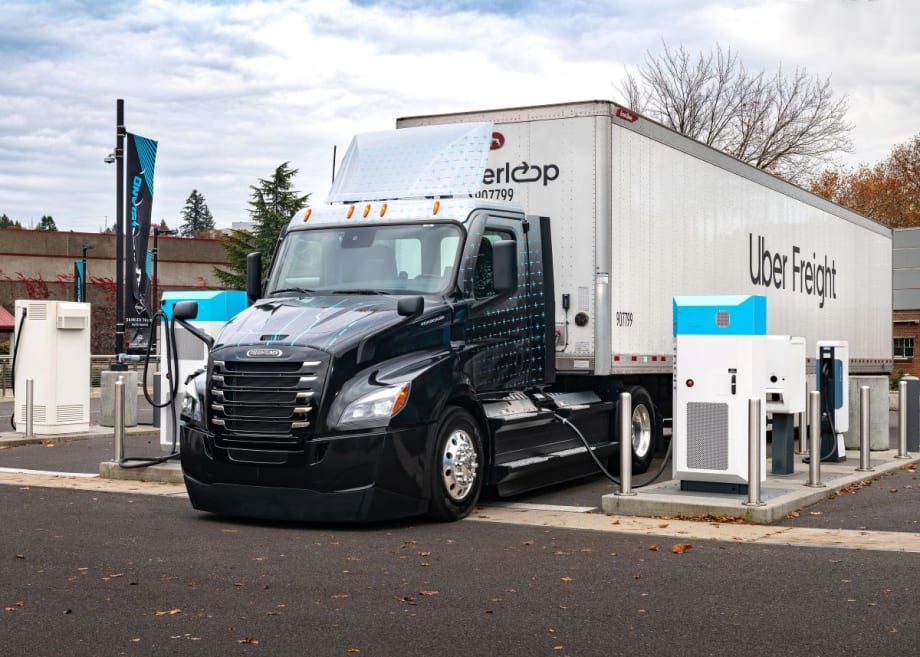
Strategic development of charging infrastrucutre is critical for the increased adoption of electric trucks, according to a new white paper from Uber Freight.
Photo: Greenlane
4 min to read
Strategically placing charging stations along both local and interstate highways is critical for accelerating fleet adoption of battery-electric trucks nationwide. That’s one of several findings in a new white paper commissioned by Uber Freight.
The report, What can Uber Freight Data Tell Us About the Future of Electrification, was compiled after analyzing Uber Freight data gathered from 500,000 dry van loads. Uber Freight said these loads are representative of U.S. freight movements. Using this information, Uber Freight analysts developed a model for the optimal development and deployment of charging stations across large markets.
This analysis includes strategic freight corridors to meaningfully address sustainability within the freight industry, according to the white paper. The analysis also takes into account and builds on announced regulations such as the Inflation Reduction Act, the proposed EPA Clean Air Act, and the Advanced Clean Trucks rule which has been adopted in several states.
Local Charging Starting Points
Uber Freight found that local hauls in large urban markets are the best candidates for rapid electrification. These areas should serve as the starting for the deployment of an eventual nationwide charging network, the study found. Uber Freight's research suggested that starting with local hauls is a good first step toward electrification due to the limitations of today’s charging infrastructure.
Looking deeper at current local charging infrastructure efforts, Uber Freight analysts also found:
In local markets, if charging stations are located strategically, only a few stations are needed in each market to accelerate electric truck adoption.
Markets like Los Angeles, Ontario, Atlanta, Dallas, and New York are strong early candidates. For example, in Dallas / Fort Worth, 10 charging stations are enough to provide early adopters with access to most local loads, accounting for 95% of local freight miles.
Optimizing truck charger locations remains a complex task with many variables, including shippers’ locations, grid readiness, throughput time-of-day, locations of truck depots, and land availability.
Although they account for a quarter of all freight loads in the U.S., local hauls (those less than 150 miles) account for a small fraction (3.2%) of the miles traveled. Therefore, electrifying the interstate system, which carries more than half of all trucking miles, is critical to achieving a meaningful reduction in freight emissions.
Meaningful, Natiowide Change Only Possible with Interstate Electrification
The challenges of installing charging infrastructure along Interstate highway corridors are much greater. But the long-term benefits for electric trucks are much more profound, the report noted.
Currently, most heavy-duty electric trucks have a maximum range of 200 miles, Uber Freight analysts said. And chargers are generally not available along the interstate system.
However, the report found, if OEMs are able to double the range to 400 miles in the coming years, and chargers become more available on a given lane, for example, nine chargers per 1,000 miles, then two thirds of all heavy-duty loads on that lane could be addressable by electric trucks.
Even with a limited truck range of 300 miles, Uber Freight analysts said, more than 75% of truck miles in the U.S. can be electrified — but only if charging infrastructure is available ubiquitously. Still, although long-distance freight electrification requires heavier investments, it will likely have higher ROI because higher mileage means greater asset utilization for fleets.
In looking at interstate electrification, the report also found that:
Initial long-distance deployment is most likely to happen on busy, but short, interstate corridors, such as the Texas Triangle lanes connecting Dallas to Houston and San Antonio, and the I-5 corridor between Los Angeles and Stockton.
As electric trucks scale, the power capacity of charging stations will become the largest constraint, even for local freight. North America’s grid must be prepared to add significant capacity to address new truck electricity demand.
Research estimates that by 2035, North America’s grid must be prepared to add 230 TWh of new truck electricity demand, including power for nearly 150,000 fast public chargers and 860,000 depot chargers.
Shipper facilities might be good candidates for doubling as charging stations. Additional charging stations at shippers’ facilities, Uber said, can increase the number of loads that could be hauled by EVs by about 12% and the number of miles by about 8%.
Public and shared chargers can complement private ones and accelerate adoption by eliminating the financial barriers for carriers that cannot invest in private chargers.
In later stages, the majority of the interstate system in the eastern U.S. should be electrified.
The white paper is the latest initiative by Uber Freight to unveil new research in aspects of trucking technology that reveal a roadmap for the thoughtful deployment and adoption of electric trucks, charging infrastructure, autonomous trucks and other technologies at scale, the company said.
More Fuel Smarts

New California Law Could Shed Light on Electric Truck Prices
Why do battery-electric Class 8 trucks remain so expensive? A California bill signed by Gov. Gavin Newsom would give fleets and state agencies more visibility into what manufacturers charge.
Read More →
How Volvo Updated Its D13 for EPA 2027 [Watch]
Volvo’s updated D13 promises lower emissions without sacrificing performance or fuel economy. Take a closer look at what changed inside the engine in this HDT Spotlight video.
Read More →
Diesel Price Spike Shortens Payback for Natural Gas Trucks, Report Says
Energy Vision estimates fleets could recover the higher purchase price of an RNG-fueled Class 8 tractor in 1.3 to 2.8 years under current fuel-price scenarios.
Read More →

Calstart Becomes Catalyst Mobility, Reflecting Broader Focus
Calstart is now Catalyst Mobility, reflecting the nonprofit’s growing national role in clean transportation, including zero-emission trucks, infrastructure and incentive programs.
Read More →
Record Diesel Prices Squeeze Trucking Fleets
Average U.S. diesel prices have climbed to nearly $6 a gallon, surpassing the 2022 record as tight refinery capacity and Middle East disruptions keep fuel costs elevated.
Read More →
Sponsored•September 9, 2026
How Fuel Delivery Shapes Engine Performance
Fuel delivery depends on more than what happens at the injector. For fleet, maintenance and technical professionals, looking at the full path from pump to injector can provide useful context for understanding engine performance.
Read More →
East Coast Port Launches $45M Electric Truck Push
The Port Authority of New York and New Jersey announced millions in incentives for zero-emission drayage trucks, yard tractors, and new charging hubs near the port.
Read More →
Detroit Opens Orders for EPA 2027 Engines
Detroit isn’t starting from scratch to meet EPA 2027 diesel emissions standards. Its Gen 6 DD13 and DD15 engines keep much of today’s platform while updating the fuel and aftertreatment systems.
Read More →
Zero-Emission Truck Corridor Planned for West Coast
California, Oregon, Washington, British Columbia and Baja California are coordinating plans for truck charging and hydrogen fueling from Canada to Mexico.
Read More →
A Closer Look at Kenworth’s Electric T880E Vocational Truck [Video]
Learn more about Kenworth's T880E battery-electric vocational truck at the Paccar Technical Center, including its range, applications, upfitting considerations, and PTO options, in this HDT Spotlight video.
Read More →