




Stoughton Intermodal Chassis Earns Underride Guard Award
A Stoughton intermodal chassis is the first of its kind to qualify for the Insurance Institute for Highway Safety’s Toughguard award for underride protection.

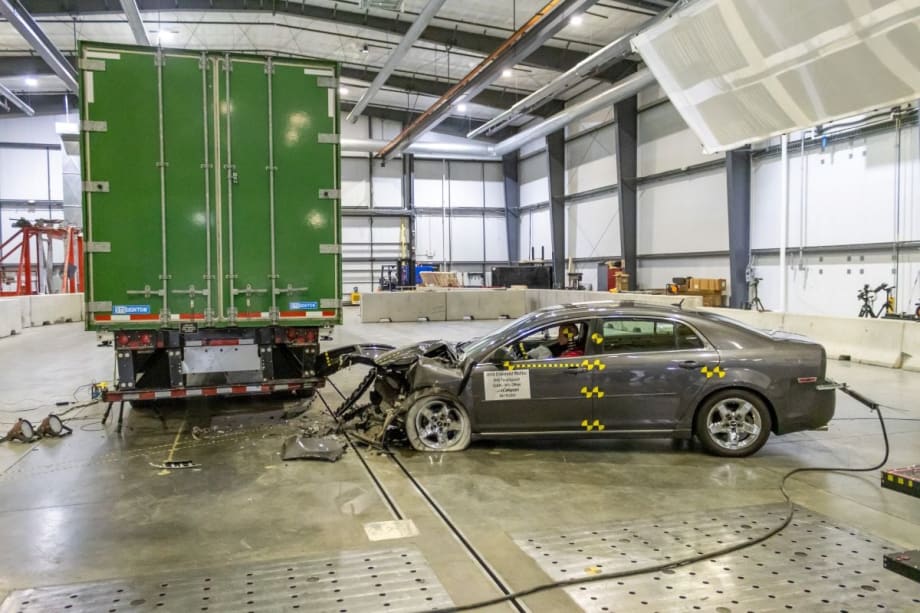
Intermodal chassis present a unique challenge when it comes to rear underride protection.
Photo: Stoughton
A Stoughton intermodal chassis is the first of its kind to qualify for the Insurance Institute for Highway Safety’s Toughguard award for underride protection.
Wisconsin-based Stoughton previously earned the award for its dry vans and refrigerated vans. Now the company’s 53-foot intermodal chassis also meets the Toughguard criteria. The award applies to models built after April 2025.
Underride guards that meet the Toughguard criteria are substantially more likely to withstand an impact, reducing the severity of the crash, according to IIHS.
Until now, only dry van, refrigerated, and flatbed trailers have qualified. But with the growing importance of shipping containers in global trade, more and more freight is being transported using intermodal chassis.
Chassis-type trailers present a unique challenge when it comes to underride protection. The frame of a dry van, refrigerated or flatbed trailer extends across its entire wheelbase, supporting the underride guard for its full width. In contrast, an intermodal chassis is a ladder-like structure that lies between the trailer’s wheels to support the removable container.
For that reason, the underride guard required a completely new design. Instead of a vertical support attached to the trailer deck, the chassis guard features long, diagonal supports running from the guard’s outboard ends to the chassis rails.
About Trailer Underride Guard Standards
The National Highway Traffic Safety Administration updated federal regulations governing rear underride protection on large trucks in June 2022.
IIHS said at the time that those standards don’t go far enough.
Truck Safety Coalition and Advocates for Highway and Auto Safety also criticized the rule and jointly filed a formal petition for reconsideration, calling the rear underride guard rule “inadequate and alarming.”
“A major weakness of the federal regulation is that in the required test, the underride guard is bolted to a universal testing rig instead of an actual trailer,” IIHS Senior Test Coordinator Sean O’Malley said in a news release.
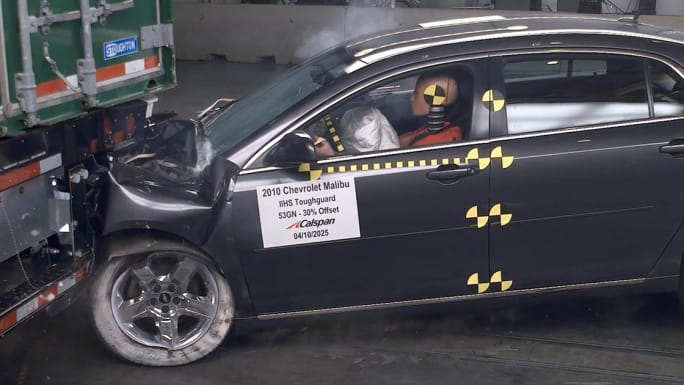
IIHS evaluates underride guards on the trailers they are designed for, which it says is more accurate than the federal government's test rig.
Photo: IIHS
“When we were developing the Toughguard program, we found that many underride guards that survived testing attached to NHTSA’s rig broke off when attached to the trailer they were built to be used on, either because the attachment points on the trailer failed or the bolts did.”
In contrast, IIHS evaluates underride guards on the trailers they are designed for.
In the IIHS test, a midsize car crashes into the back of the parked trailer at 35 mph in three configurations, hitting the trailer with its full width, a 50% overlap and a 30% overlap. To earn the IIHS award, the guard must prevent underride in all three configurations.
The 30% overlap configuration — which was left out of the new federal requirements — is the most challenging, because only the corner of the underride guard must absorb all the force of the impact.
Initially, these tests were conducted in-house by NHTSA. Now IIHS allows trailer manufacturers to submit data and footage from tests conducted at their own facilities or by contractors for IIHS experts to review. The tests of Stoughton’s intermodal chassis were conducted by Calspan.
Stoughton Trailers And Intermodal Chassis
Stoughton was also among the earliest trailer manufacturers to earn a Toughguard award for its dry vans and refrigerated trailers in 2017.
To date, nine North American trailer manufacturers, including the eight largest, have earned the IIHS underride guard awards.
Stoughton’s intermodal chassis product line is supported by three dedicated manufacturing lines in Stoughton and Evansville, Wisconsin, and Waco, Texas. The company is one of the largest chassis manufacturers in North America.
More Equipment

How Volvo Updated Its D13 for EPA 2027 [Watch]
Volvo’s updated D13 promises lower emissions without sacrificing performance or fuel economy. Take a closer look at what changed inside the engine in this HDT Spotlight video.
Read More →
Michelin Tire Improves Efficiency and Durability for Regional Fleets
The Michelin X Multi Energy D2 is a regional haul drive tire engineered to help fleets improve fuel efficiency, durability and traction in demanding stop-and-go operations.
Read More →
ZF Expands Commercial Vehicle Push in North America
ZF is expanding its North American commercial-vehicle presence with new transmission applications, electrification, trailer technology and autonomous-driving systems.
Read More →
Tesla Wants a Self-Driving Semi. Are Cameras Enough?
Could Tesla’s camera-only autonomous driving technology work on an 80,000-pound Semi? In this commentary, HDT's Deborah Lockridge takes a look at Tesla, Cybercab, and how autonomous trucks see the road.
Read More →
Kodiak: Driverless Long-Haul Truck Launch on Track for 2026
Kodiak AI says its driverless long-haul safety case is 93% complete and it remains on track to begin commercial operations by year-end 2026.
Read More →
What DOT’s Automated Vehicle Strategy Means for Trucking
The U.S. Department of Transportation issued a new automated-vehicle strategy that outlines plans for driverless-truck regulations, cross-state freight corridors, and federal safety standards.
Read More →
East Coast Port Launches $45M Electric Truck Push
The Port Authority of New York and New Jersey announced millions in incentives for zero-emission drayage trucks, yard tractors, and new charging hubs near the port.
Read More →
PlusAI Going Public to Fund Autonomous Truck Launch
A SPAC deal could provide PlusAI with up to $300 million as it works toward a 2027 commercial launch of factory-built autonomous trucks.
Read More →
NHTSA Moves to Rewrite Truck Fuel-Economy Rules
The National Highway Traffic Safety Administration says it lacks authority to regulate medium- and heavy-duty truck engines separately from complete vehicles, but the existing standards have not yet been eliminated.
Read More →
Detroit Opens Orders for EPA 2027 Engines
Detroit isn’t starting from scratch to meet EPA 2027 diesel emissions standards. Its Gen 6 DD13 and DD15 engines keep much of today’s platform while updating the fuel and aftertreatment systems.
Read More →