





From the HDT Archives (2013):
Underride Guards on Most Big Rigs Leave Passenger Vehicle Occupants at Risk, IIHS Says
Safety Groups Petition NHTSA to Reconsider Rear Underride Rule
A new underride-guard rule years in the making is still not good enough, say safety groups petitioning for it to be reconsidered.
August 31, 2022
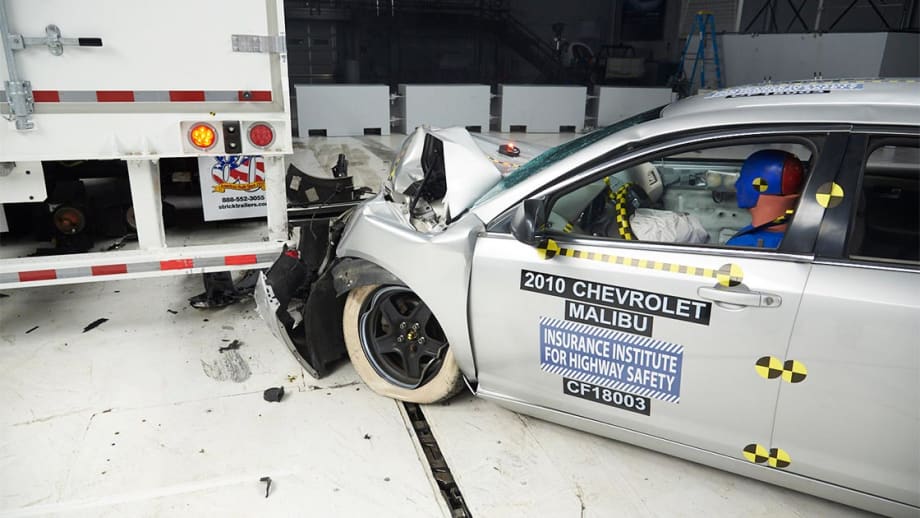
IIHS crash testing has shown it's possible to design guards that can withstand crashes with a narrow overlap, but critics say the new rule does not require such testing.
Photo: IIHS
4 min to read
Several safety groups with a focus on truck regulations have petitioned the National Highway Traffic Safety Administration to reconsider its new underride guard rule, scheduled to go into effect on Jan. 11.
On Aug. 29, the Truck Safety Coalition and Advocates for Highway and Auto Safety jointly filed a formal petition for reconsideration, calling the rear underride guard rule “inadequate and alarming.” They asked for a stay of the effective date while the petition is being considered.
The Truck Safety Coalition is a partnership between Citizens for Reliable and Safe Highways (CRASH) and Parents Against Tired Truckers. Advocates for Highway and Auto Safety is an alliance of consumer, medical, public health, law enforcement and safety groups and insurance companies and agents.
Underride crashes involve a passenger vehicle running up under the front, side, or rear of a large truck.
A NHTSA document lays out the new rear underride rule as an upgrade of the agency’s safety standards by adopting similar requirements to Transport Canada’s standards for rear impact guards. These standards address the impact on passenger vehicles all the way down to the subcompact range. The rule amends FMVSS No. 223, “Rear Impact Guards,” and FMVSS No. 224, “Rear Impact Protection.”
The underride rule has been in the works since 2015. Since then, many trailer makers have voluntarily improved their underride guards.
Critics: Underride Rule Relies on Flawed Data
The petition contends that NHTSA failed to consider relevant available data on underride crashes as well as testing performed by the Insurance Institute for Highway Safety. The safety groups said NHTSA relied on a single 2013 research study conducted by the University of Michigan Transportation Research Institute. That in turn used FARS data (Fatality Analysis Reporting System,) which the groups contend includes insufficient data on underride crashes.
Underride crashes are underreported due to a variety of factors, according to the petition. such as variability across states in defining underride crashes, inconsistencies in state crash reporting forms and documentation methods, and limited information provided to state and local police on how to consistently identify and record underride crash data. In fact, the petition noted, a Government Accountability Office report in 2019 said two state police departments don’t collect underride data because “underride crashes are not a traffic safety priority for them.”
The Insurance Institute for Highway Safety recommended NHTSA improve its underride data collection efforts as far back as 1992, the petitioners said, adding that the National Transportation Safety Board has made several recommendations to NHTSA to improve the data involving underride crashes.
IIHS Underride Testing
In 2011, the Insurance Institute for Highway Safety released testing results indicating that many underride guards performed poorly. It petitioned the federal government to improve underride protection.
In 2017, IIHS introduced its Toughguard award for trailers with guards that prevent underride during three different scenarios: When the full width of the vehicle collides with the guard, a 50% overlap with the guard, and a 30% overlap with the guard. Currently, nine North American trailer manufacturers, including the eight largest, have earned the Toughguard award for some or all of their trailers.
“There is no sound excuse for the rule, at a minimum, to not meet the test the Insurance Institute for Highway Safety has been using to rate rear underride guards for the last five years, especially considering nine major trailer manufacturers meet it,” said Cathy Chase, president of Advocates.
In the Investment and Jobs Act passed late last year (known widely as the Bipartisan Infrastructure Law), Congress required NHTSA to complete the underride rulemaking and mandated that the final rule include performance standards matching the IIHS award, according to the safety groups’ petition.
“NHTSA’s rear underride guard final rule fails to even meet Infrastructure Investment and Jobs Act (IIJA) requirements, dropping the directive to issue a standard effective at 35 mph when 30% of the passenger vehicle overlaps with the rear underride guard,” according to the groups.
More to Come on Underride from NHTSA
NHTSA said when it announced the underride rule that it is working to implement other underride provisions mandated by the IIJA infrastructure bill:
Establishing a federal advisory committee on underride protection, which will complete research on side underride guards for trailers and semi-trailers to assess their effectiveness, feasibility, benefits, costs, and impact on intermodal operations.
Planning to publish an advance notice of proposed rulemaking on requirements for side underride guards for crashes into the sides of trailers and semi-trailers. This rulemaking also responds to a provision in the IIJA to report the findings of research on side underride guards in a Federal Register notice to seek public comment.
Improving data collection of underride crashes by recommending inclusion of underride data in state crash data systems and by providing educational materials to state and local police departments on identifying and recording underride crashes.
Conducting research on rear-impact guard designs that “better protect occupants of passenger vehicles in even more rear underride crash scenarios.”
More Safety & Compliance

FMCSA Pauses Biennial-Update Enforcement Amid Motus Transition
Carriers whose updates were due on or after June 1 have more time, while FMCSA works to stabilize its new registration system and warns of phishing sites impersonating its new carrier registration system, Motus.
Read More →
ZF Expands Commercial Vehicle Push in North America
ZF is expanding its North American commercial-vehicle presence with new transmission applications, electrification, trailer technology and autonomous-driving systems.
Read More →
Truck Drivers Need More Than Another Alert
Fleets have more visibility into truck health, safety events, and driver activity than ever. The next challenge is turning all that information into useful guidance for the person who has to decide what to do next.
Read More →
Tesla Wants a Self-Driving Semi. Are Cameras Enough?
Could Tesla’s camera-only autonomous driving technology work on an 80,000-pound Semi? In this commentary, HDT's Deborah Lockridge takes a look at Tesla, Cybercab, and how autonomous trucks see the road.
Read More →
What DOT’s Automated Vehicle Strategy Means for Trucking
The U.S. Department of Transportation issued a new automated-vehicle strategy that outlines plans for driverless-truck regulations, cross-state freight corridors, and federal safety standards.
Read More →
NYC Expands Speed, Pedestrian Safety Tech Across Fleet
New York City is expanding intelligent speed assistance and pedestrian-alert systems across its municipal fleet, moving the technologies from pilot programs into vehicle procurement and retrofit requirements.
Read More →
FMCSA Removes 110 Truck Driver Training Schools from Certified ELDT List
Federal regulators also are targeting more than 160 additional training providers and launching a nationwide audit of third-party CDL skills testers as part of a broader crackdown on trucking fraud.
Read More →
Beyond DOT Compliance: What Makes a Trucking Fleet Truly Safe?
A trucking fleet can follow every rule and still make unsafe decisions. The real test comes when safety conflicts with freight, productivity, or cost.
Read More →
Hours of Service Pilot Programs: FMCSA Readies for 2027 Rollout
Two pilot programs could eventually reshape hours-of-service rules, giving truck drivers options to pause their 14-hour clock or use longer split sleeper rest periods.
Read More →
New Guide Offers Pet Safety Tips for Truck Drivers
Hundreds of thousands of pets travel in truck cabs. A new safety guide from Volvo Trucks and the Center for Pet Safety offers practical advice for truck drivers who bring dogs and cats along for the ride.
Read More →