





J.B. Hunt Testing Natural-Gas Cummins X15N in New Clean Energy Program
Solar to Power J.B. Hunt Campus
J.B. Hunt's new solar facility will provide power for its headquarters equivalent to eliminating 1,400 passenger vehicles from the road each year.
January 29, 2025
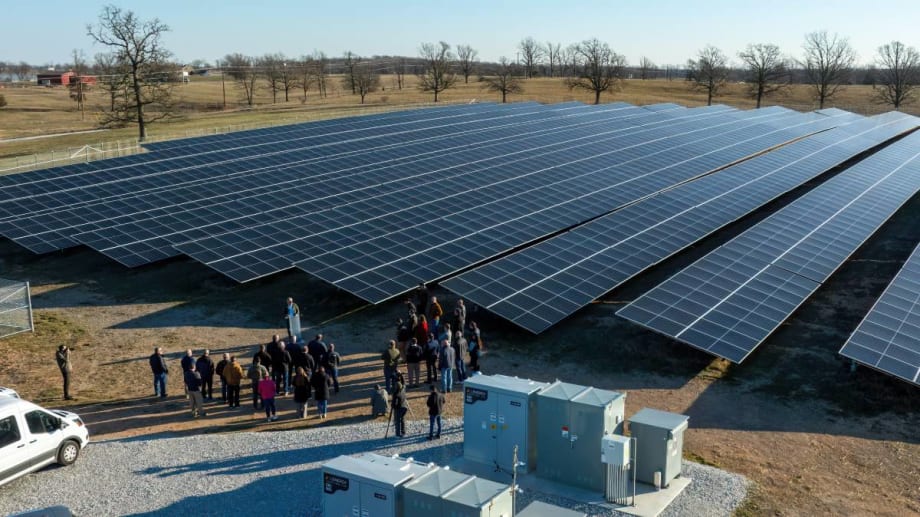
J.B. Hunt continues its sustainability journey with the launch of a solar farm.
Photo: J.B. Hunt
2 min to read
J.B. Hunt Transport Services launched a solar facility in Gentry, Arkansas, that will generate enough electricity to offset up to 80% of the power used by its three main corporate campus buildings in Lowell.
The 40-acre solar facility includes nearly 18,000 solar panels and 10,000-plus bi-facial solar modules to capture sunlight, which is then converted to electricity and transmitted to a nearby electric grid for Carroll County Electric.
The facility will produce approximately 9.3M kWh annually and use net metering, which helps transfer surplus power onto the power grid.
J.B. Hunt's Commitment to Sustainable Supply Chains
“By commissioning this solar facility, J.B. Hunt is demonstrating our commitment to enhancing the communities we serve and to investing in economically viable practices aimed at creating a more sustainable supply chain,” said Greer Woodruff, executive vice president of safety, sustainability and maintenance at J.B. Hunt.
“The annual amount of clean energy generated by the J.B. Hunt Solar Facility will be equivalent to that used by nearly 1,200 homes," Woodruff said.
"And, by drawing power from the sun and not a carbon-based source, the carbon dioxide kept from entering the atmosphere will be equivalent to eliminating 1,400 passenger vehicles from the road each year.”
Construction of the facility began in 2024. The project was managed by NextEra Energy and completed by Verogy. Both Trio (formerly Edison Energy) and Carroll Electric Cooperative Corporation provided ongoing consultation throughout planning and development.
In 2023, J.B. Hunt surpassed the halfway mark to achieving its ambitious goal to reduce its carbon emission intensity 32% by 2034 from a baseline year of 2019.
More Fleet Management

Kodiak Lines Up Fleets for Driverless Trucking
An agreement for 75 trucks, a new Texas freight lane, and progress on safety validation move Kodiak closer to its planned driverless highway launch.
Read More →
ITS Logistics Settles Religious Harassment Case
The Nevada-based logistics firm agreed to pay more than $396,000 to settle a religious harassment charge involving an employee's Jewish identity.
Read More →
Your Trucks Are Busy. That Doesn’t Mean They’re Winning.
High utilization doesn’t always mean strong margins. Looking beyond the current load can help fleets make better dispatch decisions and get more value from each truck’s time.
Read More →
Why This Trucking Recovery Is Different
Freight demand remains sluggish, but rising costs and tougher enforcement have taken enough capacity out of the market to change the outlook for motor carriers.
Read More →
Platform Science Adds Dispatch and Safety Tools
Four additions to PS Fleet help fleets monitor loads, manage driver coaching, share truck locations and adjust video system settings.
Read More →
PrePass Intelligence Mines Fleet Bypass, Toll and Safety Data
PrePass Intelligence helps fleets measure bypass savings, flag potential toll overcharges, and spot suspicious transactions by combining data from separate systems.
Read More →
Motive Adds AI Agents for Fleet Operations
New tools automate follow-up on fleet data, from maintenance work orders to driver alerts, with two-way voice conversations planned for later this year.
Read More →
Can You Beat Our Trucking Trivia Challenge?
Test your truck knowledge with 19 trivia questions from Heavy Duty Trucking Exchange. Can you keep up with the fleet pros?
Read More →
BeyondTrucks Adds Rules Checks to Dispatch
New Compatibility Engine checks driver qualifications, equipment requirements and fleet policies before loads are dispatched.
Read More →
Diesel Prices Hijack Trucking’s Worry List
ATRI’s annual survey finds cautious optimism about freight, but diesel costs, litigation, and insurance continue to squeeze fleets. Drivers have different priorities on several issues.
Read More →