





Emission intensity measures the volume of absolute emissions emitted against a relevant business output, allowing for business growth while still showing emissions improvement on a per unit basis.
J.B. Hunt’s Ambitious Emission Reduction Goal
J.B. Hunt will focus on alternative vehicles, biogenic fuels and improving fuel economy to reach its emission-reduction target by 2034.
November 15, 2022
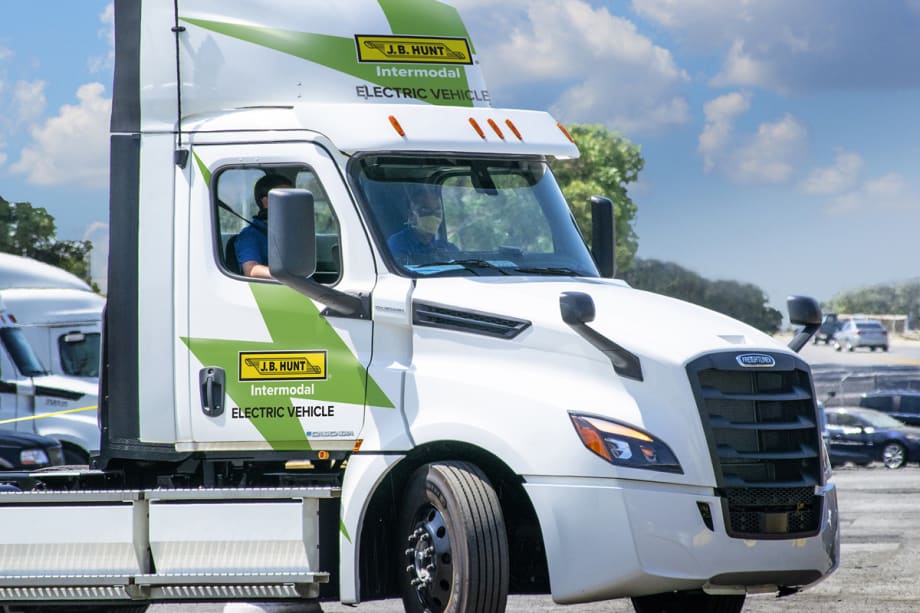
J.B. Hunt will focus on alternative vehicles, biogenic fuels and improving fuel economy to reach its emission-reduction target by 2034.
Photo: J.B. Hunt
2 min to read
J.B. Hunt Transport Services has committed to reduce its carbon emission intensity 32% by 2034 compared to its 2019 levels.
J.B. Hunt will focus on three key areas to reach its emission-reduction target by 2034:
Incorporating alternative powered equipment into its fleet
Expanding the use of biogenic fuels
Improving fuel economy (diesel powered miles-per-gallon)
“Our goal is an ambitious challenge to improve J.B. Hunt’s carbon footprint and to help advance the transportation industry’s progress in developing sustainable solutions that are commercially viable and scalable for widespread adoption,” said Craig Harper, chief sustainability officer and executive vice president at J.B. Hunt, in a press release.
Achieving the company’s target is dependent on significant progress with the development and availability of new industry technology and the infrastructure needed to enable their day-to-day use on an industry-wide scale. Examples include developments such as:
ongoing enhancements to commercial motor vehicles;
charging and refueling infrastructure;
expanded capacity on the electrical grid;
increased availability of biogenic fuels; and,
the incorporation of more energy resources with lower carbon intensity.
J.B. Hunt’s goal is an intensity target aligned with the original goal of the Paris Climate Agreement to limit global warming to 2 degrees Celsius. The company’s target will focus on reducing Scope 1 and Scope 2 emissions per company operated ton-mile 32% by 2034 from a 2019 base year.
J.B. Hunt developed a roadmap for how its goal could be achieved if certain assumptions, including those related to electric vehicles, biogenic fuels and MPG improvements, are met. These assumptions were made with understanding of company operations and following consultation with suppliers and original equipment manufacturers and recommendations from a variety of industry organizations.
While J.B. Hunt must depend on other companies and industries for these assumptions to be realized, the company plans to encourage, support and monitor the advancements needed to achieve its goal, company officials said.
More Fuel Smarts

How Volvo Updated Its D13 for EPA 2027 [Watch]
Volvo’s updated D13 promises lower emissions without sacrificing performance or fuel economy. Take a closer look at what changed inside the engine in this HDT Spotlight video.
Read More →
Diesel Price Spike Shortens Payback for Natural Gas Trucks, Report Says
Energy Vision estimates fleets could recover the higher purchase price of an RNG-fueled Class 8 tractor in 1.3 to 2.8 years under current fuel-price scenarios.
Read More →
Calstart Becomes Catalyst Mobility, Reflecting Broader Focus
Calstart is now Catalyst Mobility, reflecting the nonprofit’s growing national role in clean transportation, including zero-emission trucks, infrastructure and incentive programs.
Read More →

Record Diesel Prices Squeeze Trucking Fleets
Average U.S. diesel prices have climbed to nearly $6 a gallon, surpassing the 2022 record as tight refinery capacity and Middle East disruptions keep fuel costs elevated.
Read More →
Sponsored•September 9, 2026
How Fuel Delivery Shapes Engine Performance
Fuel delivery depends on more than what happens at the injector. For fleet, maintenance and technical professionals, looking at the full path from pump to injector can provide useful context for understanding engine performance.
Read More →
East Coast Port Launches $45M Electric Truck Push
The Port Authority of New York and New Jersey announced millions in incentives for zero-emission drayage trucks, yard tractors, and new charging hubs near the port.
Read More →
California Bill Could Shed Light on Electric Truck Prices
Why do battery-electric Class 8 trucks remain so expensive? A California bill headed to Gov. Gavin Newsom would give fleets and state agencies more visibility into what manufacturers charge.
Read More →
Detroit Opens Orders for EPA 2027 Engines
Detroit isn’t starting from scratch to meet EPA 2027 diesel emissions standards. Its Gen 6 DD13 and DD15 engines keep much of today’s platform while updating the fuel and aftertreatment systems.
Read More →
Zero-Emission Truck Corridor Planned for West Coast
California, Oregon, Washington, British Columbia and Baja California are coordinating plans for truck charging and hydrogen fueling from Canada to Mexico.
Read More →
A Closer Look at Kenworth’s Electric T880E Vocational Truck [Video]
Learn more about Kenworth's T880E battery-electric vocational truck at the Paccar Technical Center, including its range, applications, upfitting considerations, and PTO options, in this HDT Spotlight video.
Read More →