




J.B. Hunt Testing Natural-Gas Cummins X15N in New Clean Energy Program
A 2025 Peterbilt 579 day cab tractor equipped with Cummins’ 15-liter X15N natural gas engine will be available for heavy duty trucking fleets to test on their normal routes in up to two-week intervals.

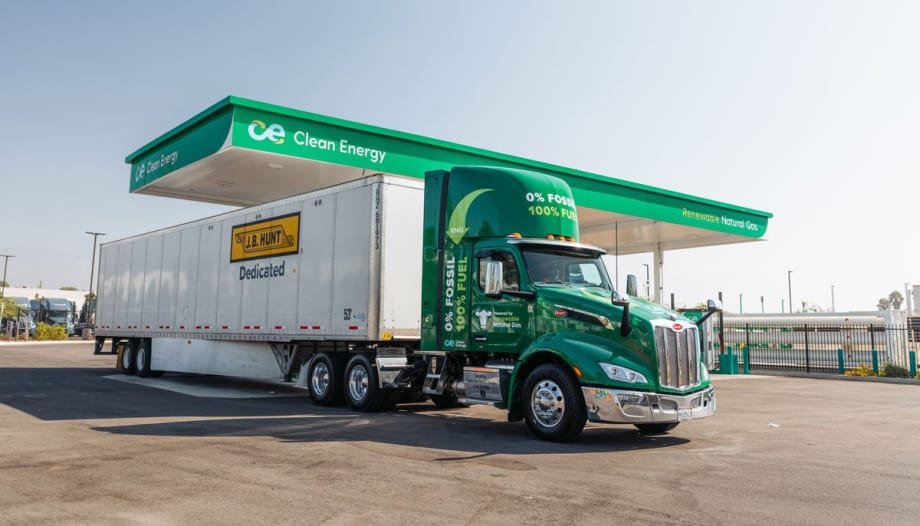
J.B. Hunt is testing Cummins' new ISXN natural gas engine.
Photo: J.B. Hunt/Clean Energy
J.B. Hunt Transport is the first trucking company to participate in a new demo program from Clean Energy Fuels to allow heavy-duty fleets to operate a truck equipped with the new Cummins X15N engine fueled with natural gas.
The 2025 Peterbilt Model 579 day cab tractor, branded in Clean Energy’s signature green and equipped with Cummins’ 15-liter X15N natural gas engine, will be available for fleets to test on their normal routes in up to two-week intervals.
The fleets operating the demo truck will be able to use Clean Energy’s fueling infrastructure, which consists of over 600 stations across North America, 200 of which have public tractor-trailer access.
“We are constantly exploring and testing opportunities that have the potential to deliver value for customers who are looking to reduce carbon emissions in their supply chain,” said Greer Woodruff, executive vice president of safety, sustainability and maintenance at J.B. Hunt.
“Vehicles powered by renewable natural gas produce significantly less carbon emissions throughout their lifecycle and are more compatible with today’s available infrastructure than most competing emissions reduction technologies.
“The new technology and supporting fuel network in this pilot have the potential to be a viable, cost-effective solution for customers wanting to decrease their carbon footprint in the near term.”
The new Cummins X15N engine is getting praise for its capability to haul heavy loads for a 700+ mile range and is delivering on similar power and torque to its diesel counterpart the X15.
Clean Energy’s X15N demo truck program is expected to run through 2025 or longer as demand and interest grows.
The truck will make its way through large and medium size heavy-duty trucking companies in California, Arizona, Texas, Oklahoma, Ohio, Michigan, Pennsylvania, Florida, and states in between.
J.B. Hunt Working Toward Sustainability Goals
J.B. Hunt has worked closely with OEMs, fuel suppliers and infrastructure developers for more than 15 years to study the economic and operational viability of natural-gas powered vehicles and their potential impact on GHG reductions.
Today, J.B. Hunt operates more than 180 renewable natural gas-powered vehicles on behalf of customers.
Alternative-powered vehicles and the adoption of biogenic fuels are two essential components for the company to achieve its ambitious goal to reduce its carbon emissions intensity 32% by 2034 from a baseline year of 2019.
In 2023, J.B. Hunt surpassed the halfway mark for reaching its goal.
In addition, J.B. Hunt reduces carbon footprint by converting over-the-road shipments to rail, which on average reduces a shipment’s carbon footprint by 65% versus highway truck transportation.
More About Why Renewable Natural Gas Can Help Cut Trucking's Carbon Footprint
The X15N also has the ability to drastically reduce greenhouse gas (GHG) emissions when powered by RNG. RNG can have a negative carbon-intensity score, allowing trucks to reduce their carbon emissions by up to 300% compared to diesel.
RNG is a biogenic fuel made entirely from organic waste at facilities like dairy farms. Agriculture accounts for over 10% of U.S. GHG emissions and the transportation sector accounts for another 28%, according to the EPA. Capturing methane from farm waste lowers these emissions.
RNG, produced by that captured methane and used as a transportation fuel, significantly lowers GHG emissions on a lifecycle basis when compared to diesel.
More Fuel Smarts

How Volvo Updated Its D13 for EPA 2027 [Watch]
Volvo’s updated D13 promises lower emissions without sacrificing performance or fuel economy. Take a closer look at what changed inside the engine in this HDT Spotlight video.
Read More →
Diesel Price Spike Shortens Payback for Natural Gas Trucks, Report Says
Energy Vision estimates fleets could recover the higher purchase price of an RNG-fueled Class 8 tractor in 1.3 to 2.8 years under current fuel-price scenarios.
Read More →
Calstart Becomes Catalyst Mobility, Reflecting Broader Focus
Calstart is now Catalyst Mobility, reflecting the nonprofit’s growing national role in clean transportation, including zero-emission trucks, infrastructure and incentive programs.
Read More →

Record Diesel Prices Squeeze Trucking Fleets
Average U.S. diesel prices have climbed to nearly $6 a gallon, surpassing the 2022 record as tight refinery capacity and Middle East disruptions keep fuel costs elevated.
Read More →
How Fuel Delivery Shapes Engine Performance
Fuel delivery depends on more than what happens at the injector. For fleet, maintenance and technical professionals, looking at the full path from pump to injector can provide useful context for understanding engine performance.
Read More →
East Coast Port Launches $45M Electric Truck Push
The Port Authority of New York and New Jersey announced millions in incentives for zero-emission drayage trucks, yard tractors, and new charging hubs near the port.
Read More →
California Bill Could Shed Light on Electric Truck Prices
Why do battery-electric Class 8 trucks remain so expensive? A California bill headed to Gov. Gavin Newsom would give fleets and state agencies more visibility into what manufacturers charge.
Read More →
Detroit Opens Orders for EPA 2027 Engines
Detroit isn’t starting from scratch to meet EPA 2027 diesel emissions standards. Its Gen 6 DD13 and DD15 engines keep much of today’s platform while updating the fuel and aftertreatment systems.
Read More →
Zero-Emission Truck Corridor Planned for West Coast
California, Oregon, Washington, British Columbia and Baja California are coordinating plans for truck charging and hydrogen fueling from Canada to Mexico.
Read More →
A Closer Look at Kenworth’s Electric T880E Vocational Truck [Video]
Learn more about Kenworth's T880E battery-electric vocational truck at the Paccar Technical Center, including its range, applications, upfitting considerations, and PTO options, in this HDT Spotlight video.
Read More →