




Heavy Duty Trucking Logo
MenuMENU
SearchSEARCH

Albert Transport Pushes Diesel Efficiency to the Limit

Owner-operator Henry Albert has spent decades proving how far efficiency can go with diesel, and he's demonstrating those techniques in NACFE's Run on Less-Messy Middle.

Nicole Damron
Nicole DamronNews Content Coordinator
Read Nicole's Posts
November 12, 2025
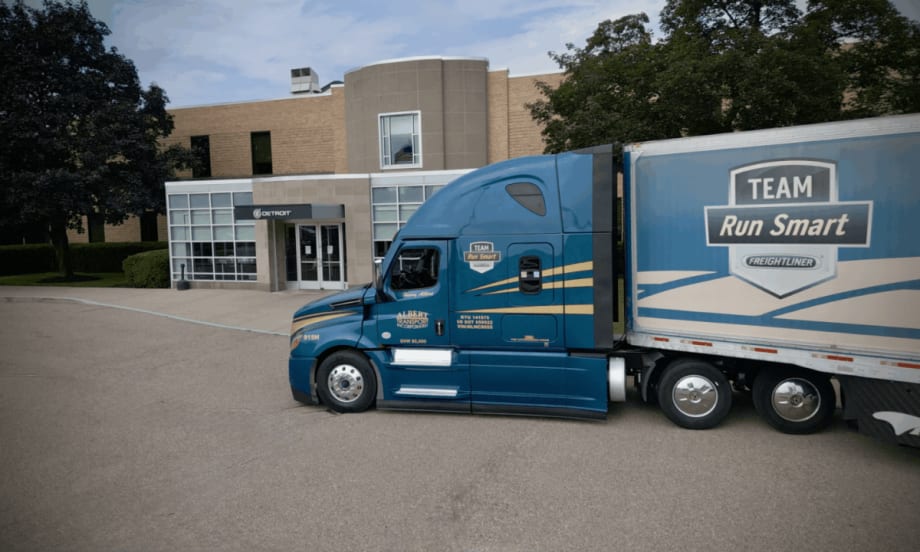
A blue Freightliner Cascadia truck operated by Albert Transport and branded with the Team Run Smart logo parked outside a Detroit Diesel facility.

Henry Albert’s Freightliner Cascadia is equipped with aerodynamic enhancements and fuel-saving technologies that help him consistently reach double-digit mpg on long-haul routes.

Photo: NACFE

4 min to read


For more than four decades, Henry Albert, owner and operator of Albert Transport, has made a career out of proving that fuel efficiency isn’t just a function of technology — it’s a mindset. Since launching his one-truck operation in 1983, Albert has refined every element of his business to squeeze the most performance out of every gallon of fuel.

Ad Loading...

Operating out of Laredo, Texas, Albert hauls general freight across the country in his 2022 Freightliner Cascadia. As a longtime member of Freightliner’s Team Run Smart and a returning participant in the North American Council for Freight Efficiency's Run on Less, Albert brings a veteran’s discipline to his work. To date, he’s achieved a lifetime high of 13.7 mpg and averages 10.5 mpg, all remarkable results for a Class 8 diesel tractor.

Ad Loading...

Albert Transport Fleet Profile

Location: Laredo, Texas

Truck Class: Class 8 tractor

Make/Model: 2022 Freightliner Cascadia

Route type(s):

Type 1: Motor City Express (heavy/moderate run): Laredo to Charlotte, NC, to Quincy, MI, to Redford, MI, back to Laredo, TX (includes mountains)

Type 2: Garden State Express (light run): Laredo to Swebesboro, NJ, to Newark, DE, back to Laredo

Type 3: Queen City Express (moderate loads): Laredo to Charlotte and back to Laredo

Engine/Fuel type: Detroit DD15 455 hp diesel engine

Estimated range: Up to 1,400 miles on a single tank of diesel

Fuel tank: 150 gallon fuel tank

Fuel provider: Truck stop fueling, primarily at TA-Petro locations

Driver Discipline Meets Technology

Albert’s operation demonstrates that technology can enhance performance, but only when it’s paired with a driver who understands it. His results are as much a product of careful technique as they are of cutting-edge design.

“Drivers play a large role in fuel economy,” Albert explained. “Just knowing the spec and the product that they’re moving along, they have a lot of control in the way that they drive.”

He treats every mile as an opportunity to learn, constantly monitoring conditions, anticipating traffic, and minimizing idling — something he’s famously done just once in his career.

For Albert, efficiency isn’t only about profit margins — it’s about professionalism and stewardship. “I focus real keenly on fuel mileage for a couple of reasons,” he said. “One, it’s just the right thing to do — it’s good for the environment. The other is, it’s my number one expense as an owner-operator — my fuel bill.”

A Truck Built for Efficiency

Albert’s current truck, a 2022 Freightliner Cascadia, serves as a rolling case study in how equipment design and driver behavior can work together. Every spec, from aerodynamics to powertrain, has been optimized for fuel savings.

Ad Loading...

The truck is equipped with solar panels that power a dual HVAC system, allowing Albert to stay comfortable without idling — one of many small changes that add up to significant gains.

Albert explained that another tool in his arsenal is the Hendrickson OptiMaax liftable axle, which automatically adjusts based on load weight, reducing friction, tire wear, and fuel consumption. 

“Because of having a lift axle, I’m only powering one differential,” he said in a NACFE interview video.

Aerodynamics and Design in Motion

Efficiency for Albert extends beyond the tractor itself. His trailer configuration, which includes full-length side skirts and wide-base single tires, maximizes airflow and minimizes drag. Albert also runs wide-base single tires on all axles to reduce rolling resistance and unnecessary weight.

“Why have more tires on the ground than you need?” he asked. “I’m saving close to 750 pounds by having all these axles as single tires that are wide instead of a dual-wheel assembly.”

Ad Loading...

Progress Through Experience

Albert has been driving Freightliner Cascadias since their introduction and has witnessed firsthand how engineering advances translate into measurable fuel savings

Since its 2007 debut, the Freightliner Cascadia has seen fuel efficiency improve by more than 35%, with the latest fifth-generation model delivering nearly a 2% gain over its predecessor.

That steady progress — driven by collaboration between manufacturers and drivers — keeps him motivated. Albert emphasized that improving efficiency is an ongoing process. With each truck and every mile on the road, he continues testing new ideas and refining his driving habits to see how much more performance can be gained from each vehicle.

Sharing Knowledge, Shaping the Future

Beyond his own operation, Albert dedicates time to mentoring other drivers through Team Run Smart and NACFE’s educational initiatives. Helping others understand fuel-efficient technologies and practices is, to him, one of the most rewarding aspects of the job: 

“One of the things I really enjoy, especially since becoming part of Team Run Smart, is that it gives me a chance to give back to an industry that’s given me so much,” he said.

Ad Loading...

“When drivers see all this Freightliner Team Run Smart, they might be struggling with the technology. Showing them how to use it and getting them comfortable with it — knowing their day is going to be better, more profitable, and safer — that’s one of the most rewarding parts to me.”

Driving the Example Forward

Albert Transport’s participation in Run on Less: The Messy Middle continues a decades-long commitment to showing what’s possible when focus, technology, and consistency align. 

In a world moving toward zero-emission solutions, Albert’s work proves that discipline and efficiency behind the wheel remain just as vital to a sustainable freight future.

More Fuel Smarts

Solar panels on top of a red Class 8 truck sleeper cab
Equipmentby Deborah LockridgeMarch 15, 2026

Vanair Introduces Solar, Battery Power Ecosystem for Class 8 Trucks

The company’s expanded EPEQ ecosystem includes flexible solar panels, lithium batteries, hydraulic power systems, and a portable fast charger for electric trucks.

Read More →
HDT Talks Trucking thumbnail saying: NACFE's Messy Middle: Which Fuel Wins?
Fuel SmartsMarch 11, 2026

Run on Less “Messy Middle” Data Shows Multiple Paths for Truck Powertrains [Listen]

Listen as Mike Roeth of the North American Council for Freight Efficiency shares insights into battery-electric trucks, natural gas, biofuels, and clean diesel on this episode of HDT Talks Trucking.

Read More →
YouTube thumbnail with Mike Roeth of NACFE saying "NACFE's Messy Middle: Which Fuel Wins?"
Fuel Smartsby Deborah LockridgeMarch 11, 2026

Run on Less “Messy Middle” Data Shows Multiple Paths Forward for Truck Powertrains [Watch]

NACFE's Run on Less - Messy Middle project demonstrates the power of data in helping to guide the future of alternative fuels and powertrains for heavy-duty trucks.

Read More →
Ad Loading...
Mike Kucharski, vice president, JKC Trucking.
Fuel Smartsby Jack RobertsMarch 10, 2026

Trucking Executive Warns Fuel Spike from Middle East Conflict Hitting Fleets Fast

Mike Kucharski, vice president of refrigerated carrier JKC Trucking, says diesel price jumps tied to global instability are squeezing carriers already struggling with weak freight rates.

Read More →
A mechanic in a workshop leans over the open engine compartment of a large yellow vehicle, inspecting components while holding a tablet.
Sponsoredby Kristy CoffmanMarch 9, 2026

Smarter Maintenance Strategies to Keep Trucks Rolling

In today’s cost-conscious market, fleets are finding new ways to get more value from every truck on the road. See how smarter maintenance strategies can boost uptime, control costs and drive stronger long-term returns.

Read More →
Group of researchers and engineers standing next to an electric heavy-duty truck used in Purdue’s wireless charging project.
Fuel Smartsby News/Media ReleaseFebruary 3, 2026

Researchers Demonstrate Wireless Charging of Electric Heavy-Duty Truck at Highway Speeds

Purdue researchers demonstrated a high-power wireless charging system capable of delivering energy to electric heavy-duty trucks at highway speeds, advancing the concept of electrified roadways for freight transportation.

Read More →
Ad Loading...
Illustration showing diesel exhaust fluid pump sign and EPA headquarters
Equipmentby Deborah LockridgeFebruary 3, 2026

EPA Wants to Know: Are DEF De-Rates Really Needed for Diesel Emissions Compliance?

The Environmental Protection Agency is asking diesel engine makers to provide information about diesel exhaust fluid system failures as it considers changes to emissions regulations.

Read More →
SponsoredFebruary 1, 2026

6 Dashcam Tactics to Improve Safety & ROI

6 intelligent dashcam tactics to improve safety and boost ROI

Read More →
Fuel Smartsby Deborah LockridgeJanuary 29, 2026

California: Clean Truck Check Rules Still in Force for Out-of-State Trucks, Despite EPA Disapproval

The Environmental Protection Agency said California can’t enforce its Heavy-Duty Inspection and Maintenance Regulation, known as Clean Truck Check, on vehicles registered outside the state. But California said it will keep enforcing the rule.

Read More →
Ad Loading...
Illustration of Department of Justice building superimposed by truck exhaust stacks
Fuel SmartsJanuary 27, 2026

Justice Department Pulls Back on Criminal Prosecution of Diesel Emissions Deletes

The Trump administration has announced it will no longer criminally prosecute “diesel delete” cases of truck owners altering emissions systems in violation of EPA regulations. What does that mean for heavy-duty fleets?

Read More →









