





You also might like: Navistar San Antonio Plant Showcases Latest Manufacturing Tech
Navistar CEO Calls for Long-Term Commitment to get to Net Zero
The trucking industry has done much over the past several years in its quest to reach zero net carbon emissions — but it’s far too soon to pat itself on the back, said Navistar CEO Mathias Carlbaum at ACT Expo.
May 12, 2022

Navistar CEO Mathias Carlbaum: "We are bringing a higher purpose to our work: to create sustainability through future technology."
Photo: Jack Roberts
6 min to read
Taking the stage on the second day of ACT Expo as keynote speaker, Navistar CEO Mathias Carlbaum pointed out a newspaper article from 1912, with a scientist reporting that “coal consumption is affecting our climate.”
“I grew up in Sweden,” Carlbaum told attendees at the event in Long Beach, California. “That is a carbon-neutral country where future generations are taught environmental consciousness. As that newspaper article shows, we have been aware of climate change for many years now. And Scania has many years of working on sustainability. And that is now our task at Navistar.” (Scania parent company Traton Group completed its acquisition of Navistar less than a year ago.)
But, Carlbaum added, the race to net-zero emissions is not simply about new technology. Increasingly, he said, OEMs must pay attention to cost parity in order to make the case for fleets to switch to alternative fuels or battery-electric vehicles.
“The challenge now is, ‘When will a new, alternative-fuel or electric truck cost the same as a conventional internal combustion engine truck?’” he said. “And I think it will be 2030 before we reach that breaking point. Once we do, I think things will then begin to move very fast with BEVs and other alt-fuel vehicles. Cost parity is already coming quite soon for BEV and fuel cell electric vehicles. But we need other parts to come into place bring the point of TCO parity closer in time.”

Carlbaum told the audience at ACT Expo that once a new battery-electric or fuel-cell truck costs the same as a conventional internal combustion engine truck, wider adoption will come quickly.
Photo: GNA/ACT Expo
Detailing where things stand today, Carlbaum noted that charging times for batteries continue to decrease and that smaller batteries with greater capacity will soon allow greater vehicle payloads.
“FCEV, BEV and alt-fuel will all have their place in future fleets,” he said. “I think BEV will account for about 60% of long-haul applications — that seems to be the sweet spot for that technology — with FCEV accounting for 5%, and 10% to 15% using some type of alternative fuel. But there is a huge potential for BEVs. By 2030, I think 50% of all trucks by volume will be BEVs.”
Turning to the regulatory front, Carlbaum called for a national waiver of 2,000 lbs. on BEVs to help accelerate acceptance among fleets and counter reduced payload capacity. He also noted the need for more consistent, long-term regulations as GHG3 mandates begin to near their implementation dates.
“Short-term regulations are often counter-productive,” he observed. “Longer-term guidelines would be more helpful as we focus on GHG3.”
Additionally, the government should not choose the technology OEMs adopt to meet regulations. “We are perfectly capable of doing that ourselves,” he said. “There is a lot of money and resources flowing into this industry.”
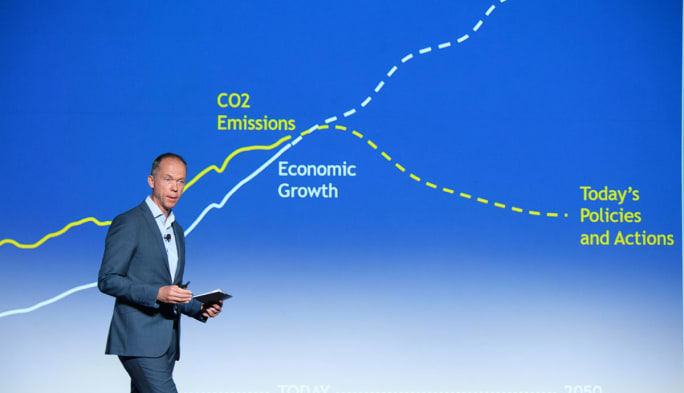
Navistar's Mathias Carlbaum says government regulations should not dictate the technology OEMs use to reach GHG goals. “We are perfectly capable of doing that ourselves."
Photo: GNA/ACT Expo
However, Carlbaum cautioned, it is too soon for the North American trucking industry to pat itself on the back, even though it has made great strides toward a greener — and eventually net zero — future over the past several years.
“We have cut greenhouse gas emissions by 60% since 2010,” he said. “But, under our current technology path, we can only hope to cut emissions by another 15% in the next 20 years. And that is not good enough. There are already many countries in Europe that are already where the U.S. wants to be on carbon emissions by 2050. We have a clearly chosen path ahead of us, but we need to accelerate our progress along that path.”
Navistar is determined to be a leader in that journey, Carlbaum said. Traton will invest $2.7 billion in electric mobility research and developement by 2026, and Volkswagen Group will invest $93.6 billion in electric vehicles and digitalization over the next five years.
An Energy Evolution and a Logistics Revolution
During an in-person interview following his keynote address at ACT Expo, Carlbaum sat down with HDT to discuss the overall state of North America today and the transition that is taking place within Navistar as it becomes an integral part of a global commercial vehicle OEM.
HDT: What is the state of the “green” transportation movement in North American right now from Navistar’s perspective?
Carlbaum: We see a collective awareness in the right direction taking root in America right now. Momentum toward green transportation is gaining among OEMs and suppliers. And there are many new interesting start-ups, as well. But we’re still one or two years away from customers actually kicking the tires on the products we’re working on today.
HDT: What about current supply chain issues? Do you see any movement there?
Carlbaum: When the first supply chain issues appeared, simply saying “six months” felt like a good answer to the question. It seemed like things would work themselves out in that time frame. But now, over a year later, we still are tied up when it comes to goods — more so than we were a year ago. We trust our suppliers are doing their best. We are all partners.
HDT: What does that mean now when it comes to allocating trucks? Are you trying to find new customers? Or just busy trying to take care of existing customers?
Carlbaum: We want to take of the customers we have. But, unfortunately, we just do not have enough trucks for everybody right now. We are trying to be as transparent as possible and as fair as possible. We are lucky to have a good dealer network that helps us through this.
HDT: How is the process of bringing Navistar into the Traton Group coming along?
Carlbaum: We are recruiting heavily on the tech side of things now to be competitive with these new technologies you see here [at ACT Expo]. It is not for Traton Group to teach Navistar what to do. They have their own strengths and know their market better than anyone at Traton ever could. What we want to do is keep everything that is good about Navistar, and then add new dimensions to that culture.
HDT: Still, Traton is a German company. And much of the new technology coming into trucking today seems to originate in Europe. So, where will Navistar look within the Traton Group for new technology to bring to North America?
Carlbaum: Scania. Without question, Scania. We are on a cultural journey at Navistar. And now, we have new values and leadership behavior based around reducing emissions and combatting climate change. And this is appealing to most humans. We are bringing a higher purpose to our work: to create sustainability through future technology. But there is no question that Scania is the technology driver for us in Class 8. We will soon be there in that space with the right battery and chemistry exclusive for the U.S., with the correct capacity for energy storage and mega-chargers to support them.
HDT: And what about autonomous technology?
Carlbaum: A moment ago, you said that Europe is the technology leader for trucking today. And that is largely true. But when it comes to autonomous technology, the U.S. is clearly the world leader in developing this technology. Scania is working with TuSimple in Europe. And Navistar will work with them here in the U.S. So we will have a common approach, and shared resources based on what is happening in Europe. And there is a third leg to this technology platform, as well. And that is China. Autonomous technology is definitely happening there, as well.
When you look at it, what is coming now, with electric trucks and alternative fuels, it’s mind-blowing. We are in an energy evolution today as these new fuels and drivetrains are being developed. But, once that evolution occurs, we will then see a revolution that goes far beyond those kinds of changes. We will see the birth of a new, data-driven, green logistics network that will create a completely new trucking ecosystem, landscape and operating parameters for all players.
[Editor's Notes: This article was updated on May 18 at 8:25 a.m. CT to correct the amount of investment Traton and VW are making in electric mobility.]
More Fuel Smarts

How Volvo Updated Its D13 for EPA 2027 [Watch]
Volvo’s updated D13 promises lower emissions without sacrificing performance or fuel economy. Take a closer look at what changed inside the engine in this HDT Spotlight video.
Read More →
Diesel Price Spike Shortens Payback for Natural Gas Trucks, Report Says
Energy Vision estimates fleets could recover the higher purchase price of an RNG-fueled Class 8 tractor in 1.3 to 2.8 years under current fuel-price scenarios.
Read More →
Calstart Becomes Catalyst Mobility, Reflecting Broader Focus
Calstart is now Catalyst Mobility, reflecting the nonprofit’s growing national role in clean transportation, including zero-emission trucks, infrastructure and incentive programs.
Read More →

Record Diesel Prices Squeeze Trucking Fleets
Average U.S. diesel prices have climbed to nearly $6 a gallon, surpassing the 2022 record as tight refinery capacity and Middle East disruptions keep fuel costs elevated.
Read More →
Sponsored•September 9, 2026
How Fuel Delivery Shapes Engine Performance
Fuel delivery depends on more than what happens at the injector. For fleet, maintenance and technical professionals, looking at the full path from pump to injector can provide useful context for understanding engine performance.
Read More →
East Coast Port Launches $45M Electric Truck Push
The Port Authority of New York and New Jersey announced millions in incentives for zero-emission drayage trucks, yard tractors, and new charging hubs near the port.
Read More →
California Bill Could Shed Light on Electric Truck Prices
Why do battery-electric Class 8 trucks remain so expensive? A California bill headed to Gov. Gavin Newsom would give fleets and state agencies more visibility into what manufacturers charge.
Read More →
Detroit Opens Orders for EPA 2027 Engines
Detroit isn’t starting from scratch to meet EPA 2027 diesel emissions standards. Its Gen 6 DD13 and DD15 engines keep much of today’s platform while updating the fuel and aftertreatment systems.
Read More →
Zero-Emission Truck Corridor Planned for West Coast
California, Oregon, Washington, British Columbia and Baja California are coordinating plans for truck charging and hydrogen fueling from Canada to Mexico.
Read More →
A Closer Look at Kenworth’s Electric T880E Vocational Truck [Video]
Learn more about Kenworth's T880E battery-electric vocational truck at the Paccar Technical Center, including its range, applications, upfitting considerations, and PTO options, in this HDT Spotlight video.
Read More →