




Navistar San Antonio Plant Showcases Latest Manufacturing Tech
Navistar showed off its new San Antonio Manufacturing Plant March 23, holding it up as an example of the latest, most high-tech and sustainable manufacturing techniques.

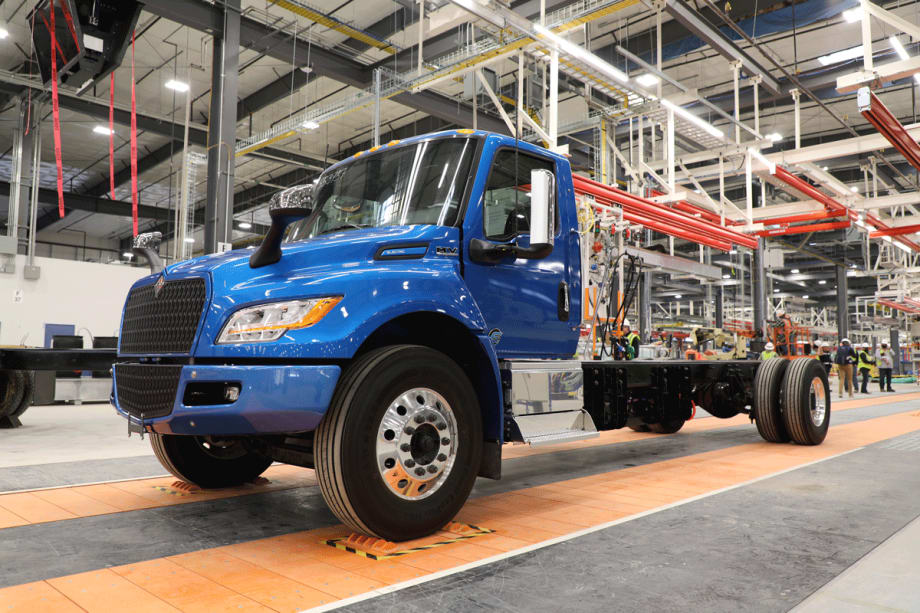
Navistar's new San Antonio Manufacturing Plant will build both electric and internal-combustion Class 6-8 vehicles.
Photo: Navistar
Navistar showed off its new San Antonio Manufacturing Plant to reporters March 23, holding it up as an example of the latest high-tech, sustainable manufacturing techniques. The factory is set to hit full capacity this summer.
The nearly 1-million-square-foot manufacturing facility includes a body shop, paint shop, general assembly shop, and logistics center equipped to produce Class 6-8 vehicles, including electric vehicle models. The plant has been up and running since January, and the first truck off the line was a battery-electric medium-duty International eMV.
Based in Lisle, Illinois, Navistar builds International and IC Bus vehicles.
The company said the San Antonio plant will provide benchmarks in process optimization, real-time production management, and sustainability, according to a news release. The facility improves quality, lowers costs, and provides capacity support to Navistar’s current manufacturing footprint.
This is the first commercial truck assembly plant in the U.S. since the early 1990s, according to Navistar CEO Mathias Carlbaum. (Kenworth's Renton, Washington, plant opened in 1993.)
He also said that by 2030, more than 50% of the vehicles that leave the new San Antonio manufacturing plant will be zero-emission vehicles.
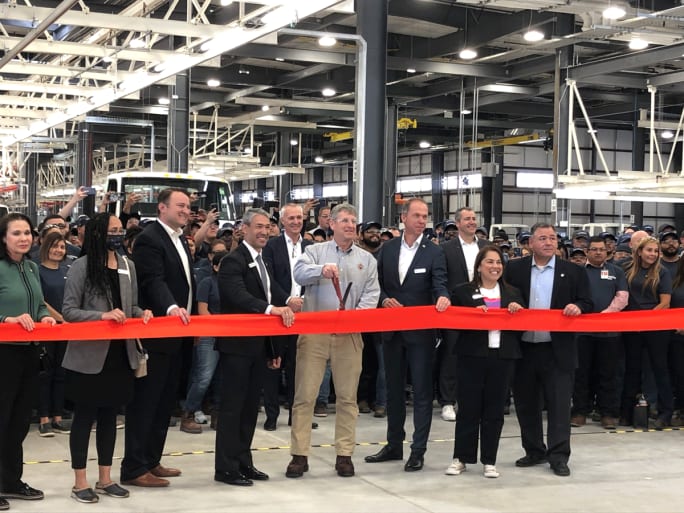
A March 23 ribbon-cutting was the formal opening of the new Navistar plant, which has been ramping up production since January.
Photo: Jim Park
“The choices we make today will take Navistar to a new level of impact in the transportation industry,” said Mark Hernandez, executive vice president, Global Manufacturing and Supply Chain. “That's why we are laying the foundation for the future in this plant, because the future begins with the decisions and investments we make today.
“The San Antonio manufacturing plant was meticulously planned and constructed to highlight our many manufacturing strengths and build toward future manufacturing goals surrounding Industry 4.0 technologies, quality and sustainability.”
“Industry 4.0” is a term being used for what many see as a new industrial revolution — where manufacturers integrate new technologies, advanced manufacturing techniques, the Internet of Things, cloud computing and analytics, and AI and machine learning into their production facilities and operations.
Examples of the concept at the San Antonio plant include automated guided vehicles that shuttle cabs and engines throughout the plant, and computer monitors that plant personnel use to get information on a truck’s build and parts during each step of the assembly process.
Fit for the Future
The San Antonio Manufacturing Plant was constructed with efficient energy use goals in mind. As part of the U.S. Department of Energy’s Better Buildings, Better Plants Program, Navistar is committed to reducing energy intensity in San Antonio and other U.S. plants by 20% by 2030. LEDs illuminate the plant, using 75% less power than conventional lighting, and translucent panels allow natural light to brighten the indoor space as a supplement to the lighting system. The building also includes energy-efficient wall paneling to better regulate indoor temperatures.
Fuel-cell forklifts will replace all-electric models, with hydrogen produced on site.
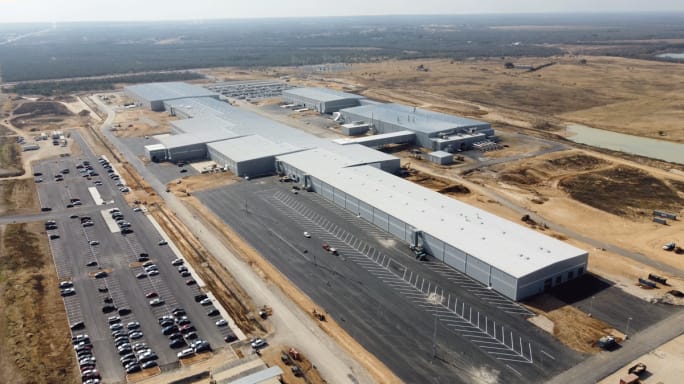
The Navistar San Antonio Manufacturing Plant is a nearly 1-million-square-foot manufacturing facility, which includes sustainable operation techniques and Industry 4.0 technologies.
Photo: Navistar
The plant also will serve as Navistar’s benchmark for lean manufacturing principles to eliminate waste, improve product quality, drive operational efficiency, and reduce cost and time. Industry 4.0 principles have been incorporated to connect digital and physical technologies, allowing the plant to be more connected and easily make data-driven decisions.
“We are incorporating the latest manufacturing principles – digital factory, connected machinery, robust lean manufacturing processes and cloud analytics – to enable predictive quality and maintenance, and allowing data-driven decisions to be made on the shop floor in real time,” said Hernandez.
The San Antonio Manufacturing Plant complements Navistar’s existing assembly manufacturing footprint, which includes truck assembly plants in Springfield, Ohio, and Escobedo, Mexico; a school bus assembly plant in Tulsa, Oklahoma; and a powertrain manufacturing plant in Huntsville, Alabama. The sustainable manufacturing processes will be integrated in all existing manufacturing plants.
In the future, Navistar plans to begin operations at the Advanced Technology Center on-site, which accelerates implementation of emerging technologies and Industry 4.0 technologies within the commercial trucking space. The ATC is focused on product development, testing and validation efforts supporting the company’s strategy, and will be a key location for future research and development footprint with a focus on zero-emission components, software and autonomous technologies.
[Editor's Note: This article was updated March 24 at 11:10 a.m. EDT to correct the model name of the first truck off the manufacturing line, and at 1:20 EDT to correct how long it's been since the opening of a new U.S. truck manufacturing plant.]
More Equipment

How Volvo Updated Its D13 for EPA 2027 [Watch]
Volvo’s updated D13 promises lower emissions without sacrificing performance or fuel economy. Take a closer look at what changed inside the engine in this HDT Spotlight video.
Read More →
Michelin Tire Improves Efficiency and Durability for Regional Fleets
The Michelin X Multi Energy D2 is a regional haul drive tire engineered to help fleets improve fuel efficiency, durability and traction in demanding stop-and-go operations.
Read More →
ZF Expands Commercial Vehicle Push in North America
ZF is expanding its North American commercial-vehicle presence with new transmission applications, electrification, trailer technology and autonomous-driving systems.
Read More →
Tesla Wants a Self-Driving Semi. Are Cameras Enough?
Could Tesla’s camera-only autonomous driving technology work on an 80,000-pound Semi? In this commentary, HDT's Deborah Lockridge takes a look at Tesla, Cybercab, and how autonomous trucks see the road.
Read More →
Kodiak: Driverless Long-Haul Truck Launch on Track for 2026
Kodiak AI says its driverless long-haul safety case is 93% complete and it remains on track to begin commercial operations by year-end 2026.
Read More →
What DOT’s Automated Vehicle Strategy Means for Trucking
The U.S. Department of Transportation issued a new automated-vehicle strategy that outlines plans for driverless-truck regulations, cross-state freight corridors, and federal safety standards.
Read More →
East Coast Port Launches $45M Electric Truck Push
The Port Authority of New York and New Jersey announced millions in incentives for zero-emission drayage trucks, yard tractors, and new charging hubs near the port.
Read More →
PlusAI Going Public to Fund Autonomous Truck Launch
A SPAC deal could provide PlusAI with up to $300 million as it works toward a 2027 commercial launch of factory-built autonomous trucks.
Read More →
NHTSA Moves to Rewrite Truck Fuel-Economy Rules
The National Highway Traffic Safety Administration says it lacks authority to regulate medium- and heavy-duty truck engines separately from complete vehicles, but the existing standards have not yet been eliminated.
Read More →
Detroit Opens Orders for EPA 2027 Engines
Detroit isn’t starting from scratch to meet EPA 2027 diesel emissions standards. Its Gen 6 DD13 and DD15 engines keep much of today’s platform while updating the fuel and aftertreatment systems.
Read More →