





Related: The Downspeeding Learning Curve
NACFE Shows Downspeeding Good for 2-3% Fuel Savings
A new report delves into the use of downspeeding, which is becoming a popular fuel saving strategy for fleets. The concept makes use of numerically lower rear-axle ratios to lower engine rpm at vehicle cruise speed.
October 29, 2015
5 min to read
The latest Confidence Report released by the North American Council for Freight Efficiency and Carbon War Room reveals that downsped drivelines in Class 8 tractors can produce fuel savings of 2-3% when used in appropriate applications.
The report, released Oct. 28, explores the benefits and challenges of downspeeding for Class 8 tractors. It was the eighth Confidence Report released by the group, and the fifth this year. Other reports covered automated transmissions, resetting engine parameters, low-rolling-resistance tires and lightweighting as fuel saving strategies.
Downspeeding is a term given to the use of fast rear-axle gear ratios to produce a lower engine rpm at vehicle cruise speed. It is one of the primary powertrain-focused strategies for improving fuel economy on road tractors and regional-haul day-cab trucks with high rates of steady-state highway driving.
Downspeeding is usually accomplished by using either a very fast axle ratio combined with a direct-drive transmission or a slightly slower axle ratio combined with an overdrive transmission. The former is more commonly used and better suited to linehaul applications on fairly flat terrain, while the latter is better suited to regional and city applications with more stop/start driving.
While the downspeeding concept – sometimes referred to as "gear fast, run slow" – has been around for decades, recently introduced complementary technologies have made the practice more attractive.
"Downspeeding is seeing tremendous growth among fleets whose operation profiles allow for it," said NACFE Executive Director Mike Roeth. "The OEMs we consulted for this report say about 25% of their total on-highway real-axle build is now 2.47:1 or below. They are typically between 2.24 and 2.47. They have told us that really aggressive downspeeding configurations of 2.07:1 are just around the corner."
On top of the reported fuel economy benefits, the NACFE report also credits downspeeding with improved drivability and much quieter operation at highway speeds, which is a big plus with drivers.
The report also contains a confidence matrix that expresses the study team’s confidence in downspeeding, and offers recommendations for fleets interested in using this technology to improve fuel economy.
Key Findings of the Downspeeding Confidence Report
When optimally applied, downspeeding will improve fuel efficiency and lower the operating rpm of the engine under cruise conditions, while helping in other areas as well, such as noise reduction and improved drivability.
Downspeeding alone can save 2–3% off the fuel bill. However, specifying a downsped engine without looking at the whole of the powertrain can have negative consequences, such as increased risk of driveline failure or insufficient horsepower.
Optimal truck design will see downsped powertrains in either of the two configurations spec’d with other technologies, including automated manual transmissions (AMTs), certain rear-axle ratios, modified engine torque levels that may be restricted to certain gears, carefully chosen electronic engine parameters, and reinforced drivelines.
This package of multiple fuel efficiency technologies results in about 3–6% fuel savings overall and reduces the negatives posed by adopting downspeeding exclusively.
Downspeeding is at a tipping point, with rear-axle ratios of 2.47:1, and engine rpms of 1,100–1,300 now common offerings among powertrain manufacturers. And "aggressive downspeeding" is just around the corner, with manufacturers poised to offer rear axle ratios of around 2.08:1, and even lower engine cruise rpms of just 900–1,000.
According to Roeth, the ROI on a downspeed driveline is pretty good.
"Depending on the OE, the cost of upgrading to a downsped driveline, including more robust components recommended to mitigate possible driveline damage due to increased high-torque operation can be as low as $500 to $1000." he said. "With fuel at $3.75 per gallon and 1% savings, fleets can save about $700 in fuel per year. At 2%, about $1500. With today's sub-$2.50 fuel, the payback is going to take a little longer."
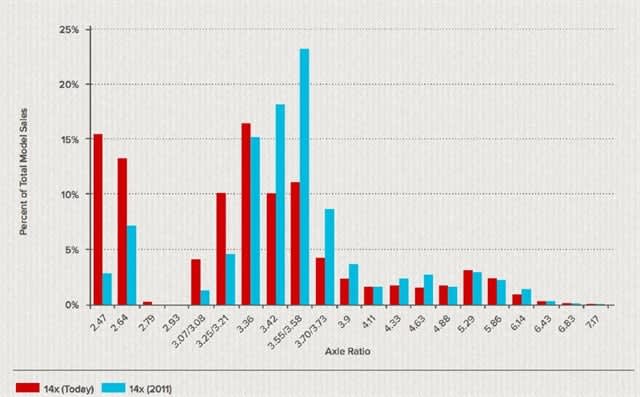
Increased use of faster rear‐axle ratios. (Source: Meritor)
The report notes that downspeeding can also be used as a driver attraction and/or retention tool.
"They said what they liked best these drivetrains was the quiet operation and the drivability," said Roeth. "But I should say that some fleets we surveyed reported those same attributes as negatives. Drivers who had not been properly trained on what to expect found the performance sluggish due to operating in the high-high-torque, low-horsepower end of the engines power band."
That could be the result of operating a downspeed driveline in less than optimal conditions, like in the mountains or where there's a lot of stop/start driving.
"Downspeeding is ideally suited to rolling terrain, not mountains, where the truck would typically shift between the top two gears," Roeth told HDT. "The really tall gearing, especially with an overdrive transmission isn't conducive to mountain driving, or city driving. A direct drive would be better in those situations, or where mountains are a large part of the fleet's geographical profile, a standard driveline might be more suitable."
The Confidence Report also discusses the challenges of downspeeding, at the forefront the greater potential for driveline failure if improperly spec’d.
Drivetrain vulnerability is a critical concern for fleets, and faster axle ratios increase the potential for damage. This is primarily because lower rpm means more torque overall, and also means that torque spikes are applied to the driveline parts at a lower frequency, which can translate into gear chatter or wear issues.
However, it notes, "our findings indicate that vehicle and component manufacturers are actively addressing this torque issue by developing heavier-duty components like driveshafts and axle housings, bearings, and gears that can handle the increased torque produced when engines turn at reduced rpm."
NACFE plans to release one more Confidence report in early December covering best maintenance practices for optimum fuel efficiency.
The next NACFE Fuel Economy Workshop is scheduled for Dec. 9 at the ACR wind tunnel facility in Indianapolis. The Workshop agenda includes a tour of the facility when the wind tunnel in action. More information is available at NACFE.org or truckingefficiency.org.
The report can be downloaded here.
More Drivers

From One Generation to the Next: How Mentorship Builds Safer Truck Drivers
After three decades in trucking, Harold Perry shares what he's learned about driver safety, mentorship, and helping the next generation build confidence behind the wheel.
Read More →
Truck Drivers Need More Than Another Alert
Fleets have more visibility into truck health, safety events, and driver activity than ever. The next challenge is turning all that information into useful guidance for the person who has to decide what to do next.
Read More →
FMCSA Removes 110 Truck Driver Training Schools from Certified ELDT List
Federal regulators also are targeting more than 160 additional training providers and launching a nationwide audit of third-party CDL skills testers as part of a broader crackdown on trucking fraud.
Read More →
Hours of Service Pilot Programs: FMCSA Readies for 2027 Rollout
Two pilot programs could eventually reshape hours-of-service rules, giving truck drivers options to pause their 14-hour clock or use longer split sleeper rest periods.
Read More →
Medical Cards, English Proficiency Reshape Roadcheck Violations
Medical-card violations jumped to the top of the driver out-of-service list during CVSA’s 2026 International Roadcheck, while English-language proficiency violations appeared among the leading violations for the first time.
Read More →
Driver Trust Can Make or Break the Success of Fleet Safety Technology
New Teletrac Navman research suggests that onboarding, transparency about driver data, and positive feedback can play a significant role in how commercial drivers respond to safety and coaching technology.
Read More →
EEOC Sues KLLM Over Alleged Sex Discrimination in Driver Training
KLLM is facing a federal sex-discrimination lawsuit over policies the EEOC alleges put female truck driver trainees at a disadvantage.
Read More →
FMCSA Moves to Codify English Language Requirements for Commercial Drivers
By changing regulations on English-language proficiency requirements for commercial drivers, rather than relying on a guidance memo, the FMCSA said future administrations won't be able to walk back the Trump administration's stricter enforcement with just a memo.
Read More →
Drivers Put Western Star Trucks to the Test at Star Nation Experience
Watch to get an inside look at the Western Star trucks, technology, and community behind the Star Nation Experience 2026!
Read More →
Trump Administration Looks to Put More Veterans Behind the Wheel
The Freedom Haulers program pulls together existing and expanded programs at several federal agencies to recruit veterans to drive commercial heavy-duty trucks and cut the red tape for them to get a CDL, training, and employment.
Read More →