





Related: Is the Capacity Crunch Slowing?
Measurement of Truckload Rates Continues Upward Trajectory
The Cass Truckload Linehaul Index for July indicates an increasing rate of acceleration for truckload linehaul pricing, posting the first double digit increase year over year since Cass began tracking it in 2005.
August 15, 2018
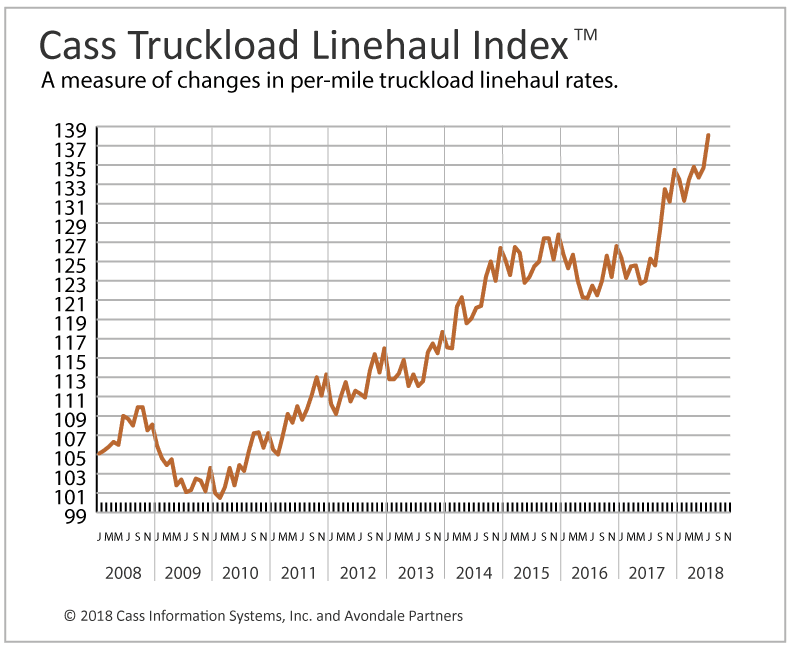
The Cass Truckload Linehaul Index posted its 16th straight year-over-year gain and its increase is only accelerating.
Source: Cass Information Systems
2 min to read
The Cass Truckload Linehaul Index for July indicates an increasing rate of acceleration for truckload linehaul pricing, posting the first double digit increase year over year since Cass began tracking it in 2005.
Compared to July 2017, the Linehaul Index increased 10.2% to 138.1. The TL Linehaul Index has been positive for 16 months in a row and all indications show that it is accelerating upward and may exceed levels not seen since the 1980s.
"Last month we increased our realized contract pricing forecast for 2018 from a range of 6% to 8% to a range of 6% to 12%, and current data is clearly signaling that the risk to our estimate may still be to the upside," stated Donald Broughton, analyst and commentator for the Cass indexes. "We believe that this is the strongest normalized percentage level of truckload pricing achieved since deregulation (normalized meaning except for extreme periods of recovery from recession)."
Cass also released its Intermodal Price index for July showing 12% increase from a year ago to 139.2. Though prices are not at their highest level for the year, it is the 22nd straight month of year-over-year increases and has been affected by increase in diesel fuel prices and tight truckload capacity.
"Tight truckload capacity and higher diesel prices are creating incremental demand and pricing power for domestic intermodal," said Donald Broughton, analyst and commentator for the Cass indexes. "Longer term, we continue to foresee oil trading in the $45 to $65 range and diesel in the $2.50 to $3.25 range throughout 2018, and even higher in certain regions within the U.S."
More Fleet Management

Kodiak Lines Up Fleets for Driverless Trucking
An agreement for 75 trucks, a new Texas freight lane, and progress on safety validation move Kodiak closer to its planned driverless highway launch.
Read More →
ITS Logistics Settles Religious Harassment Case
The Nevada-based logistics firm agreed to pay more than $396,000 to settle a religious harassment charge involving an employee's Jewish identity.
Read More →
Your Trucks Are Busy. That Doesn’t Mean They’re Winning.
High utilization doesn’t always mean strong margins. Looking beyond the current load can help fleets make better dispatch decisions and get more value from each truck’s time.
Read More →
Why This Trucking Recovery Is Different
Freight demand remains sluggish, but rising costs and tougher enforcement have taken enough capacity out of the market to change the outlook for motor carriers.
Read More →
Platform Science Adds Dispatch and Safety Tools
Four additions to PS Fleet help fleets monitor loads, manage driver coaching, share truck locations and adjust video system settings.
Read More →
PrePass Intelligence Mines Fleet Bypass, Toll and Safety Data
PrePass Intelligence helps fleets measure bypass savings, flag potential toll overcharges, and spot suspicious transactions by combining data from separate systems.
Read More →
Motive Adds AI Agents for Fleet Operations
New tools automate follow-up on fleet data, from maintenance work orders to driver alerts, with two-way voice conversations planned for later this year.
Read More →
Can You Beat Our Trucking Trivia Challenge?
Test your truck knowledge with 19 trivia questions from Heavy Duty Trucking Exchange. Can you keep up with the fleet pros?
Read More →
BeyondTrucks Adds Rules Checks to Dispatch
New Compatibility Engine checks driver qualifications, equipment requirements and fleet policies before loads are dispatched.
Read More →
Diesel Prices Hijack Trucking’s Worry List
ATRI’s annual survey finds cautious optimism about freight, but diesel costs, litigation, and insurance continue to squeeze fleets. Drivers have different priorities on several issues.
Read More →