





"We think there's value in Eaton wakes up every day thinking about how to make the best transmission possible."
Kenworth Execs Talk Trucks and Trucking
In a wide-ranging discussion with trucking journalists at its headquarters Tuesday, Kenworth executives shared their insights on topics ranging from autonomous trucks to the safety of the industry.
August 27, 2015

Kenworth GM Preston Feight talks with trucking reporters at Kenworth's headquarters. Photo: Deborah Lockridge
6 min to read

Kenworth GM Preston Feight talks with trucking reporters at Kenworth's headquarters.Photo: Deborah Lockridge
In a wide-ranging discussion with trucking journalists at its headquarters Tuesday, Kenworth executives shared their insights on topics ranging from autonomous trucks to the safety of the industry. Following are highlights:
On the economy
"Driver availability remains really the throttle on the industry," said Preston Feight, general manager of Kenworth, showing a chart with green indicators for economic numbers such as GDP growth, housing starts, auto sales, freight tonnage and more. "We have a strong economy, people are utilizing trucks to run their businesses, and it's working well for the entire industry as far as supporting this market."
Kenworth has done well, too, with its market share moving up from 12% in Class 8 five years ago to 14.7% year to date. He attributed that success largely to the company's T680 and T880 models, introduced in 2012 and 2013, respectively, which today combined make up about 75% of Kenworth's build. As additional models are added to the lineup, such as the new 76-inch mid-roof sleeper version of the T680 which will be available mid-September for flatbed and tanker fleets, he expects that trend to continue.
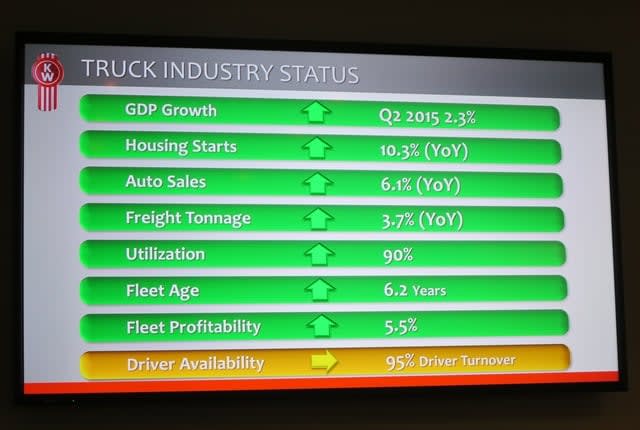
A presentation slide showing nearly all systems go in economic factors affecting trucking.
They've achieved that increase as truck sales overall in the U.S. and Canada have been on an incredible run the past five years, Feight said. When asked about whether that trend could continue, he said, "it can't keep accelerating. It's just such a high level that I don't know that it can grow beyond where it is. We've had one year above what this one was, if you go back historically, and that was a pre emissions year. We say the industry will continue to be strong next year….I don't see a single customer that's wringing their hands about how their business is doing, except the oil and gas industry."
When asked if he saw a recession in the future, Feight acknowledged that, yes, they believed there would be one in the future. While he would not speculate as to timing, he said, "if there's a recession next year or the year after that wouldn't shock us, and we would just adapt to it. That's part of the leanness of our company, to operate as if one is coming."
On Proposed Phase 2 Green House Gas/Fuel Economy regulations
"We've been through the first round," said Kenworth Chief Engineer Kevin Baney. "The good thing about GHG is it's also good for the fleets for not only improving the environment but also improving fuel economy. We are working with EPA right now; the first iteration is aggressive. It was the last time around. By the time it's time to launch it will sort itself out."
One thing that Kenworth expects to stand as currently proposed is sunsetting of the use of glider kits to turn chassis with older, more-polluting engines into like-new trucks. Kenworth started offering glider kits in 2012, and is on pace to sell more than 1,500 gliders this year. "Until the date when gliders will no longer be available, we'll meet that demand," Baney said.
"In 2018 gliders go away," Baney said. "It gives the industry time to evolve through that transition. Right now it's about meeting that market demand. It's the right thing to do but the market needs time to adjust to that."
On vertical integration
Despite the success of the MX engine, when asked about whether they would pursue a similar route in supplying its own integrated transmissions and axles as Daimler and Volvo have, Feight (who use to be chief engineer himself) responded, "Paccar tends to make its own decisions. We never just follow people…. We have really strong partnerships. I wouldn't want to underestimate the strength of our partnerships with Cummins, Eaton, Dana and Meritor. I don't think you'll see us flip over to something just because other people are doing it. Many customers want that choice, and we'll be respectful of that.
"We think there's value in Eaton wakes up every day thinking about how to make the best transmission possible. They're awake now; maybe they used to be a little more complacent about their market position, but I think the product they're putting out now and the product they're putting out in the future we co developed with them is solid, best in class."
On autonomous vehicles
Baney pointed out that technologies we are beginning to take for granted were just emerging five or 10 years ago. "Ten years ago we talked about electronic recorders, and that was coming at us, and now every truck that's built today is connected."
Back then, he says, we were looking forward to technologies such as collision avoidance with braking, predictive cruise control and lane keeping assist, "and now Bendix and Wabco have Fusion and OnBoard." By the time they became mainstream, he says, it was like the natural next step. "The autonomous vehicle is going to become an evolution of these systems."
"Now there's a lot of talk out there in terms of platooning. The technology exists. The conversation is how fleets interact with each other, the impact on the highway and on the environment. When we do it, it will seem like the natural next step.
"It’s the same for autonomous vehicles. As we release these systems and they become mainstream in the industry, it will become that next evolution. When the time's right it will feel natural," Baney explained, saying by 2025 we will likely see "autonomous" technologies such as vehicle to infrastructure networks, automatic lane change systems and automatic routing.
The next step on that road is likely platooning, he said. "The technology exists; there are demos being run around the country now. I think it's more about the acceptance within fleets, across fleets, safety concerns. It's more about liability, insurance, and fleet acceptance. It'll continue to evolve over the next few years. When it will be ready is hard to say."
Feight added that "the tolerance level of drivers, of the motoring public, and of fleets, is going to have to evolve. You can't have a failure rate. It's really intolerant of a failure rate socially I think."
On the safety of the industry
One reporter asked what Feight would tell someone from outside of the trucking industry who has read some of the mainstream media articles attacking truck safety asked him, "Is trucking safe?"
"I would say we have a very safe industry. We have professional drivers as a starting point, and that differentiates them from most of the rest of us driving on the road. So there's a higher skill level. The equipment we build has improved by orders of magnitude in its safety. I would say the truck industry leads the auto industry in terms of the safety equipment that is available, [such as] camera systems, active braking, they're right up there with high end luxury cars that provide those kinds of features. Equipment that by law is maintained and inspected every day, which is much different from most people and their vehicles. The people running the businesses care about their employees and care about their equipment, so they're going to take it seriously as well. Those things bode well for a safe environment. There's hours of service; you can jump in your car and dive for 20 hours, that's not illegal. You could just keep walking through item after item about how this industry is on top of safety and takes it very very seriously and has done an amazing job, I think."
More Equipment

Detroit Opens Orders for EPA 2027 Engines
Detroit isn’t starting from scratch to meet EPA 2027 diesel emissions standards. Its Gen 6 DD13 and DD15 engines keep much of today’s platform while updating the fuel and aftertreatment systems.
Read More →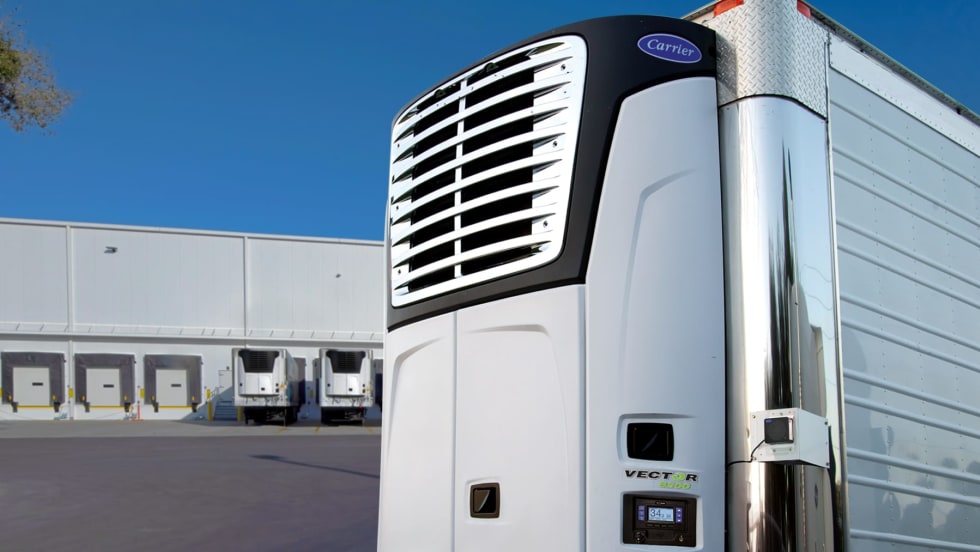
Carrier Transicold Adds All-Electric TRU for Stationary Cold Storage
Carrier Transicold’s new Vector 8200 all-electric transport refrigeration unit gives fleets a diesel-free option for temporary refrigerated and frozen trailer storage.
Read More →
A Closer Look at Kenworth’s Electric T880E Vocational Truck [Video]
Learn more about Kenworth's T880E battery-electric vocational truck at the Paccar Technical Center, including its range, applications, upfitting considerations, and PTO options, in this HDT Spotlight video.
Read More →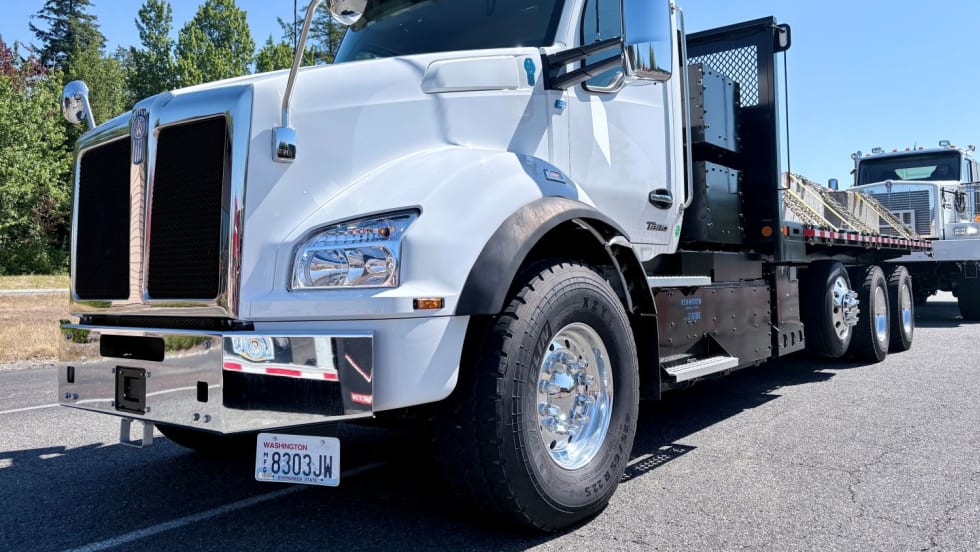
Kenworth T880E Brings EV Power to Vocational Trucks
A closer look at the Kenworth T880E’s range, charging, powertrain and upfit options — and where fleets are showing the most interest.
Read More →
What the U.S.-Canada Trade War Means for Trucking
Escalating U.S.-Canada tariffs could disrupt cross-border freight, reduce truck volumes, raise costs, and create new uncertainty for carriers on both sides of the border.
Read More →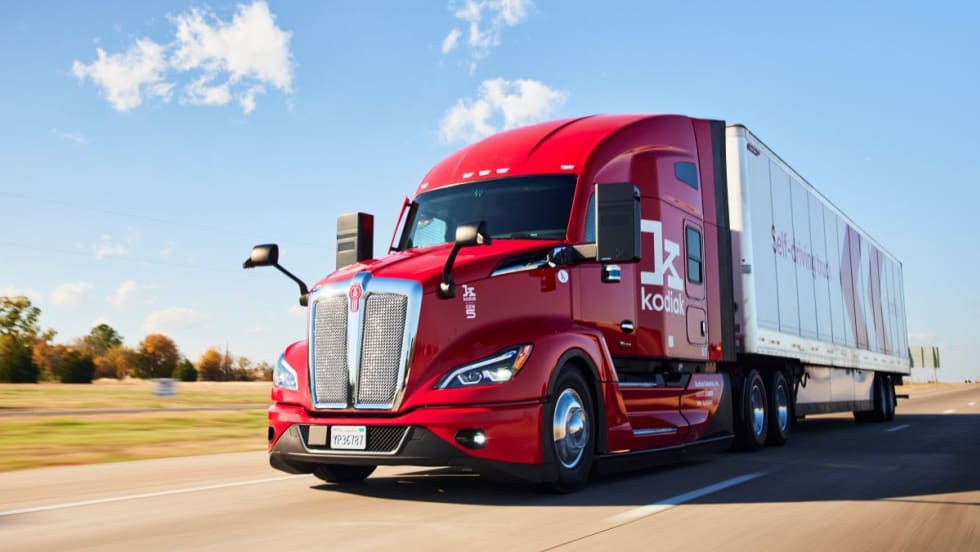
Autonomous Truck Testing Moves Ahead in California as Teamsters Challenge Rules
California has begun permitting heavy-duty autonomous truck testing, with Aurora and Kodiak among the first to receive approval, as the Teamsters sue the DMV over the new regulations.
Read More →
Behind the Wheel of the New Mack Anthem [Video]
HDT takes the new Mack Anthem around Mack’s Pennsylvania test track to see how its driver-focused design, technology, visibility and handling perform from behind the wheel.
Read More →
DTNA Plans New U.S. Truck Plant as Manufacturing Footprint Shifts
Daimler Truck North America is evaluating sites for a new assembly plant expected to open in 2029 while winding down operations at its longtime Portland manufacturing facility.
Read More →
Great Dane Flatbed Trailer Offers Light Weight and Strength
Freedom Ultra is designed for a wide range of open-deck applications, including building materials, lumber, machinery, steel products, industrial freight, and coil hauling.
Read More →
What It's Like Inside this Custom 2025 Peterbilt 589?
Take a driver's-eye tour of this customized 2025 Peterbilt 589 in this video, as longtime driver Ingrid Brown explains its features, compares it to previous models, and shares plenty of personality along the way.
Read More →