




J.B. Hunt Adds 20 Fuel-Cell-Electric Nikola Tre Trucks
For West Coast customers looking for zero-emission truck transport, J.B. Hunt has added 20 fuel-cell-electric Nikola Tre trucks to its operations.

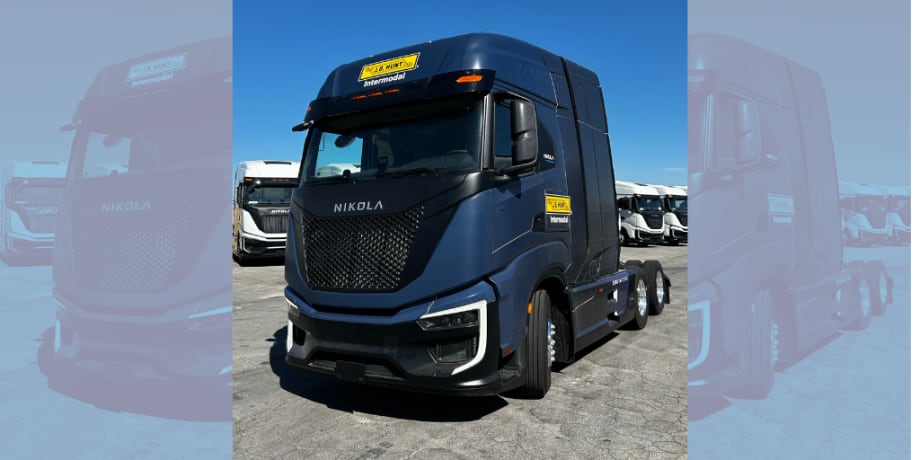
J.B. Hunt's fuel-cell electric Nikola Tre trucks will primarily work in West Coast drayage operations.
Image: HDT Graphic from J.B. Hunt photo
J.B. Hunt Transport Services has added 20 Nikola Tre fuel cell electric trucks to expand sustainability solutions for customers with freight needs along the West Coast.
Several of the new FCEVs are anticipated to support J.B. Hunt Intermodal operations in California and will primarily be used for port and drayage transport.
Hydrogen fueling and infrastructure supportwill be provided by Nikola via its HYLA brand. J.B. Hunt purchased three Nikola FCEVs in 2023 that are currently supporting dedicated customer operations.
The fuel-cell-electric trucks are expected to help alleviate growing shipper concerns with recent requirements in the state aimed at reducing carbon emissions and adopting zero-emission vehicle technology, specifically rules from the California Air Resource Board and the South Coast AQMD’s Warehouse Actions and Investments to Reduce Emissions (WAIRE) program.
Customers can eliminate WAIRE fees and reduce their carbon footprint by working with J.B. Hunt to schedule zero-emission vehicle pick-ups and deliveries.
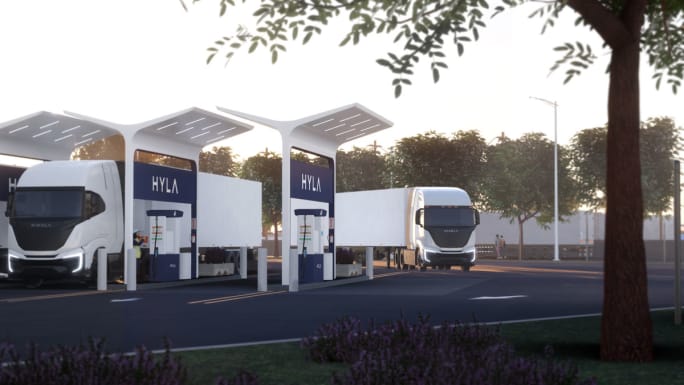
Nikola's Hyla hydrogen fueling operations will support the J.B. Hunt FCEVs.
Photo: Nikola
J.B. Hunt’s Sustainability Journey
The Nikola FCEVs will join the 200-plus alternative-powered equipment vehicles that J.B. Hunt currently operates on behalf of customers, which includes battery-electric, hydrogen-electric and renewable natural gas (RNG) powered vehicles.
“Our expertise, resources and relationships uniquely position us to help our customers pursue and realize their sustainability goals,” said Greer Woodruff, executive vice president of safety, sustainability and maintenance at J.B. Hunt.
“Zero-emission vehicles such as these will help along the path to generate viable, sustainable options that help customers advance their efforts to reduce carbon emissions in their supply chain while also helping J.B. Hunt progress on its sustainability journey.”
Recently, J.B. Hunt kicked off a pilot program with Clean Energy featuring the new Cummins X15N engine, one of the latest developments in RNG-powered vehicles. J.B. Hunt also assisted customers Daimler Truck North America and Electrolux with adding alternative powered-vehicles to its operations.
Incorporating alternative-powered equipment into its fleet, expanding the use of biogenic fuels and improving fuel economy are three key focus areas for J.B. Hunt to reach its goal to reduce carbon emission intensity 32% by 2034 from a baseline year of 2019. Overall progress toward all three areas helped the company surpass the halfway mark for reaching its ambitious goal last year.
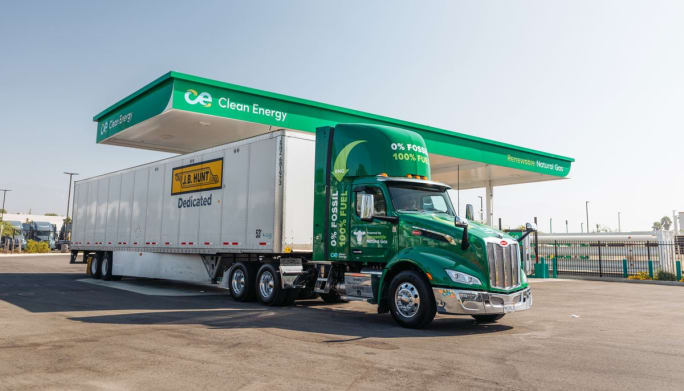
J.B. Hunt's sustainability efforts include a variety of alternative fuels, such as renewable natural gas.
Photo: J.B. Hunt/Clean Energy
Offering a Variety of Sustainable Solutions
J.B. Hunt works closely with customers on solutions to help achieve their sustainability targets. In addition to incorporating alternative-powered equipment, the company’s sustainability offerings for customers include:
Intermodal conversion – J.B. Hunt converts a large number of over-the-road shipments to rail, which on average reduces a shipment’s carbon footprint by 65% versus highway truck transportation. Over the past decade, J.B. Hunt’s intermodal service has helped avoid an estimated 30 million metric tons of CO2e emissions from over-the-road truck transportation.
Empty-mile reduction – By using its technology platform J.B. Hunt 360, the company secures backhaul capacity for customers, driving out millions of empty miles every year. In 2023 alone, J.B. Hunt helped avoid an estimated 4-plus million empty miles.
J.B. Hunt Carbon Diet Services – This best practices guide is used to advise customers on cost-effective means to reduce carbon emissions intensity using the company’s carbon diet methodology. It includes the company’s propriety CLEAN Transport Carbon Calculator used to determine a customer’s carbon footprint.
CLEAN Transport program — Through this carbon-neutral shipping offering, J.B. Hunt provides customers with a flexible method to acquire carbon offset credits equivalent to the emissions produced by their shipments.
More Fuel Smarts

How Volvo Updated Its D13 for EPA 2027 [Watch]
Volvo’s updated D13 promises lower emissions without sacrificing performance or fuel economy. Take a closer look at what changed inside the engine in this HDT Spotlight video.
Read More →
Diesel Price Spike Shortens Payback for Natural Gas Trucks, Report Says
Energy Vision estimates fleets could recover the higher purchase price of an RNG-fueled Class 8 tractor in 1.3 to 2.8 years under current fuel-price scenarios.
Read More →
Calstart Becomes Catalyst Mobility, Reflecting Broader Focus
Calstart is now Catalyst Mobility, reflecting the nonprofit’s growing national role in clean transportation, including zero-emission trucks, infrastructure and incentive programs.
Read More →

Record Diesel Prices Squeeze Trucking Fleets
Average U.S. diesel prices have climbed to nearly $6 a gallon, surpassing the 2022 record as tight refinery capacity and Middle East disruptions keep fuel costs elevated.
Read More →
How Fuel Delivery Shapes Engine Performance
Fuel delivery depends on more than what happens at the injector. For fleet, maintenance and technical professionals, looking at the full path from pump to injector can provide useful context for understanding engine performance.
Read More →
East Coast Port Launches $45M Electric Truck Push
The Port Authority of New York and New Jersey announced millions in incentives for zero-emission drayage trucks, yard tractors, and new charging hubs near the port.
Read More →
California Bill Could Shed Light on Electric Truck Prices
Why do battery-electric Class 8 trucks remain so expensive? A California bill headed to Gov. Gavin Newsom would give fleets and state agencies more visibility into what manufacturers charge.
Read More →
Detroit Opens Orders for EPA 2027 Engines
Detroit isn’t starting from scratch to meet EPA 2027 diesel emissions standards. Its Gen 6 DD13 and DD15 engines keep much of today’s platform while updating the fuel and aftertreatment systems.
Read More →
Zero-Emission Truck Corridor Planned for West Coast
California, Oregon, Washington, British Columbia and Baja California are coordinating plans for truck charging and hydrogen fueling from Canada to Mexico.
Read More →
A Closer Look at Kenworth’s Electric T880E Vocational Truck [Video]
Learn more about Kenworth's T880E battery-electric vocational truck at the Paccar Technical Center, including its range, applications, upfitting considerations, and PTO options, in this HDT Spotlight video.
Read More →