



This article is part of an HDT series,“NACFE’s Electric Fleet Leaders.”
Tesla Semis Shine on PepsiCo’s Long-Haul Electric Routes
Charge 32 Electric Trucks Simultaneously? Schneider Found a Way
 MENU
MENU SEARCH
OK Produce in Fresno, California, has completed Phase I of a three-step, true zero-emissions plan that will soon power its entire fleet of electric trucks with 100% solar power.
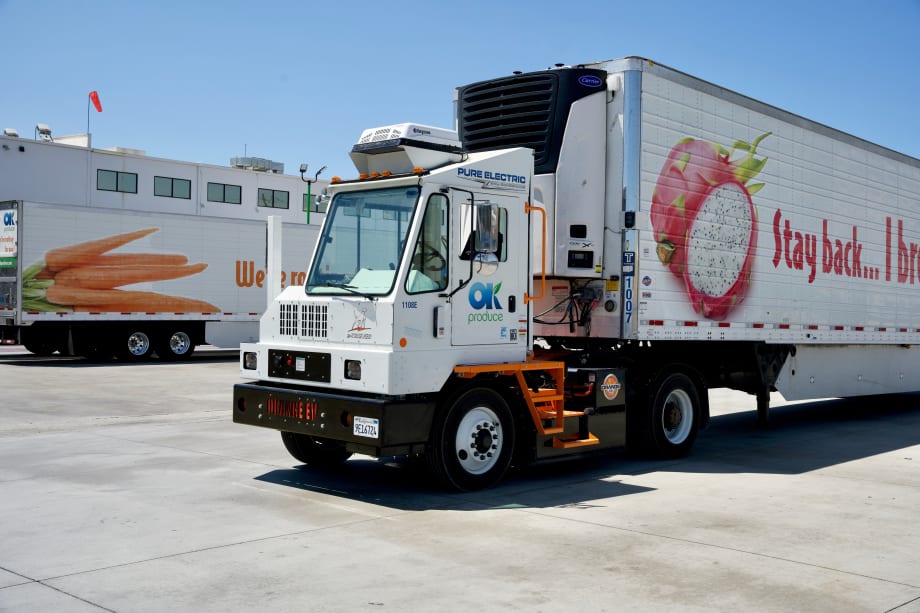
In addition to 10 Freightliner eCascadia trucks, OK Produce is also operating three Orange EV yard tractors at its Fresno, California, distribution center.
Photo: NACFE
Fresno, California’s OK Produce is a third-generation produce wholesaler that was founded in 1950 by current CEO Brady Matoian’s grandfather. The company places a priority on providing its grocery store customers across California and southern Oregon with fresh fruits and vegetables that are grown, handled and distributed in a sustainable, environmentally responsible way.
That commitment to sustainabiity also carries over into its fleet operations. It's wrapping up the first phase of a a three-step, true zero-emissions plan that will soon power its entire fleet of electric trucks with 100% solar power and it's sharing its experiences with other fleets through the North American Council for Freight Efficiency's Run on Less Electric-Depot program.
ROL-E Depot is a year-long study by NACFE analysts studying real-world battery-electric truck use and infrastructure issues. The goal is to help North American fleets begin to transition to battery-electric trucks by conveying lessons learned by fleets in the study. NACFE recently released a profile of OK’s Produce’s electrification progress.
“The 100 miles surrounding Fresno is the most vibrant growing region in the world,” Matoian explained in a NACFE video showcasing the company's efforts. “It also happens to be the worst air pollution basin in the country. So, what can we do to minimize our effect on Mother Nature? Because our business relies on it.”
The answer to that question for OK Produce is a three-phase fleet electrification plan that will use zero-emission solar energy to power its fleet of electric trucks. This includes massive investments in solar panels blanketing the roof of its facility buildings, as well as the company parking lot. These solar panels generate electricity that is used to power 10 Freightliner eCascadia trucks, three Orange EV yard tractors, as well as seven Volvo VNR Electric trucks expected to be delivered soon.
All told, OK Produce currently has 12,000 solar panels installed at its Fresno facility. Those located on the main building generate about 4.5 megawatts of electricity. And those covering the parking lot produce around 2 MW. Combined, the system generates anywhere from 6.5 million to 7 million kilowatt-hours (kWh) of power.
That power is distributed via nine Heliox chargers. The fleet managers can track the company’s entire, proprietary power grid as well as the state of all electric vehicles with BP Pulse Omega charge management software.
Through this system, 600 kW of power is provided to three 180-kW power cabinets. Each cabinet has three dispensers each, for a total of nine.
“The Heliox charging system has the ability to dynamically route power in steps of 60 kW," said Job Van Campen, product manager, Heliox.
“What this means is that if a vehicle arrives by itself and hooks up to the dispenser, it gets full 180 kW power. If a second vehicle arrives, it gets 120 kW. And then if a third truck hooks up, all three get 60 kW. So that’s maximum use of the available power, and the best way to distribute that power.”
Phase II of OK Produce’s electrification plan will be even bigger, Matoian said, building out 27 charging ports distributing 2 MW of solar energy to the trucks.
“And that’s really important. Because emissions-free is one thing. But truly clean is solar-powered electric.”
Key to OK’s success was working the Pacific Gas and Electric Company EV Fleet Team, which provided OK Produce with valuable guidance before, during and after Phase I.
“A number of programs that we’re running in the state of California are funded by the California Public Utilities Commission,” said Tim O’Neill, EV fleet specialist, PG&E EV Fleet Team, in the NACFE video. “EV Fleet is the second program. It’s designed to assist with installing their charging infrastructure when they’re putting into service medium- and heavy-duty electric vehicles.
"We assist the customers financially and design-wise. Trying to plan out and get their infrastructure in so that when their vehicles show up they actually have charging stations and can operate their vehicles.”
Finding a good partner to help during that lengthy process is critical, O’Neill stressed.
“When you have a customer that wants to have a large charging station for these kind of trucks, it does take much more planning and we usually have to do much more of an upgrade to our system,” he cautioned.
All that electricity has one purpose, of course: Power OK’s growing fleet of electric trucks.
“Three years ago, Freightliner presented us with three electric trucks, I was hooked on them before they started the PowerPoint,” Matoian said. "After, I was really excited and, on the spot, said, ‘I want to buy your first 10.’”
Driver response has been enthusiastic, added Faron Pittman, transportation trainer, OK Produce. Out of the approximately 100 drivers at the fleet, 55 have already qualified to drive the electric models.
Bob Thomason, director of transportation for OK Produce, added that although enthusiasm for the new trucks was high, the process of feeling out the new trucks was very measured.
“The goal was to start conservatively with some of our smaller routes and just test the waters,” Thomason said. “We went from a 40-mile to, maybe, a 60-mile route right here in Fresno and came back with 73% life on our battery, to pushing the limits and traveling up to Oshers, California.”
Thomason said the run to Oshers is all uphill — all the way. But with regenerative braking on the way back, the trucks arrived back at OK Produce with 47% battery life left.
“And, we thought — Wow! Hey, this is real,” he said. “That’s like an 80- to 120-mile route depending on the stops. So, we’ve seen it. We’ve tested it. And we’re continuing to kind of test and move outside of our comfort zone a little bit.”
OK is also on a learning curve with the Orange EV electric yard tractors. During the infrastructure installation, OK opted to move the shop operations elsewhere. That move, combined with the realization that the new solar grid was already delivering a lot of additional power, prompted the adoption of the electric yard tractors.
“Yard trucks really are the optimal truck for electrification for so many reasons,” said Zack Ruderman, VP, sales and marketing, Orange EV. “Whether it’s the start/stop that helps with regen braking, the inefficiency with the diesel version and the challenges with uptime for diesel versions of the yard trucks. The fact that the charger can be right there on site so that there’s no issues with range anxiety.
"And when it’s designed right, you just don’t need that much power. You don’t need huge battery packs to be successful. We’ve designed this truck so that [it can handle] two-shift operations, three-shift operations. We have plenty of operations that are 24/7.”
Johnny Saenz, transportation supervisor and driver for OK Produce, added that charging the Orange EV tractors is “extremely” easy, and noted that the trucks never have a battery charge below 40% during the workday.
“Electrifying our fleet really feels like the right thing to do,” Thomason said. “We’ve had a lot of drivers respond positively, saying ‘We understand. We see on the news this is our future. And we’re excited to be a part of it’.”

For fleet managers and collision repair professionals keeping heavy-duty trucks on the road, getting the color right the first time isn't just about appearance — it's about efficiency, turnaround time, and bottom-line results. Discover how today's digital color tools are transforming the repair process from guesswork to precision.
Read More →
Carriers whose updates were due on or after June 1 have more time, while FMCSA works to stabilize its new registration system and warns of phishing sites impersonating its new carrier registration system, Motus.
Read More →
Cargo theft is no longer just the cost of doing business. It's a multi-billion-dollar criminal enterprise exploiting vulnerabilities across your fleet, drivers, and supply chain.
Read More →
Explore how telematics help refrigerated fleets improve visibility, uptime, efficiency, compliance, and cargo protection across connected cold chain operations.
Read More →
Escalating U.S.-Canada tariffs could disrupt cross-border freight, reduce truck volumes, raise costs, and create new uncertainty for carriers on both sides of the border.
Read More →
The American Transportation Research Institute wants to know what's worrying trucking fleet managers, drivers, and other stakeholders in its annual Industry Issues survey.
Read More →
ATA President and CEO Chris Spear abruptly left his job at the association on August 21, at a pivotal time for the trucking industry.
Read More →
Public Wi-Fi can expose truck drivers and fleets to credential theft, malware, and other cyber threats. Here’s how to reduce the risk on the road.
Read More →
HDT Truck Fleet Innovator Nicky Cupp turns everyday pain points at Fraley & Schilling into opportunities for better technology and smarter processes.
Read More →
HDT Truck Fleet Innovator Adam Buttgenbach helped PepsiCo build one of North America’s largest EV fleets by focusing on where electric trucks make operational sense.
Read More →
