




Economic Analysts Tell Refrigerated Carriers Recovery Will Be Gradual
Cautious would be the word to summarize Bob Costello's comments on the economy at last week's meeting of the Refrigerated Division of the Truckload Carriers Association. Perhaps even cautiously optimistic. Costello is the American Trucking Associations' chief economist. He complimented the refrigerated haulers on being less affected by the economic downturn than other fleets, a direct consequence of people's need to eat no matter the general state of the economy.
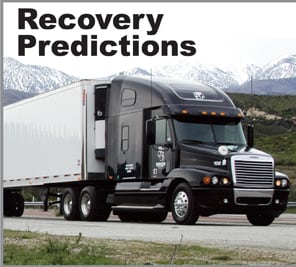
Cautious would be the word to summarize Bob Costello's comments on the economy at last week's meeting of the Refrigerated Division of the Truckload Carriers Association. Perhaps even cautiously optimistic.
Costello is the American Trucking Associations' chief economist. He complimented the refrigerated haulers on being less affected by the economic downturn than other fleets, a direct consequence of people's need to eat no matter the general state of the economy.
However, as was also pointed out during the meeting by John Christner of John Christner Trucking, the nature of the freight has changed somewhat, as consumers shifted away from high-end restaurants to lower-priced venues or to eating more at home. One of the consequences is that dairy haulers have been experiencing a mini-boom as demand for milk and ice cream - home staples - has escalated in response to this shift.
But while refrigerated freight volumes have been impacted only a little, especially as compared to the general freight picture, refrigerated carriers have still seen erosion of their rates by 13 percent over the last year, said Costello.
Much capacity has gone out of the industry and trucking jobs have fallen at an alarming rate. In 2008, nearly 76,900 trucking jobs were lost, most of them drivers, noted Kevin Burch, president of Jet Express and this year's ATA chairman, in his remarks. This year has seen further loses of 75,000 jobs in the first six months, with a potential to rise to 150,000 if this carry on as they are.
But Costello struck a mildly optimistic note, saying that economic indicators show we may have turned the corner. "We're starting to see some signs of life, but it's going to be real slow going," he said. "The caveat is the financial crisis is still recovering. There will be no steep recovery."
This is in contrast to some analysts, who say so much capacity has gone out of trucking, as evidenced by the falling driver population, that when the recovery happens it will result is strong demand and high rates. But Costello said this is an unlikely scenario. And, for the first time in memory, he says, trucking will not lead out of this recovery.
Despite record numbers of used trucks going to export markets such as Russia and Nigeria, shrinking overall truck capacity 6.5 percent over the last nine quarters, demand will not materialize quickly. The consumer - that comprises 70 percent of the economy -- will not ramp up consumption rapidly, because more than 6.5 million jobs have been lost from the general economy. Inventories have shrunk, as noted by other economists, said Costello, but demand has shrunk even more, so there is still available inventory to support the gradual recovery he is predicting.
The economic indicators Costello looked at include job numbers, which saw 700,000 additional job losses in January shrinking to 300,000 in May. Still negative, but in the current economic conditions, an optimistic sign.
Real gross domestic product growth ceased in January 2007 and the fourth quarter of 2008 saw a 6 percent reduction of GDP, making this "the worst economy in a generation." However, this reduction had slowed to negative 2 percent for the second quarter this year, and the third quarter looks like it will turn positive to maybe a fourth of a percent. By next year we could be looking at 2 percent growth. However, Costello noted that historically, GDP normally grows a shade under 3 percent for the United States. Going forward that is likely to be only around 2 percent, he said.
Speaking after Costello, Geoffrey Colvin, senior editor at large for Fortune Magazine and a widely read commentator, said there has been a fundamental shift in the way consumers react to the swings in the economy. During the good years, the tendency has been to save and then use those savings in the bad years, smoothing out the wild swings in consumption. This time, though, consumers spent in the good times. As they saw their net worth in real estate tumble, they have turned into savers, exacerbating the downturn and stretching it to the longest since the Great Depression.
Costello noted that Americans on average have seen their net worth decline from $52,000 to $39,000. The correction is ongoing, though the graph he showed indicated that the long-term sustainable growth in property values was about to be intersected by falling values - another indicator that things could be ready to turn around. However, the high prices paid for homes in the recent past mean high debt service and less disposable income to sustain high GDP growth. The historical near 3 percent growth will likely fall to 2 percent for 2010 through 2013, he said.
Other good news is that with so much under-utilized capacity in the marketplace, inflation will probably not be a factor in the recovery. "This is a U-shaped recovery, not a V," Costello said.
More Fleet Management

Nominations Open for HDT Emerging Leaders
Heavy Duty Trucking is looking for accomplished trucking fleet professionals under 40 who are making an impact and helping lead the industry forward.
Read More →
Why Private Fleets Are Taking More Freight
Private fleets are putting their own trucks on demanding customers and high-cost lanes as companies seek greater control over service, costs, and capacity.
Read More →
Color Match Smarter: Tools That Restore & Perform
For fleet managers and collision repair professionals keeping heavy-duty trucks on the road, getting the color right the first time isn't just about appearance — it's about efficiency, turnaround time, and bottom-line results. Discover how today's digital color tools are transforming the repair process from guesswork to precision.
Read More →


FMCSA Pauses Biennial-Update Enforcement Amid Motus Transition
Carriers whose updates were due on or after June 1 have more time, while FMCSA works to stabilize its new registration system and warns of phishing sites impersonating its new carrier registration system, Motus.
Read More →
2026 Blueprint for Countering Smarter Supply Chain Theft
Cargo theft is no longer just the cost of doing business. It's a multi-billion-dollar criminal enterprise exploiting vulnerabilities across your fleet, drivers, and supply chain.
Read More →
How Telematics Improves Visibility, Control, and Performance in Refrigerated Fleets
Explore how telematics help refrigerated fleets improve visibility, uptime, efficiency, compliance, and cargo protection across connected cold chain operations.
Read More →
What the U.S.-Canada Trade War Means for Trucking
Escalating U.S.-Canada tariffs could disrupt cross-border freight, reduce truck volumes, raise costs, and create new uncertainty for carriers on both sides of the border.
Read More →
What Are Trucking’s Top Concerns for 2026?
The American Transportation Research Institute wants to know what's worrying trucking fleet managers, drivers, and other stakeholders in its annual Industry Issues survey.
Read More →
American Trucking Associations Looks for a New Leader
ATA President and CEO Chris Spear abruptly left his job at the association on August 21, at a pivotal time for the trucking industry.
Read More →
Public Wi-Fi Cybersecurity Risks: How Truck Drivers and Fleets Can Protect Their Data
Public Wi-Fi can expose truck drivers and fleets to credential theft, malware, and other cyber threats. Here’s how to reduce the risk on the road.
Read More →