




Range, Charging Data Surprising in NACFE Run on Less Electric - Depot
The North American Council for Freight Efficiency's Run on Less Electric - Depot study is under way. The Freightliner eCascadias, Volvo VNR Electrics, Tesla Semi and other battery-electric trucks are turning up some data that's a bit of a surprise.

“The Run on Less series isn't something that we made up to be like a marketing or an engineering demo. This is real stuff. These are the real trucks and real freight,” said Mike Roeth.
Source: NACFE/HDT Illustration
The North American Council for Freight Efficiency's Run on Less Electric - Depot study is under way, and partway into the run, the results already looked promising, according to Mike Roeth, NACFE executive director — and some were a bit surprising.
Roeth and Ari Kahn, manager, carbon-free transportation, Rocky Mountain Institute, recently live-streamed a conversation about the successes they found during the first week of the latest Run on Less.
The run began Sept. 11 and continues through Sept. 30. With data streaming from 21 battery-electric trucks and their chargers to a real-time dashboard, ROL Electric - Depot will share stories from the participating fleets via video and print. Afterward, the Run on Less team will analyze and report its findings, initially in October, and then throughout 2024.
“The Run on Less series isn't something that we made up to be like a marketing or an engineering demo. This is real stuff. These are the real trucks and real freight,” said Roeth. “It’s been exciting to delve into electric trucks, and to get these major players to participate in the run and share this detailed information has been extraordinary.”
After considering 121 applicants planning to operate 5,700 vehicles, 10 depots were chosen to be highlighted as part of the program. Experts from NACFE and RMI visited all 10 depot sites, which collectively operate 291 electric trucks.
When Roeth and Kahn talked about the successes and challenges of Run on Less - Electric Depot, they shared some of the major lessons learned in the run this year. Those include:
Small depots are ready for electrification now, and electrification at large depots is becoming more possible.
There have been big improvements in trucks and chargers since Run on Less - Electric in 2021.
The industry needs cost and weight reductions to improve the total cost of ownership.
Range can be extended with multiple charges per shift at the depot and en route.
It’s still taking too long for power delivery and infrastructure to be installed, which is driving portable/temporary charging.
The diversity, passion, and capability of the people involved is helping to scale the adoption of electric trucks.
“We have been able to use the data captured so far to provide a little more depth to some of these key points,” Roeth said.
Based on the early findings, Roeth said he has been surprised by several things.
Reality of Charging
First, he said it is frustrating when people think that the range of these trucks is based on how far they can go in a single charge.
Four fleets in the run are charging twice a day, thereby increasing the potential range. Others have not found the second charging necessary because the trucks remain in the depot overnight and then make deliveries.
Trucks returning for a second charging typically must remain close to the depot, but in some cases that is working well. Roeth said he is seeing that in drayage, beverage delivery, and fruit and vegetable delivery, pointing to OK Produce.
“I think the fact that these, the charging and the range, have doubled since 2021 when we did the first Run on Less Electric, is significant,” Roeth said.
He also said that OEMs are improving cost, weight, and performance, and the “Tesla numbers speak for themselves.”
“I think that Tesla numbers and even some of these other dynamics are starting to show that maybe that longer regional haul return-to-base operations might actually be something that's possible, not just hopeful,” Roeth added.
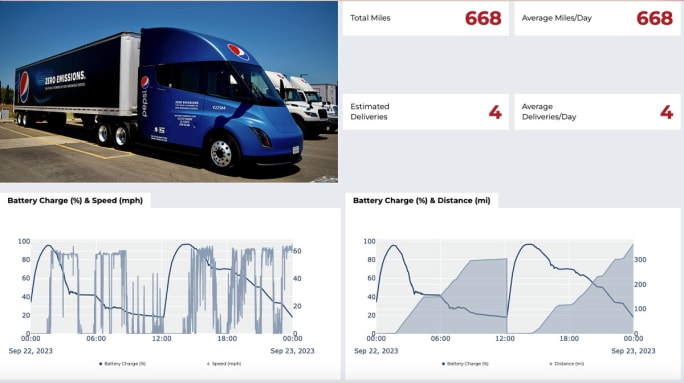
The electric Tesla Semis operated by Pepsico have been making fairly long runs, as seen in this screen capture of data from the NACFE Run on Less Electric Depot website.
Source: Run on Less
Khan said he has been surprised by how many of the trucks are able to charge so quickly. Roeth responded by pointing to how charging capabilities have increased dramatically.
“A number of the fleets say how quickly they can go from, say, a 10%, or a 20%, state of charge up to 70% or 80% and get that truck rolling again,” Roeth said. “If that truck can get out for a second run during the driver's hours of service, it may not need to get up to 90% or 100%.”
He points to Penske and Performance Teams as an example. They are running in first-generation Volvo VNR Electrics and can return to base at maybe 30% remaining on the battery. The driver takes a little longer lunch or break, and in about 45 minutes, the battery can be charged back up to 70% and then the truck can go back out and log additional miles for the day.
Range and Charging
“Range anxiety, and range, is a real deal. We don't want to diminish that at all,” said Roeth when Khan broached the subject.
Most traditional trucks, Roeth pointed out, whether delivery, medium-, or even heavy-duty, may have conventional fuel tanks that allow for two, three, or four days of deliveries. So, moving over to electric charging is what he called a “significant change in operations.” Electric fleets are chasing range, range per day, and range per charge. However, ROL Electric - Depot has found that bigger batteries may not be needed in some situations, even though technology is increasing battery sizes and capabilities.
“Part of why we say small depots are electric-viable now is because we're blown by the battery needs. So, we've got bigger batteries in some of these cases than we probably will end up with,” explained Roeth. “So, I do think as we move forward in this journey, we're going to see smaller battery-pack options in some of these trucks to be able to handle some of those shorter routes.”
Run on Less is finding, according to Roeth, that small depots in urban areas are requiring smaller amounts of power and less investment to deploy electric trucks.
Run on Less reports that:
Daily Purolator and UPS delivery routes are proving to be in the 14 to 42-mile range.
Frito-Lay completely transformed its Queens location in about one year, needing only 0.9 MWh/day of electric energy.
Fleets are charging many trucks with a few chargers. US Foods, for instance, is operating 15 heavy-duty tractors with only five portable chargers.
Roeth said the electrification of large depots is turning out to be more realistic than first thought. Even in longer regional hall fleets that return to base each day, electric trucks are proving to be viable.
Run on Less finds that:
Fleets, along with their utilities and engineering, procurement, and construction partners, are delivering big power — up to 5MWs — to these depots as well as to charging-as-a-service sites, such as WattEV.
There is a significant amount of electricity needed for these large heavy-duty trucks. It is predicted that Scheider’s South El Monte depot would use 40.2 MWh/day if it were 100% electric, the highest daily energy demand NACFE projected.
The Tesla Semis at PepsiCo’s Sacramento beverages depot have completed 384 miles on a single charge and 806 miles in a single 24-hour day, enabled by fast 750-kW charging.
Other Class 8 tractors are demonstrating range at double that of the trucks that took part in Run on Less – Electric in 2021. There is better efficiency, including optimizing regenerative braking and return-to-base charging during single-driver shifts. This has occurred consistently at OK Produce, Penske, Performance Team, PepsiCo, and Schneider.
“We’ve heard arguments that it is taking too long to deploy the needed infrastructure at depots and at charging-as-a-service locations,” Roeth said, and shared some insights from the 122 interviews NACFE conducted leading up to the run.
It takes 12 to 36 months for infrastructure implementation.
Long planning and approval cycles are necessary to enable the grid for these large loads but are simply taking too long.
Other issues include supply chain challenges, planning inefficiencies, delayed permit approvals at the sites and other problems.
Fleets are employing temporary/portable chargers and other creative infrastructure solutions to avoid even longer delays so they can begin to use the trucks that have been delivered.
Improving Efficiency
Roeth said the advances in diesel fuel efficiency in recent years will translate to electric. Taking diesel trucks from 6 mpg to 8 mpg means a longer electric range. Those improvements were achieved through learning more about low-rolling-resistance tires, aerodynamics, idling, appropriate cruise control settings to handle typography, handling starts and stops, and much more.
“We've learned so much and we've executed and implemented those in the diesel and gas trucks, that now the electric trucks just get that benefit. And that is huge,” said Roeth.
More Fuel Smarts

How Volvo Updated Its D13 for EPA 2027 [Watch]
Volvo’s updated D13 promises lower emissions without sacrificing performance or fuel economy. Take a closer look at what changed inside the engine in this HDT Spotlight video.
Read More →
Diesel Price Spike Shortens Payback for Natural Gas Trucks, Report Says
Energy Vision estimates fleets could recover the higher purchase price of an RNG-fueled Class 8 tractor in 1.3 to 2.8 years under current fuel-price scenarios.
Read More →
Calstart Becomes Catalyst Mobility, Reflecting Broader Focus
Calstart is now Catalyst Mobility, reflecting the nonprofit’s growing national role in clean transportation, including zero-emission trucks, infrastructure and incentive programs.
Read More →

Record Diesel Prices Squeeze Trucking Fleets
Average U.S. diesel prices have climbed to nearly $6 a gallon, surpassing the 2022 record as tight refinery capacity and Middle East disruptions keep fuel costs elevated.
Read More →
How Fuel Delivery Shapes Engine Performance
Fuel delivery depends on more than what happens at the injector. For fleet, maintenance and technical professionals, looking at the full path from pump to injector can provide useful context for understanding engine performance.
Read More →
East Coast Port Launches $45M Electric Truck Push
The Port Authority of New York and New Jersey announced millions in incentives for zero-emission drayage trucks, yard tractors, and new charging hubs near the port.
Read More →
California Bill Could Shed Light on Electric Truck Prices
Why do battery-electric Class 8 trucks remain so expensive? A California bill headed to Gov. Gavin Newsom would give fleets and state agencies more visibility into what manufacturers charge.
Read More →
Detroit Opens Orders for EPA 2027 Engines
Detroit isn’t starting from scratch to meet EPA 2027 diesel emissions standards. Its Gen 6 DD13 and DD15 engines keep much of today’s platform while updating the fuel and aftertreatment systems.
Read More →
Zero-Emission Truck Corridor Planned for West Coast
California, Oregon, Washington, British Columbia and Baja California are coordinating plans for truck charging and hydrogen fueling from Canada to Mexico.
Read More →
A Closer Look at Kenworth’s Electric T880E Vocational Truck [Video]
Learn more about Kenworth's T880E battery-electric vocational truck at the Paccar Technical Center, including its range, applications, upfitting considerations, and PTO options, in this HDT Spotlight video.
Read More →