




Daimler to Test Hydrogen Fuel Cell Trucks with Customer Fleets
Daimler Trucks will be testing Mercedes-Benz GenH2 hydrogen-fuel cell trucks with partners that will haul freight on public roads in Germany. Efforts will focus on liquid hydrogen and the creation of fueling infrastructure.

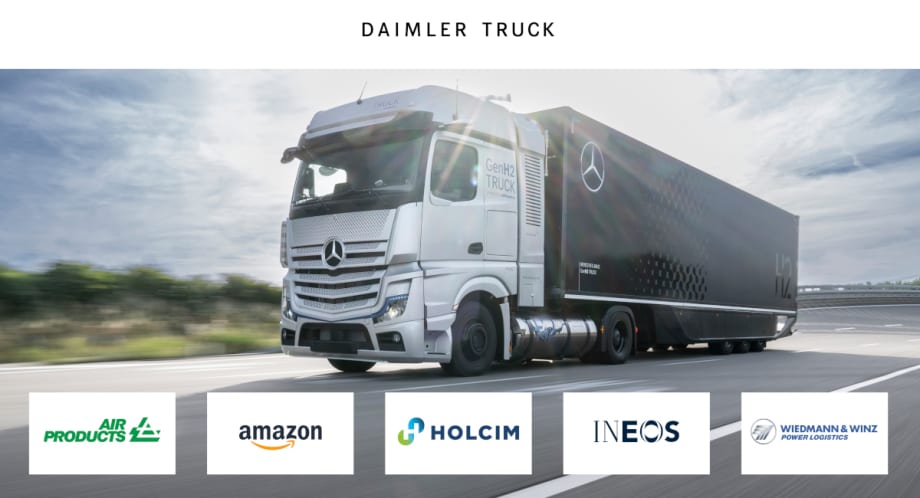
Five companies have partnered with Daimler Trucks to test hydrogen fuel-cell Mercedes trucks on freight routes in Germany.
Photo: Daimler Trucks
Daimler Truck is entering the next development phase for its hydrogen fuel-cell trucks. After a rigorous testing phase on the test track and on public roads, the FCEV trucks are now ready for deployment testing with customers.
The company is building a customer-trial fleet of Mercedes-Benz GenH2 Trucks. Amazon, Air Products, Ineos, Holcim, and Wiedmann & Winz will take part in its first customer trials to gain initial experience in CO2-free long-distance transport with fuel-cell trucks. Daimler reports those trials are expected to begin in mid-2024.
Long-Haul Routes
The five semi-trailer tractors will be deployed in Germany on different long-haul applications and specific routes, such as the transport of building materials, sea containers, or cylinder gases.
During these first customer trials, the GenH2 Trucks will remain under the direct supervision and responsibility of Mercedes-Benz Trucks. The vehicles will be refueled at designated public liquid hydrogen filling stations (sLH2) in Wörth am Rhein and in the Duisburg area.
Daimler said it and its partner companies are demonstrating that decarbonized transport with hydrogen-powered trucks is already possible today.
However, for the transformation to succeed, it will be necessary in the coming years to ensure the build-up of an international refueling infrastructure and a sufficient supply of green liquid hydrogen, Daimler said.
Practical Experience for Companies
“Our customers get to know fuel-cell technology in daily real-life operation, and our engineering team gets to better understand customer needs and relevant use cases, taking them into account for series development,” said Andreas Gorbach, member of the board of management of Daimler Truck AG and responsible for truck technology.
Wiedmann & Winz, based in Geislingen an der Steige (Baden-Württemberg), will be one of the first companies to test the Mercedes-Benz GenH2 Truck.
Wiedmann & Winz Managing Director Micha Lege sees a high deployment potential for the truck, particularly on pan-European logistic routes.
“Our company has always been a frontrunner when it comes to innovation," Lage said, including being an early adopter of telematics and digitization, and recent deployment of a battery-electric eActros 300 as a tractor in everyday operations.
John Landwehr, whose logistics company Gerdes + Landwehr is part of the Holcim Group, intends to transport granulates and minerals for the building material industry with the Mercedes-Benz GenH2 Truck.
“Payload has always played an important role in our bulk logistics when it comes to CO2-footprint and efficiency," he said. "After extensive tests with battery-electric trucks, we are delighted to continue exploring the path toward sustainable transport with a hydrogen-powered truck. Only with our own specific experience can we make the right decisions for the change that begins in 2025 in our business group.”
Caroline Stancell, Air Products general manager hydrogen for mobility, Europe and Africa, said the company is planning to convert its entire global fleet to hydrogen-powered vehicles. The Mercedes-Benz GenH2 Truck will be deployed in its existing fleet to transport cylinder gases.
“We are also proud to be providing Daimler Truck with some of the necessary refueling infrastructure and hydrogen as part of the trials," Stancell said. "Our latest mobile fueling station for liquid hydrogen will be used for the project in the Duisburg area and can therefore operate under real conditions.”
“As both a user and producer of hydrogen, Ineos is in a unique position to support this transition,” said Wouter Bleukx, business director hydrogen at Ineos Inovyn.
Liquid Hydrogen Technology (sLH2)
Daimler Truck said it prefers liquid hydrogen in the development of hydrogen-based drives. Liquid hydrogen not only has a significantly higher energy density than gaseous H2, but transport costs can also be significantly reduced.
As a result, more hydrogen can be carried, which significantly increases the range and enables comparable performance of the vehicle with that of a conventional diesel truck. Liquid hydrogen tanks also offer advantages in terms of cost and weight. Therefore, the use of liquid hydrogen enables a higher payload, according to Daimler.
Liquid Hydrogen Refueling
A new refueling process for liquid hydrogen, subcooled liquid hydrogen (sLH2), will be used in the customer-trial fleet. The technology was developed jointly with Linde and is freely available to all interested companies via an ISO standard.
The innovative approach enables an even higher storage density compared to LH2 and a refueling time of 10 to 15 minutes. The companies are planning the first refueling of a fuel-cell truck at a pilot station in Wörth am Rhein for the beginning of 2024.
Daimler said it and its partners are planning for a high level of transparency and openness around the jointly developed sLH2 technology, helping to establish a global mass market for the new refueling process.
GenH2 Truck Performance
Daimler's development engineers based the GenH2 Truck on the characteristics of the conventional Mercedes-Benz Actros long-haul truck in terms of payload, range, and performance.
The Mercedes-Benz GenH2 Trucks in these first customer trials offer a payload of approximately 25 tons and a gross combination weight (GCW) of 40 tons.
Two special liquid hydrogen tanks and a Cellcentric fuel-cell system enable this high payload and long range, the company explained. The two stainless-steel liquid-hydrogen tanks of the GenH2 Truck have a particularly high storage capacity of 88 kilograms (44 kg each) which makes them suited for covering long distances.
The stainless-steel tank system consists of two tubes, one within the other, that are connected to each other and vacuum insulated.
The fuel-cell system of the GenH2 Truck delivers 300 kilowatts (2 x150 kW) and the battery provides an additional 400 kW temporarily. At 70 kWh, the storage capacity of the battery is relatively low, as it is not intended to meet energy needs, but mainly to be switched on to provide situational power support for the fuel cell during peak loads while accelerating or while driving uphill fully loaded.
At the same time, the relatively light battery allows a higher payload. It is recharged with braking energy and excess fuel-cell energy.
A core element of the operating strategy of the fuel-cell and battery system is a cooling and heating system that keeps all components at a suitable operating temperature, ensuring maximum durability. In a pre-series version, the two electric motors are designed for a total of 2 x 230 kW continuous power and 2 x 330 kW maximum power.
Recent Demonstration
In September, a public-road-approved prototype of the Mercedes-Benz GenH2 Truck completed Daimler Truck’s record hydrogen run covering 1,047 km (650 miles) with one fill of liquid hydrogen. The company plans to introduce the series version of the Mercedes-Benz GenH2 Truck in the second half of the decade.
Ongoing Development
Daimler said it has committed itself to the Paris Climate Agreement. The objective is to offer new vehicles that are CO2-neutral in the company’s global core markets of Europe, the U.S., and Japan by 2039.
The truck maker said it is consistently pursuing a dual-track strategy with both hydrogen- and battery-powered vehicles. Daimler Truck is convinced that rapid and cost-improved coverage of this energy demand can only be achieved with both technologies.
Battery-electric trucks are the ideal choice for distribution haulage and in the case of the eActros 600, for long-distance haulage with regular deployment on plannable routes with suitable distances and charging options.
However, Daimler said fuel-cell trucks could be a better solution especially for very flexible and particularly demanding deployments in heavy-duty transport and long-distance haulage. In addition, the availability of appropriate infrastructure and sufficient green electricity are crucial for a successful transition to CO2-free technologies.
More Fuel Smarts

How Volvo Updated Its D13 for EPA 2027 [Watch]
Volvo’s updated D13 promises lower emissions without sacrificing performance or fuel economy. Take a closer look at what changed inside the engine in this HDT Spotlight video.
Read More →
Diesel Price Spike Shortens Payback for Natural Gas Trucks, Report Says
Energy Vision estimates fleets could recover the higher purchase price of an RNG-fueled Class 8 tractor in 1.3 to 2.8 years under current fuel-price scenarios.
Read More →
Calstart Becomes Catalyst Mobility, Reflecting Broader Focus
Calstart is now Catalyst Mobility, reflecting the nonprofit’s growing national role in clean transportation, including zero-emission trucks, infrastructure and incentive programs.
Read More →

Record Diesel Prices Squeeze Trucking Fleets
Average U.S. diesel prices have climbed to nearly $6 a gallon, surpassing the 2022 record as tight refinery capacity and Middle East disruptions keep fuel costs elevated.
Read More →
How Fuel Delivery Shapes Engine Performance
Fuel delivery depends on more than what happens at the injector. For fleet, maintenance and technical professionals, looking at the full path from pump to injector can provide useful context for understanding engine performance.
Read More →
East Coast Port Launches $45M Electric Truck Push
The Port Authority of New York and New Jersey announced millions in incentives for zero-emission drayage trucks, yard tractors, and new charging hubs near the port.
Read More →
California Bill Could Shed Light on Electric Truck Prices
Why do battery-electric Class 8 trucks remain so expensive? A California bill headed to Gov. Gavin Newsom would give fleets and state agencies more visibility into what manufacturers charge.
Read More →
Detroit Opens Orders for EPA 2027 Engines
Detroit isn’t starting from scratch to meet EPA 2027 diesel emissions standards. Its Gen 6 DD13 and DD15 engines keep much of today’s platform while updating the fuel and aftertreatment systems.
Read More →
Zero-Emission Truck Corridor Planned for West Coast
California, Oregon, Washington, British Columbia and Baja California are coordinating plans for truck charging and hydrogen fueling from Canada to Mexico.
Read More →
A Closer Look at Kenworth’s Electric T880E Vocational Truck [Video]
Learn more about Kenworth's T880E battery-electric vocational truck at the Paccar Technical Center, including its range, applications, upfitting considerations, and PTO options, in this HDT Spotlight video.
Read More →