




COVID-19 Still Brings Uncertainty to 2021 Trucking Outlook
As the COVID-19 vaccine helps return life to normal later in the year, the effect on trucking freight and rates will vary as consumer spending is expected to shift back toward services. That’s one takeaway from the transportation analysts at FTR in a recent webinar, “Preparing for 2021.”

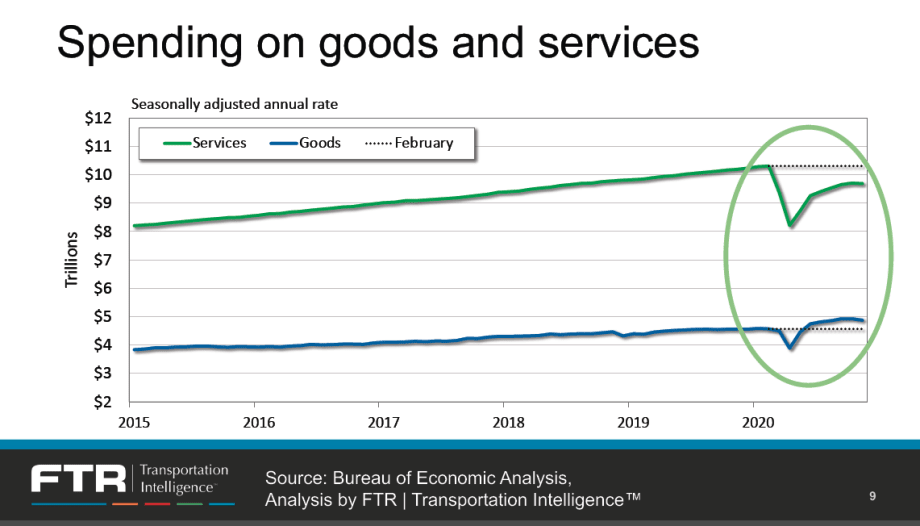
Unable to spend money on concerts or vacations during the pandemic, people have been buying more goods -- which means more freight.
FTR Slide
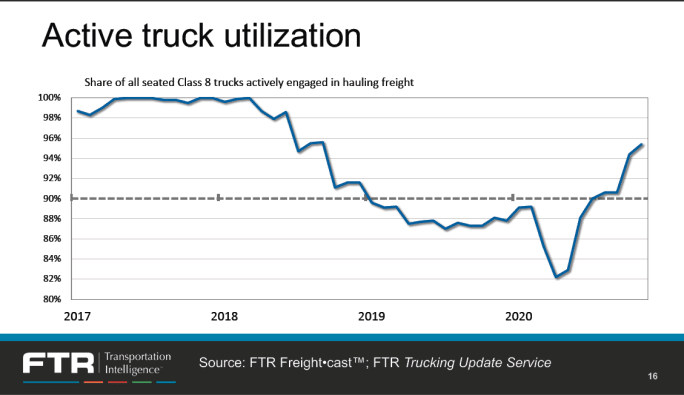
With truck utilization still down, rates continue to rise.
FTR Slide
As the COVID-19 vaccine helps return life to normal later in the year, the effect on trucking freight and rates will vary as consumer spending is expected to shift back toward services. That’s one takeaway from the transportation analysts at FTR in a recent webinar, “Preparing for 2021.”
Last year was a roller-coaster for both Gross Domestic Product and what FTR calls GDP Goods Transport, the part of GDP that most affects freight transportation, with negative growth in the first two quarters of the year as the pandemic resulted in lockdowns, rebounding in the third quarter as those lockdowns eased. But FTR expects growth to be more moderate in 2021, forecasting growth in GDP of 4% in the first quarter, dropping to 2.6% by the fourth quarter, and goods transport growth of 6.2% in the first quarter, dropping to 2.4% by the fourth quarter.
The goods economy is slowing, but remains strong with gains in retail trade, construction, manufacturing, transportation, etc., said FTR.
With demand for goods transported by truck high, and a continuing driver shortage exacerbated by the pandemic and the new federal drug-testing clearinghouse, FTR reports that active truck utilization, the share of all seated Class 8 trucks actively engaged in hauling freight, has only recovered to a bit below 96%. It had been below 90% since the beginning of 2019, and the pandemic caused it to plunge to as low as 82%. But it’s still far below the 100% utilization we saw in 2017 going into 2018.
“We are going to be challenged for months to come due to pandemic and drug testing with active utilization,” said Avery Vise, FTR’s VP of trucking.
High demand and low utilization has led to a boom in rates, especially spot rates. Vise said FTR expects contract rates in 2021 to be 10-11% higher than in 2020 – but he cautioned that the 10% figure is not from where we are right now.
What's Happening at the Ports
FTR outlined some interesting trends in intermodal container traffic going through the nation’s ports. Although overall intermodal traffic is back to pre-pandemic and even above that, international imports have surged.
Because inventories in the retail sector are very low, retailers are trying to restock, and many of those goods are coming in from overseas, so we are at record levels of import activity, explained. Eric Starks, FTR chairman and CEO.
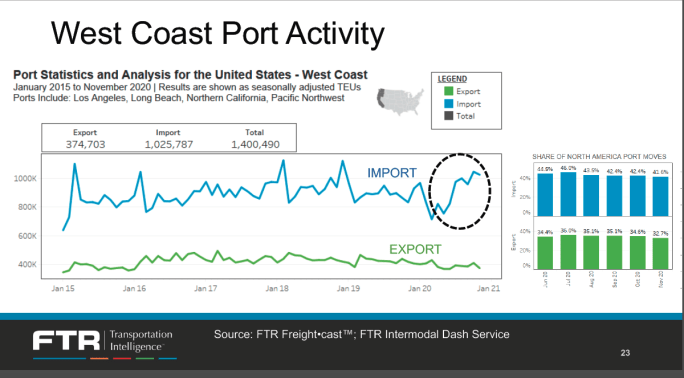
West Coast ports appear to be losing some market share to East and Gulf Coast ports.
FTR Slide
However, while West Coast import levels have rebounded noticeably, and enough that they have been experiencing severe congestion problems in the southern California ports, it has not rebounded to the same levels that overall intermodal traffic has.
“We’ll have to pay significant attention to this, because traditionally that is where most of the transloading occurs,” where a 53-foot box comes into the port, is loaded onto a truck or train and moved inland.
“When we look at North American port share, we’ve seen the West Coast starting to lose a bit of share,” Starks said. The Gulf Coast ports have seen a huge increase in import activity and are gaining market share, and the East Coast ports are gaining market share as well.
“The East Coast is traditionally bringing in stuff from Europe, or slow-steam stuff coming in from Asia,” taking advantage of the Panama Canal, which was expanded to accommodate larger container ships in 2016. The increase in traffic to the East and Gulf Coast ports is probably a mix of both, he said. West Coast ports are seeing constraints due to congestion and to worker shortages due to the COVID-19 pandemic, and companies are also looking to get their imports into the country closer to their distribution centers instead of sending it across the country from the West Coast.
In addition, normal seasonal trends of containers coming into China may well be disrupted this year, he said. The lunar, or Chinese, New Year typically means a lull in containers coming in from Asia that allows ports to catch up. China, particularly, tends to shut down for 12 days,” Starks said. “That is going away this year. They have pretty much indicated ships are planning to continue to move in that time frame and we won’t see a noticeable slowdown.”
What Will 2021 Bring Trucking?
The biggest unknown about what 2021 will bring to trucking is the COVID-19 pandemic, Starks said. The nation is nearing 400,000 deaths, with the daily number of deaths higher now than they were at the previous peak of the pandemic last April, and some quarter-million new cases being recorded every day, according to the Centers for Disease Control and Prevention.
“It’ll be well into February at a minimum before we see any sort of peaking out, and hopefully not just stabilization but reduction in a lot of those measurements,” he said. It will be several weeks before we have a sense of how the holidays affected the spread of the virus.
FTR said its assumptions for its forecast do not assume a nationwide shutdown like what we saw last March and April, predicting responses will be more regional in nature, and that as more people get vaccinated, there won’t be a compelling social mandate to shut things down.
With the surge in COVID-19, however, for the first time since April we saw a decline in the overall number of payroll jobs as reported by the U.S. Bureau of Labor Statistics, noted Vise. “The vast majority of the loss of just over half a million were in leisure and hospitality, industries hit hard by the pandemic. Basically all of the sectors that lost any jobs in November were in the service arena.”
Unemployment claims also rose. “The employment situation continues to be problematic,” Starks said. “If this continues, overall growth becomes somewhat constrained.”
Another factor will be government stimulus, which the incoming Biden administration has promised to try to push through Congress. This would be in addition to the bill passed in December, which restores $300 a week in extra unemployment benefits that had expired at the end of September.
That bill also included a $600 payment to taxpayers, and the Biden administration wants to add another $1,400. But Vise said unlike unemployment checks, which likely will go to paying for things like food and clothing that translate into truck freight, much of these stimulus checks end up in the bank.
Goods Vs. Services
One of the unknowns FTR has been trying to assess is the balance between goods and services. What has been a boon for much of trucking during the pandemic is that as spending on services such as vacations, concerts, and dining out has been curtailed, people have been spending more on goods. While sectors of trucking that depend on the service economy, such as fleets involved in food service or hauling events, have been hit hard, for most of the industry, that has meant more freight to haul.
“Do we see goods continuing to be purchased as people start to get vaccinated and in the second half of the year feel they can go out and do things?” Starks said. “There is a possibility where they say, ‘I’m ready to go out to eat, to go on vacation,’ and you may have a shift from one area to another. Does that mean you stop buying goods, or do you have enough money to be able to buy goods AND buy services? I’m viewing it more as a fourth-quarter type of thing, once people start to feel more comfortable in doing those things.”
More Fleet Management

Why Private Fleets Are Taking More Freight
Private fleets are putting their own trucks on demanding customers and high-cost lanes as companies seek greater control over service, costs, and capacity.
Read More →
Color Match Smarter: Tools That Restore & Perform
For fleet managers and collision repair professionals keeping heavy-duty trucks on the road, getting the color right the first time isn't just about appearance — it's about efficiency, turnaround time, and bottom-line results. Discover how today's digital color tools are transforming the repair process from guesswork to precision.
Read More →
FMCSA Pauses Biennial-Update Enforcement Amid Motus Transition
Carriers whose updates were due on or after June 1 have more time, while FMCSA works to stabilize its new registration system and warns of phishing sites impersonating its new carrier registration system, Motus.
Read More →


2026 Blueprint for Countering Smarter Supply Chain Theft
Cargo theft is no longer just the cost of doing business. It's a multi-billion-dollar criminal enterprise exploiting vulnerabilities across your fleet, drivers, and supply chain.
Read More →
How Telematics Improves Visibility, Control, and Performance in Refrigerated Fleets
Explore how telematics help refrigerated fleets improve visibility, uptime, efficiency, compliance, and cargo protection across connected cold chain operations.
Read More →
What the U.S.-Canada Trade War Means for Trucking
Escalating U.S.-Canada tariffs could disrupt cross-border freight, reduce truck volumes, raise costs, and create new uncertainty for carriers on both sides of the border.
Read More →
What Are Trucking’s Top Concerns for 2026?
The American Transportation Research Institute wants to know what's worrying trucking fleet managers, drivers, and other stakeholders in its annual Industry Issues survey.
Read More →
American Trucking Associations Looks for a New Leader
ATA President and CEO Chris Spear abruptly left his job at the association on August 21, at a pivotal time for the trucking industry.
Read More →
Public Wi-Fi Cybersecurity Risks: How Truck Drivers and Fleets Can Protect Their Data
Public Wi-Fi can expose truck drivers and fleets to credential theft, malware, and other cyber threats. Here’s how to reduce the risk on the road.
Read More →
For Nicky Cupp, Fleet Innovation Starts With Frustration
HDT Truck Fleet Innovator Nicky Cupp turns everyday pain points at Fraley & Schilling into opportunities for better technology and smarter processes.
Read More →