




NACFE Report Outlines Benefits of Regional Haul Routes
A switch to more regional haul routes, combined with a slate of new and emerging technologies, could transform the trucking industry on multiple fronts, says a new report from the North America Council for Freight Efficiency.

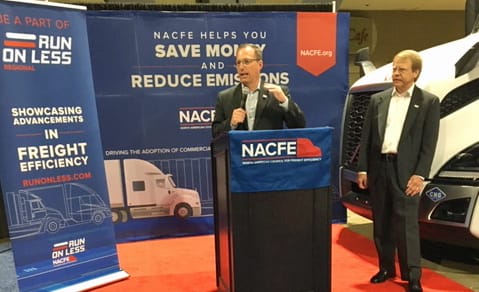
NACFE's Mike Roeth outlines the regional report findings at ACT Expo.
Photo by Chris Brown
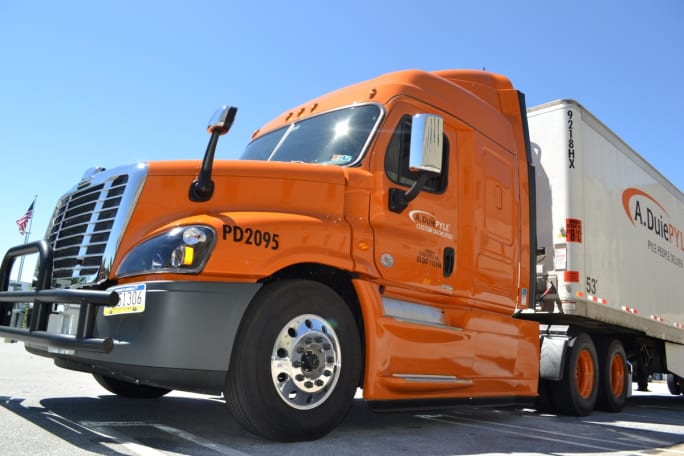
According to a new report by the North American Council for Freight Efficiency, an industry-wide shift to more regional haul routes could help fleets with a variety of common headaches, including driver retention and lower fuel costs.
Photo: A. Duie Pyle
Could a change in trucking’s long-haul business model be in the making?
It’s certainly worth considering, according to a new report from the North American Council for Freight Efficiency, "More Regional Haul: An Opportunity for Trucking?" which outlines possible outcomes – both positive and negative – for fleets looking for new ways to deal with rising operational costs and the ongoing driver shortage.
“If you ask most people to define trucking, words like ‘over the road’ and ‘long haul’ are likely to be part of the description,” says Rick Mihelic, NACFE’s director of future technologies and study team manager. "But the reality is that 45% of the Class 8 tractors produced today are day cabs, and a high percentage of those trucks are involved in regional haul operations."
That sentiment is echoed by Kerry Stritt, vice president of fleet operations at Southeastern Freight Lines, who contributed to the report. “The growth of regional haul has the potential to help address the driver shortage as well as increase the use of alternate fuel vehicles.”
Mike Roeth, NACFE’s founder and executive director, who said that the two biggest takeaways from the report revolve around drivers and alternate fueled vehicles. “Regional operations means drivers are more likely to get home on a regular basis and that could help the industry with its the driver recruitment and retention problem,” Roeth pointed out. “Regional operations are also fertile ground for alternate fueled vehicles because, by their very nature, they make it easier for fueling infrastructure for vehicles that use an energy source other than gasoline or diesel fuel to be installed.”
According to the report, which can be downloaded for free here, regional haul trucking is increasing due to a number of interacting trends. This starts with drivers, who naturally want to be home more often, which is pushing many fleets to move toward shorter, more predictable, and sometimes dedicated routes.
The rise of e-commerce is also changing the dynamics of freight and parcel delivery, the report notes, requiring greater distribution of inventory to a wider set of locations, boosting demand for regional haul. And as buyers make smaller orders to be delivered more frequently and sooner, more and larger local delivery trucks are needed. The increase in regional hauling helps attract and retain drivers and can expedite the adoption of electrification and other alternate fuels. However, it has an opportunity to do much more.
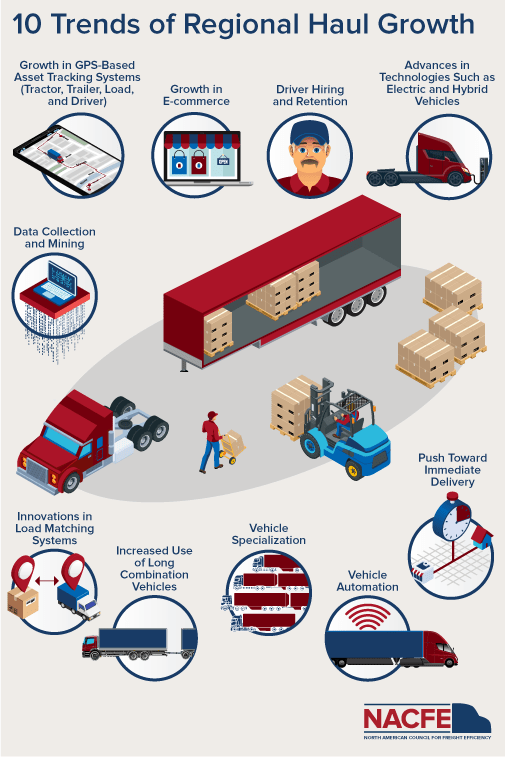
Several major trends are driving a push toward more regional-haul truck routes and could spur more technological innovation both inside, and outside of the vehicle, a NACFE report found.
Image: NACFE
NACFE confirmed in the report that there is currently growth in regional haul operations versus over-the-road operations, driven by a combination of several factors:
Driver hiring and retention
Growth in e-commerce
The push towards immediate delivery
Growth in GPS-based asset tracking systems (tractor, trailer, load and driver)
Advances in technologies such as electric and hybrid vehicles
Vehicle automation
Innovations in load matching systems
Increased use of long combination vehicles
Data collection and mining
Vehicle specialization
The report said that currently, much of the freight movement in North America is similar to a pickup basketball game, “With the different players interacting chaotically in the present moment with little coordinated effort.”
However, the potential to radically change the way this game is played is possible thanks to new and upcoming technologies described in the report, which Roeth said can ultimately turn this into a choreographed stage performance, with many benefits to fleets, drivers, and society as a whole.
The increased use of automation is one of these key regional haul enablers, which NACFE says can safely simplify the task of driving and allow more applicants to be accepted as drivers. The report’s authors also said automation can also help maximize the driver’s hours of service and on-road paid time, move more product per day with available vehicles and drivers, and help reduce the impact of the driver shortage.
All told, NACFE’s report on the growth of regional haul predicts this business practice, combined with new and emerging technologies, has great potential to help fleets overcome some of the challenges they currently face moving goods. Additionally, the report noted that shorter and more predictable routes mean greater opportunity for electric and alternatively fueled vehicles.
Roeth said that for now, the main question the report laid out is how the trucking industry can hasten the movement toward regional haul to better take advantage of its opportunities for drivers and electrification. It’s an issue he hopes to engage a wider section of discussion and debate in the industry and explore further in the future.
More Fleet Management

Kodiak Lines Up Fleets for Driverless Trucking
An agreement for 75 trucks, a new Texas freight lane, and progress on safety validation move Kodiak closer to its planned driverless highway launch.
Read More →
ITS Logistics Settles Religious Harassment Case
The Nevada-based logistics firm agreed to pay more than $396,000 to settle a religious harassment charge involving an employee's Jewish identity.
Read More →
Your Trucks Are Busy. That Doesn’t Mean They’re Winning.
High utilization doesn’t always mean strong margins. Looking beyond the current load can help fleets make better dispatch decisions and get more value from each truck’s time.
Read More →
Why This Trucking Recovery Is Different
Freight demand remains sluggish, but rising costs and tougher enforcement have taken enough capacity out of the market to change the outlook for motor carriers.
Read More →
Platform Science Adds Dispatch and Safety Tools
Four additions to PS Fleet help fleets monitor loads, manage driver coaching, share truck locations and adjust video system settings.
Read More →
PrePass Intelligence Mines Fleet Bypass, Toll and Safety Data
PrePass Intelligence helps fleets measure bypass savings, flag potential toll overcharges, and spot suspicious transactions by combining data from separate systems.
Read More →
Motive Adds AI Agents for Fleet Operations
New tools automate follow-up on fleet data, from maintenance work orders to driver alerts, with two-way voice conversations planned for later this year.
Read More →
Can You Beat Our Trucking Trivia Challenge?
Test your truck knowledge with 19 trivia questions from Heavy Duty Trucking Exchange. Can you keep up with the fleet pros?
Read More →
BeyondTrucks Adds Rules Checks to Dispatch
New Compatibility Engine checks driver qualifications, equipment requirements and fleet policies before loads are dispatched.
Read More →
Diesel Prices Hijack Trucking’s Worry List
ATRI’s annual survey finds cautious optimism about freight, but diesel costs, litigation, and insurance continue to squeeze fleets. Drivers have different priorities on several issues.
Read More →